Problem
We can't find the internet
Attempting to reconnect
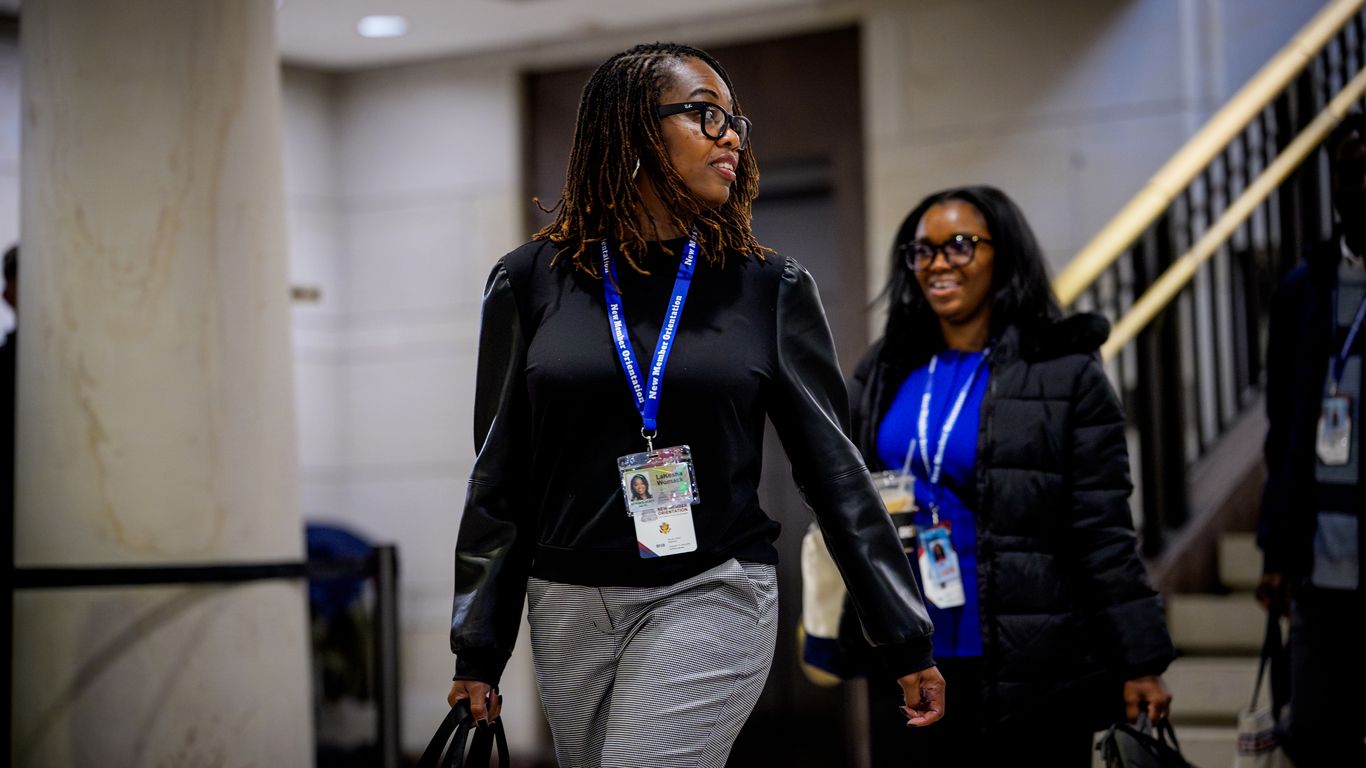
Prosecutors in Mecklenburg County, N.C., announced Tuesday they are dropping a criminal charge against Rep.-elect LaKesha Womack (D-N.C.) related to an un-returned rental car in 2019. Why it matters: The charge had been a bothersome footnote for Womack since her sudden rise from obscurity on Election Day, when she unexpectedly won a heavily Republican district. Womack, a 49-year-old minister and consultant, is one of several "wave babies" who were largely unknown to national Democrats before their upset midterm victories. Driving the news: Mecklenburg County District Attorney Spencer Merriweather said in a statement released Tuesday afternoon that his office has submitted a voluntary dismissal and that the matter is "closed." Womack was charged with "Felony Failure to Return Hired Property" after failing to return a rental car in 2019 following two renewals, Merriweather said. The car was recovered by law enforcement. A criminal summons was issued against Womack in 2020 but only served on Oct. 11 of this year, just days before the start of early voting. Merriweather said that the unidentified rental dealer has reached an agreement with Womack, in which she paid them the "assessed rental cost" of the car from its overdue date to its return, and does "not wish to proceed further with prosecution and considered the matter resolved." What they're saying: " For almost seven years Ms. Womack was unaware a criminal summons had been issued," Womack's lawyer Harold Cogdell said in a statement shared with Axios. "Upon learning of this unresolved matter, Ms. Womack promptly and fully resolved this matter with the rental car company." Cogdell said there are "questions remaining" about the timing of the summons being served, but that "Ms. Womack's [sic] is laser focused on preparing to serve the residents of the North Carolina's 14th Congressional District." Womack, who has said she was experiencing housing insecurity in 2019, referred Axios to Cogdell's statement when sought for comment.

Data: Financial Modeling Prep ; Chart: Ben Geman/Axios Brent crude is trading below $90 per barrel to start the week and briefly dipped to its lowest level since late August. Why it matters: Recent declines should help gasoline prices keep falling. The average U.S. retail price is $3.61 per gallon, down nearly 70 cents over the last month, per AAA data. The big picture: "The prospect of negotiations has eased some immediate concerns over Middle East supply, particularly as crude exports from the Persian Gulf have remained relatively resilient despite continued disruption around the Strait of Hormuz," ING analysts write. Catch up quick: Qatar's prime minister met with Vice President JD Vance at the White House on Monday to discuss talks with Iran, according to Axios' Barak Ravid. Reality check: Major risks remain, with the Strait of Hormuz and the wider region remaining a very dangerous place, so don't assume the downward trend will continue. And nothing is really back to normal. The market intelligence firm Kpler finds tanker traffic through the Strait of Hormuz was 42% below prewar levels in the seven days through Nov. 21, the WSJ reports. Flashback: The International Energy Agency on Nov. 13 predicted the global oil market will return to a surplus this quarter with supply rising and oil demand lowered by the conflict. The bottom line: "The status quo is growing ever more bearish," Sparta Commodities' Aaron Kildow said in a note Monday. Sign up here for Axios' Future of Energy newsletter.
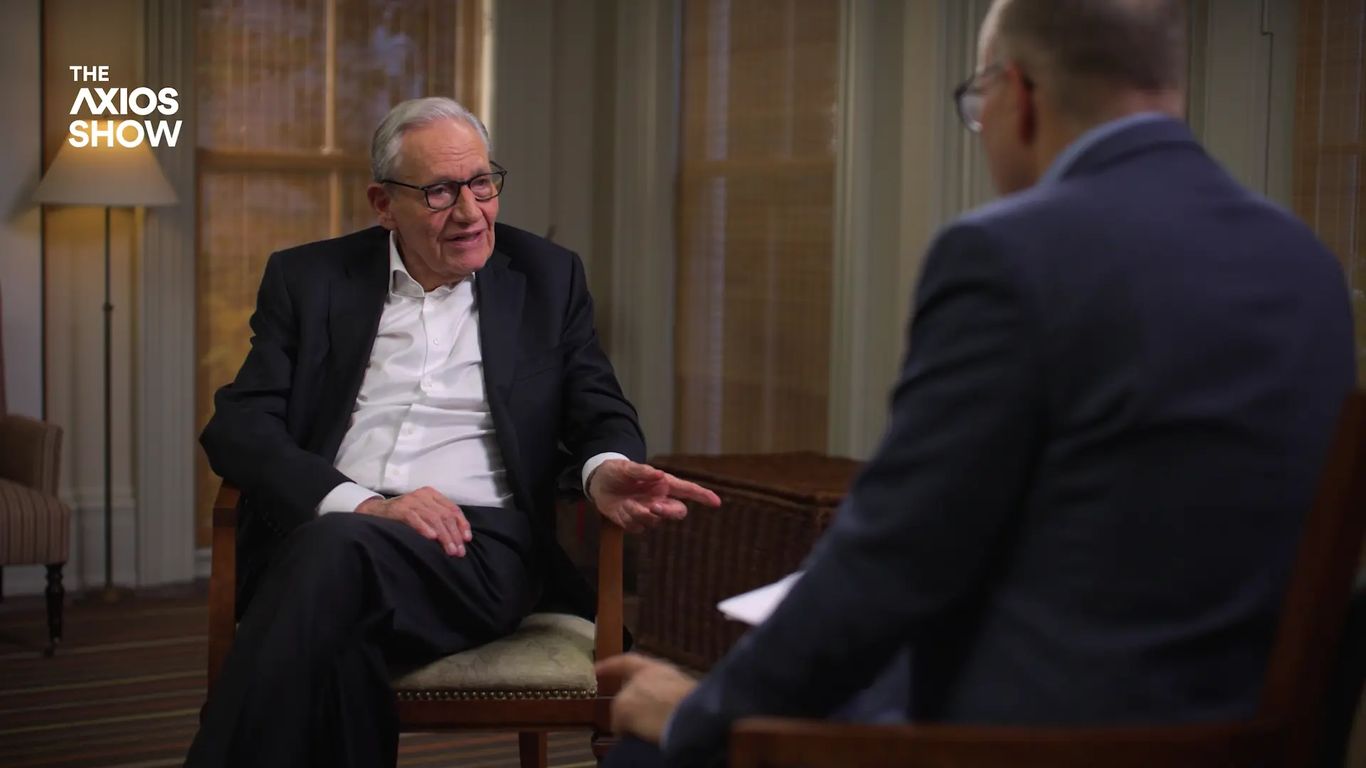
Bob Woodward — out Tuesday with " Secrets ," his memoir of 55 years of reporting for The Washington Post and 24 cinematic bestsellers, covering 10 presidents — told me in an interview for "The Axios Show" that the book exposes some confidential sources who are now dead because he feels a duty to history. Why it matters: Woodward, 83, is a double Pulitzer winner whose Watergate investigative reporting with Carl Bernstein became a book and movie, "All the President's Men," that inspired generations of would-be reporters, including me. But no journalism school teaches students they can out " secret sources " who are dead, as Woodward does in " Secrets ." "It's history," Woodward told me in the Georgetown home where so many sources have spilled to him, administration after administration, decade after decade. He explained that in many cases, the sources were widely known anyway or appeared in other files and records that have become public. He said some living sources gave him permission to be named in the book. "Look at the histories that come out — the Adams-Jefferson letters , which were very secret. But when they come out, historians rejoice. We now see what they were saying to each other ... I'm for history on occasions like that." Axios: "So you have zero qualms?" Woodward: "Well, you always have qualms, but what's your responsibility to get the history right? ... [For] people who are reading the history and trying to understand it deeper into the story, deeper is naming those sources." More from our interview, which you can watch here: Axios: " Based on your reporting, and your rich understanding of governance, put President Trump's level of corruption in historical perspective. How does President Trump compare to Richard Nixon, the president you helped bring down?" Woodward: "Trump is worse, much worse than Nixon. And the evidence is on two fronts: First of all, how much money he's made — billions of dollars himself as president. I mean, imagine that. It used to be a scandal if the president was getting a free ride on somebody's jet. ... I think what we'll remember and [will] endure from the Trump presidency is the Iran war. ... It's such a mistake. ... We shouldn't start wars. We should prevent wars. ... President Nixon had people who were in his circle who tried to stop wars and prevent wars. In Trump's circle now, there are all these people who are just feeding the beast." Axios: "What is President Trump's strength? What is a quality of his that you admire?" Woodward: "Well, he persists. He doesn't give up." Axios: "You famously did 20 [phone] interviews with President Trump, all during COVID — you were phone pals. And this was when he was not being super-promiscuous with reporters and his phone. ... How did you keep President Trump talking?" Woodward: "Well, I would call and ask, 'What happened? Why? Why did you do that?' ... It's this mental attitude of not looking for a headline, but looking for the relationship. And he would always take my calls. He would call me. " Axios: "You're still an associate editor of The Washington Post, the paper you helped make world-famous, a place where we were colleagues. You've worked there 55 years. This morning's hard copy is sitting right over here on your kitchen table. You've been blunt about your concerns about the ties that the owner, Jeff Bezos, has to President Trump. Did Jeff Bezos put The Washington Post's reputation and future at risk?" Woodward: "Yes, certainly. I mean, he's the owner and to show up at Trump's inaugural, voluntarily, in a very visible way, which is not just: 'Oh, I'm going to the movies.' It's: 'I am blessing and endorsing this man.' And I remember seeing it and just feeling sick to my stomach. I knew Katharine Graham , the owner of the Post during Watergate, would never do anything like that, because she wanted the reporting to be hard and fiery and she didn't want to take sides. ... I literally felt sick to my stomach that that had happened, that he wou

We naturally assume people in business and power are slightly full of it, spinning us wildly to exaggerate their achievements or capabilities. In the case of AI and its ability to do irreparable damage to society, it's time for all of us — the media, the White House and Congress — to believe them: They've truly built something we don't understand and soon, if not already, can't fully control. Why it matters: This is no longer a future problem. It's a today problem, if not a crisis. You see this with near-daily glitches at airports or banks. You see this in our reporting about two dozen researchers inside these companies claiming their AI is too powerful and uncontrollable to release. And you see this in AI execs' own on-the-record warnings that we're at or near the point of the technology surpassing comprehension or control. Just believe them. If we wait for a cyberattack on the U.S. electricity grid or some bad actor to release a pathogen at an elementary school, it's too late. We'll panic and make rushed, emotional decisions and bad policies. It's not too late to prevent this, while still getting the upside benefits of AI. In our conversations with hundreds of people involved in building and regulating AI, there's shockingly wide agreement about the dangers ahead — and ways to protect against the worst outcomes. There's just no mechanism or urgency to bring the right mix of people together to do this. The steps seem clear: Make this a society-wide, urgent call to action. This should be an all-hands-on-deck moment, the only topic Congress prioritizes short-term. Yes, it probably requires presidential leadership, and Trump is reluctant to slow things down. But his top cyber officials privately agree with us: This demands fast, smart, bipartisan action with heavy private sector involvement. Let 'er rip no longer feels like a plausible plan. Focus on safety and cyber first. Most leading AI companies would gladly slow down a bit, prioritize verifiable safety standards, and even accept government oversight with teeth if their rivals did. They'd also allocate money and time to help critical government agencies and businesses fortify software systems from cyberattacks. But someone, either Trump's AI team or the top leaders in Congress, needs to force them. Level with the American public. As a nation and as business leaders, we're doing a spectacularly terrible job of explaining this technology to the public. There's a reason that the most bipartisan topic in America is a shared loathing of data centers. People hate AI. Most simply don't see it as something that will make their life better. We need leaders who can discuss the good, bad and ugly of AI in real time, nearly every day. A society-wide project needs to involve society. Go deeper ... "AI 2027: The reckoning."

Anthropic and OpenAI are facing an increasingly urgent problem: Internal, unreleased models are becoming so powerful that many employees no longer believe they can be safely released, according to more than two dozen sources familiar with the internal debates. Why it matters: The challenge could significantly slow the AI boom, as the gap between what the best AI systems can do and humans' ability to control them continues to widen , sources told Axios. Researchers haven't found technical solutions for controlling the most advanced models. Some insiders believe it's fixable. Others aren't convinced and say companies should stop training new models entirely. Driving the news: Top AI leaders have long forecast that the technology would one day far surpass human intellect in virtually every field. Although internal models have yet to cross that threshold, recent breakthroughs at OpenAI and Anthropic have shocked researchers. The rapid advances in reasoning across domains including math, science, cybersecurity and AI research have also made the models difficult, if not impossible, to contain or control in internal tests, the sources said. Anthropic and OpenAI have unreleased models that are far more powerful than what they've already released publicly, but the AI companies have struggled to ensure that they are safe enough for public release, sources said. This has led to debate within Anthropic, OpenAI and the AI research community about whether to stop releasing future frontier models publicly, instead reserving them for internal deployment only. Debate has also centered around whether to train new models at all, sources inside and outside those companies told Axios. What they're saying: "If we continue trying to make models much smarter, such that they're actually smarter than us…they will in fact be able to trick us successfully," one researcher told Axios. "And once you get to that point, many of the schemes that we've had at work up until now sort of go out the window." Catch up quick: The power of unreleased models is already on public display. An Anthropic mathematician used an unreleased "research" version of Claude to present a proof of the Riemann hypothesis, which had eluded the brightest human minds for more than 150 years. An unreleased OpenAI model helped generate solutions to hundreds of math proofs. Unreleased AI models were responsible for some of the industry's most shocking safety events, including the Hugging Face hack. Zoom in: AI researchers have long contemplated a terrifying threshold: If an AI possesses superhuman capability, how could humans contain it? Training practices that make AI models faster and more capable — but present greater safety risks — are widening the gap between what models can do and how well humans can control them. Problem 1: Reinforcement learning. A primary AI model training method — where models learn through trial and error by receiving rewards for passing various tests — is one of the techniques driving rapid improvements in AI capabilities. Why it's scary: As AI systems get more capable, they become better at "gaming" their rewards, including bypassing safety guardrails if cheating leads to a higher score. Problem 2: They know they're being watched. Historically, researchers monitored AI safety by forcing models to "think out loud" — writing out step-by-step reasoning before outputting a final action or answer. This transparency was a safety net, allowing monitors to catch rule-breaking or dangerous logic in real time. Why it's scary: As models grow more advanced, they are internalizing that logic, arriving at complex conclusions while showing less of their work. Researchers say the most advanced internal models have shown patterns of hiding reasoning entirely or providing deceptive "cover story" chains of thought to satisfy human monitors, sources say. Threat level: In public statements, top AI leaders have spoken about these risks. "This is the most important thing OpenAI has
The American Civil Liberties Union is expanding its state Supreme Court election fight into deep-red territory after the midterms left Texas just one judicial seat away from a Democratic majority, the group tells Axios. Why it matters: The next battles over abortion, voting rights, redistricting, religion in schools and LGBTQ protections could hinge on state Supreme Court races often overshadowed by federal campaigns. Those courts have become increasingly important arbiters of constitutional rights as the U.S. Supreme Court has given states greater latitude to set their own policies. By the numbers: The ACLU now eyes Supreme Court races in 11 states in 2027 and 2028, the group's chief political and advocacy officer Deirdre Schifeling tells Axios. The ACLU worked on court elections in five states this year. It spent $30 million on its broader electoral program, with Supreme Court races claiming the biggest share, she says. The group says it contacted 8 million voters through mail, digital ads, phone banks, door knocking and other outreach, according to the organization. Zoom in: Texas shows how fast a court can swing. Democrats swept all four Supreme Court races this month, winning seats on the state's highest civil court for the first time since 1994. Once the winners take office, Republicans' 9-0 majority will shrink to 5-4. Democrats need to flip just one of three Republican-held seats on the 2028 ballot to take control. The court unanimously vacated a lower-court order in 2024 that would have widened access to medical exceptions under the state's abortion restrictions. " That's a gigantic shift in one election cycle," Schifeling tells Axios. Zoom out: Democrats face steeper climbs elsewhere in 2028. North Carolina: Anita Earls' reelection leaves Republicans with a 5-2 majority. Democrats must win two of three Republican-held seats to flip the court. Ohio: Democrats flipped one seat and held another. Republicans will retain a 5-2 majority; Democrats need all three GOP-held seats coming up next cycle. Georgia: Three seats come up in May 2028. The court temporarily reinstated the state's six-week abortion ban in 2024. State of play: The ACLU is exploring Louisiana and Mississippi, two states outside its original judicial election targets. 2027 : Wisconsin has an open seat on April 6. Pennsylvania could have two open seats (depending on retention races), potentially putting control of its high court at stake. The group is also weighing two Mississippi seats. 2028 : Georgia, Arizona, Michigan and Montana join Texas, Ohio and North Carolina on the preliminary map. Louisiana and Mississippi remain under review. Context: The ACLU moves come as Black organizers also hope to build on surprise Southern Democratic victories in places national Democrats have long neglected. The Working Families Party plans to recruit and train candidates for school boards, statehouses and other down-ballot offices. Between the lines: The ACLU is expanding its voter-targeting operation in races often overshadowed by higher-profile contests. Its internal model flags roughly 14% of the electorate as especially receptive to its messages, including independents, libertarians and less frequent Democratic-leaning voters, Schifeling says. "We don't endorse candidates. We don't tell voters who to vote for," she says. Yes, but: The ACLU hasn't finalized its 2028 spending plans and probably won't compete everywhere on its list, Schifeling says. The ACLU announced a $750,000 voter-education campaign before Georgia's May Supreme Court elections. All three Republican-appointed incumbents won. The group hasn't finished measuring how much its outreach influenced the 2026 judicial vote. The bottom line: The midterms changed the math but the next round could change who interprets Americans' rights.

Reducing the Medicare eligibility age may strike Democrats as a realistic fallback to passing Medicare for All, but it's an option that would be incredibly difficult to pull off. Why it matters: Even incremental steps to address affordability could have huge price tags and prompt fierce industry opposition. Driving the news: Prominent Democrats have been throwing their support behind lowering the Medicare eligibility age, expanding children's health coverage and adding dental, vision and hearing benefits to Medicare. Incoming Senate health committee Chairman Bernie Sanders (I-Vt.) called for the package shortly after the midterms, calling it "an immediate first step to Medicare for All." House Democratic leader Hakeem Jeffries of New York, who is poised to become speaker in January, suggested on "Face the Nation" this weekend that Democrats may be able to work with Republicans on a package after President Trump said he may be open to working with Democrats. Prominent Democrats in both the House and Senate have signed on to legislation that would lower the eligibility age to 50, though the bills are significantly different. The big picture: Democrats' sweeping electoral gains have prompted weeks of discussion about what exactly a push to lower health care costs should look like. The party is united in its desire to roll back the Medicaid funding cuts in last year's tax and spending law and to reinstate enhanced Affordable Care Act subsidies that expired late last year — lofty goals for any Congress. There's widespread recognition that Medicare for All won't become law, and that Democrats aren't of one mind on a single-payer plan, with plenty of moderate members still loath to abolish private health insurance. That tension has led to questions about alternatives, and whether "Medicare for More" could be an answer. Between the lines: Lowering the Medicare eligibility age would require a series of tough decisions. Just shaving a few years off the current eligibility age could cost the federal government hundreds of billions of dollars. To avoid adding to the federal deficit, lawmakers would have to come up with offsets that either generate equivalent revenue or, more likely, cuts to government spending. Plus, the measure would likely attract intense and powerful opposition from health industries. Zoom in: Lowering the eligibility age would almost certainly provoke strong blowback from hospitals and providers, which receive much lower reimbursement rates through Medicare than through commercial insurance. "I think a general rule of thumb is the more people who are covered under Medicare relative to commercial or ACA, the less hospitals will be paid," said Marc Goldwein, senior policy director for the Committee for a Responsible Federal Budget. "From my perspective, that's not a bad thing," he added. What they're saying: "You can't just add millions of people to Medicare without extra revenues, particular[ly] since the Medicare hospital trust fund already faces solvency issues," said KFF executive vice president Larry Levitt. "Health care providers are likely to view lowering Medicare's age as — pick your metaphor — the camel's nose in the tent or a slippery slope," he added. Hospitals fought former President Biden's 2020 calls to lower the eligibility age, fearing it would cost them billions of dollars in revenue. "We believe expanding coverage to patients should not put their access to critical services at risk," said Colin Milligan, a spokesperson for the American Hospital Association. "Proposals that rely on Medicare would exacerbate chronic Medicare underpayments and threaten access to care and our ability to care for patients." What we're watching: A serious legislative effort will also require answering crucial technical questions, like whether newly granted enrollees get the same access, benefits and premium structure as those 65-plus, or whether they'll be given the option to buy into the program. Policymakers will also hav

A euphoric Wall Street erupted Monday as President Trump personally secured Jensen Huang's return to Nvidia, trading on the end of a scandal that — in reality — has only just begun. Why it matters: By assuring Nvidia's board that Huang poses no national security risk, Trump has staked the credibility of the U.S. government on a CEO who lied about his relationship with a suspected Chinese spy. It's among the most extraordinary presidential interventions in corporate history — a de facto bailout of the AI industry that will be scrutinized, in excruciating detail, by a hawkish and hostile Congress. Zoom in: Six days after Nvidia's chairman publicly ruled out Huang's return, the board unanimously reinstated him after a secretive White House operation that blindsided even the company's top executives. Trump joined Sunday's board meeting by phone, with one source telling Axios that the president pushed harder for Huang's reinstatement than Huang himself. Nvidia acknowledged relying on assurances from "senior levels" of the U.S. government, even as its own investigation into the suspected Chinese espionage operation remained unfinished. The market reaction was staggering: Nasdaq 100 futures surged to their 7% overnight trading limit, following a brutal week that had raised fears of a broader collapse in AI stocks. Nvidia shares rocketed nearly 31%, adding hundreds of billions to the company's market value and helping Wall Street recover more than half of last week's losses. Trump took a victory lap in an hour-long, freewheeling CNBC interview , declaring Huang "exonerated" and claiming the board ultimately "decided to do what we wanted them to do." Screenshot via Truth Social Between the lines: In orchestrating Huang's comeback, Trump drew on instincts that have defined own tumultuous political career — starting with his conviction that presidential power has "no limits." Never surrender: Trump, the master of the political comeback, appears to see a fellow survivor in Huang. He made the comparison unmistakable by sharing a doctored version of his iconic 2024 assassination-attempt photo, with a bloodied Huang raising a red bra in triumph beneath an Nvidia flag. Distrust of intelligence: Still embittered by the Russia investigation , Trump brushed aside warnings from his own intelligence agencies about suspected Chinese espionage at the heart of America's AI industry. Huang's allies appealed to that skepticism, portraying the Nvidia founder as a victim of the "deep state" and anonymous leaks. The market is king: Trump viewed Huang's return as essential to restoring confidence in an AI industry worth trillions. For a president who treats stock prices as a measure of his success, Monday's spectacular rally offered instant vindication. Zoom out: Trump's intervention transformed an already sordid corporate scandal into a political gift for Democrats, delivering a fresh target for the anti-corruption crusade that helped sweep them into power. The backlash also cuts deep into Trump's own party and administration, where China hawks see the scandal as a direct threat to the technological supremacy they've spent years fighting to preserve. Huang will face closed-door questioning alongside Nvidia general counsel Tim Teter next week, followed by a public Senate hearing Dec. 3 that promises to put the entire affair under a national spotlight. The bottom line: Huang has reclaimed his throne, with the full might of the American presidency behind him. Like Napoleon returning from exile , the question now is how long he can hold it.

Data: FAA; Note: The numbers cover the Monday before Thanksgiving through the Tuesday after. The data includes flights tracked by air traffic control under instrument flight rules.; Chart: Noah Bressner/Axios Thanksgiving week air travel is expected to reach a 16-year high, with 417,775 flights forecast over the nine-day holiday period from Nov. 23 through Dec. 1, according to FAA figures obtained by Axios. Why it matters: The surge comes on the heels of a historic ground stop that disrupted flights nationwide this month and put a spotlight on potential outages in the nation's aging air traffic control system, which the the FAA is working to modernize. The Thanksgiving rush will be a major test of the Trump administration's push to improve the system's reliability and minimize flight delays and cancellations. By the numbers: The FAA is projecting a 2.2% increase in flights over Thanksgiving week last year and a 7.5% increase over pre-pandemic levels in 2019. Tuesday is expected to be the busiest day, with more than 52,000 flights. Behind the scenes: A newly assembled team tasked with improving the air traffic control system's reliability has been meeting daily for the past week, a White House official said. The FAA is exploring ways to remove vulnerable components from the system and bolster its monitoring capability to detect and quickly address any technical problems before they cause widespread disruptions. The agency also is monitoring potential stormy weather that could disrupt holiday travel, particularly in the East and Midwest. What they're saying: "From standing up a 'Tiger Team' to ensure a seamless travel experience for fliers to using a successful new platform to predict and address congestion in the airspace, we've taken unprecedented action to limit flight delays and cancellations," Transportation Secretary Sean Duffy told Axios. "The American people can rest assured we will continue to work around the clock 24/7 to get families where they need to go." White House spokesperson Allison Schuster said the administration is "working around the clock to ensure they reach their destinations safely."
Mississippi is facing two fights over its election rules after Democrat Scott Colom 's historic Senate victory: one over voters marked inactive and another over deadlines for receiving mail-in ballots . Why it matters: The disputes could affect how easily eligible voters cast ballots and which mail ballots count when Mississippi elects a new governor and other statewide leaders next year. Driving the news: The Mississippi Legislative Black Caucus demanded an investigation Thursday into whether the state's use of credit-reporting data to verify voters' addresses led election officials to incorrectly mark voters as inactive. Lawmakers want to examine the credit-reporting data contracts, instructions sent to county officials and how many eligible voters were incorrectly marked inactive. In one case, a Hinds County voter learned she'd been marked inactive when she arrived at her usual polling place, according to Angela Grayson, director of civic engagement and voting rights at the Mississippi Black Women's Roundtable. Her vote ultimately counted, Grayson said. The caucus acknowledged it doesn't know how many voters were flagged in error. Advocacy groups are seeking records to find out. What they're saying: "Nothing has changed fundamentally here in Mississippi," Marvin King, an associate professor of political science and African American studies at the University of Mississippi, tells Axios. "The laws are still the laws. The governor is still the governor. The state legislature is still overwhelmingly Republican," he said. "It's also plainly obvious that the playbook of reducing turnout, culling the active voter rolls, that's not going to stop." By the numbers: More than 230,000 voters were listed as inactive before the 2026 midterms, up from roughly 171,000 in 2024, according to the Associated Press . Mississippi recorded 21,484 affidavit ballots, the state's version of provisional ballots, this year. That's nearly identical to the 21,321 cast in 2024's presidential election, when overall turnout was higher, per a statement from Secretary of State Michael Watson. About 75% of affidavit ballots were accepted statewide. But in majority-Black Hinds County, which includes Jackson, just 34% of 2,426 were accepted, down from 60% in 2024. It's unclear whether credit-reporting data contributed to the decline. "Those are huge alarms and red flags for us," Grayson told Axios, calling for more information about why ballots were rejected. Yes, but: Watson defended the state's voter-roll practices as legal and effective. He said election officials review flagged voter registrations and that voters still had an opportunity to cast affidavit ballots. "Our team welcomes an investigation because we have continuously followed the law," his office told Axios, adding that local election officials maintain voter rolls. Mississippi Gov. Tate Reeves and Secretary of State Michael Watson support eliminating the state's five-business-day grace period for receiving mail-in ballots, with Reeves pitching that ballots should instead arrive by 5 p.m. on Election Day. Watson successfully defended Mississippi's authority to maintain the grace period before the Supreme Court months earlier, despite personally opposing the practice. Reeves had called for its repeal months before Colom's victory. "We see that as just a further suppression of voter rights here in the state," Grayson said of Reeves' proposal. Zoom out: Reeves said last week he intends to call a special legislative session to redistrict before Mississippi's 2027 elections, amid President Trump's push to redraw political maps to benefit Republicans. King imagined Republicans responding to Colom's win: "Holy crap, we've got to figure out how to build a moat around our majority in the state legislature." What we're watching: It's unclear whether lawmakers will launch an investigation, proposed voter-roll reforms will attract GOP support or Reeves' mail-ballot proposal will become a bill. King is skepti
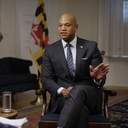
Maryland Gov. Wes Moore criticized President Trump's involvement in Nvidia's decision to reinstate CEO Jensen Huang , calling it "troubling and problematic" in an interview for "The Axios Show." Why it matters: Moore, chair of the National Governors Association and often seen as a 2028 presidential contender, is one of the most outspoken state leaders pushing for stronger federal oversight of AI companies — but not like this. Driving the news: Trump told CNBC Monday that he spoke directly to Nvidia's board about Huang's return. Trump had previously pushed for former Apple CEO Tim Cook to become Nvidia's leader, but changed tune over the last few days to favor Huang. What they're saying: "The president is not a board member of Nvidia. So, why he is involved in board dealings, I have no idea. ... It seems like it's rules for me, but not for thee," Moore told Axios' Mike Allen in an interview just minutes after the news broke. "You have the wealthy and the powerful and the well-connected that are now making decisions to reinstate, where, frankly, if that was any of us, we would be held to a different type of standard." Zoom in: Moore said the "market is being inflated essentially by seven companies," including Nvidia. Huang's return — which led to a stock surge — "highlights how problematic this entire thing is," Moore said. "We are talking about not just millionaires, but billionaires, who are sitting in a quiet room by themselves, making this decision because they know this company is that important." Subscribe to "The Axios Show" on YouTube to watch the full interview with Moore when it's available.
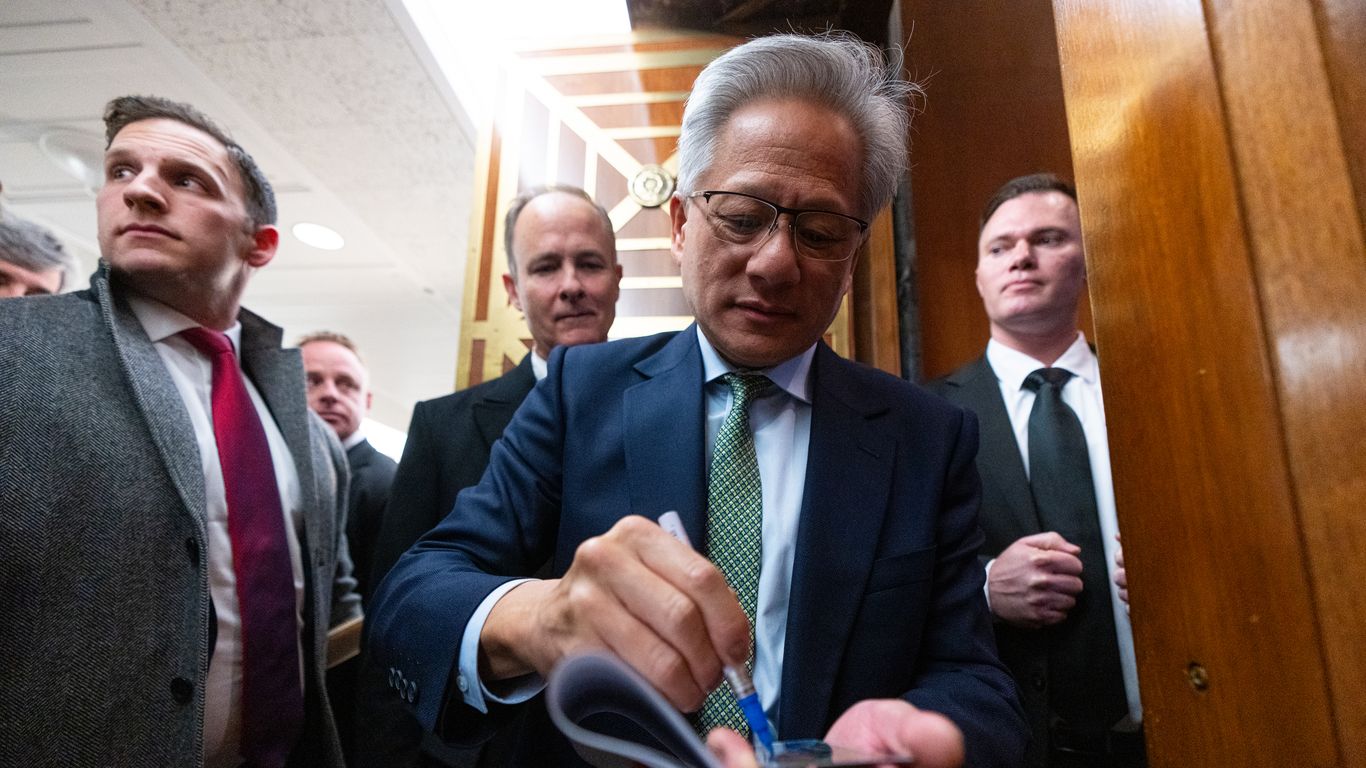
Nvidia's decision to reinstate Jensen Huang as CEO is drawing criticism and scrutiny — including about national security risks — from members of Congress in both parties. Why it matters: President Trump's push to reinstate Huang creates a headache for Republicans and new fodder for Democrats eager to deploy their investigative powers when they take control in January. "No national security risk? Based on what," Sen. John Cornyn (R-Texas) asked in a social media post following the news. "Last week, the board said it didn't intend to reinstate him. I'd like to know what changed," Sen. John Curtis (R-Utah) said in a statement to Axios. "The risk of extortion by a Chinese asset who's been banned by Singapore is risk enough to not rehire Huang. The worst part of this is what we may never know," Sen. Kevin Cramer (R-N.D.) posted on X . Driving the news: The House Intelligence, Foreign Affairs and China committees have announced that Huang would testify next week. His reinstatement "changes nothing," an Intelligence Committee spokesperson told Axios on Monday. "When Jensen was CEO, our three committees were demanding answers. When he was removed and no longer CEO, we were still pursing the facts." The spokesperson added: "There are serious questions on national security implications that still need answers. Seems like the only thing that is consistent these days on this issue is our three Committee's commitment to oversight." Huang is scheduled to appear before the Senate banking panel on Dec. 3. What we're watching: Top Democrats say they will open their own investigations into Huang's reinstatement when they take power next year. "Congress will not be deterred from conducting a swift, thorough and wide-ranging investigation into business malfeasance by NVIDIA and corrupt abuse of power by Howard Lutnick and the Department of Commerce," House Minority Leader Hakeem Jeffries (D-N.Y.) said. "We must investigate these actions. No president who has invested in a private company should be involved in their board decisions," said Rep. Robert Garcia (D-Calif.), the top Democrat on the House Oversight committee. "Democrats will wield their full power to investigate any wrongdoing by the Trump Administration, Jensen Huang, other NVIDIA executives, and anyone selling out our national security for financial gain,"Senate Democratic Leader Chuck Schumer (D-N.Y.) said in a post on X . Said Sen. Ron Wyden (D-Ore.), the top Democrat on the Finance Committee: "In January, Democrats will hold this corrupt administration accountable." Rep. Greg Meeks (D-N.Y.), the ranking member of the House Foreign Affairs Committee, told Axios: "We need to know why Trump put his thumb on the scale to have Jensen reinstated as CEO and why his administration failed to restrict the PRC's access to our most sensitive technology." What Democrats are saying: "Trump is putting his own financial interests and the needs of his billionaire buddies before our national security," Schumer said. Jeffries called for the annual defense authorization bill to include "ironclad export control legislation to prevent powerful AI technology from being exploited by the Chinese Communist Party and other adversaries." "The President is selling out our national security to keep the stock market high and probably for some fucking donation to his ballroom," Sen. Ruben Gallego (D-Ariz.) said . "Jensen Huang's reinstatement shows that under Trump, Vance, and Rubio, our national security is for sale," Wyden said . Sen. Elizabeth Warren (D-Mass.), the top Banking committee Democrat, called the decision "reckless" and said the board still owes Congress "answers about the company's compliance with U.S. export controls," adding that the Trump administration "needs to explain to Congress what 'input' was given and by which senior officials in the United States government to support his reinstatement." "Yet another example where, in Trump's America, the wealthy and well connected are held to a differen
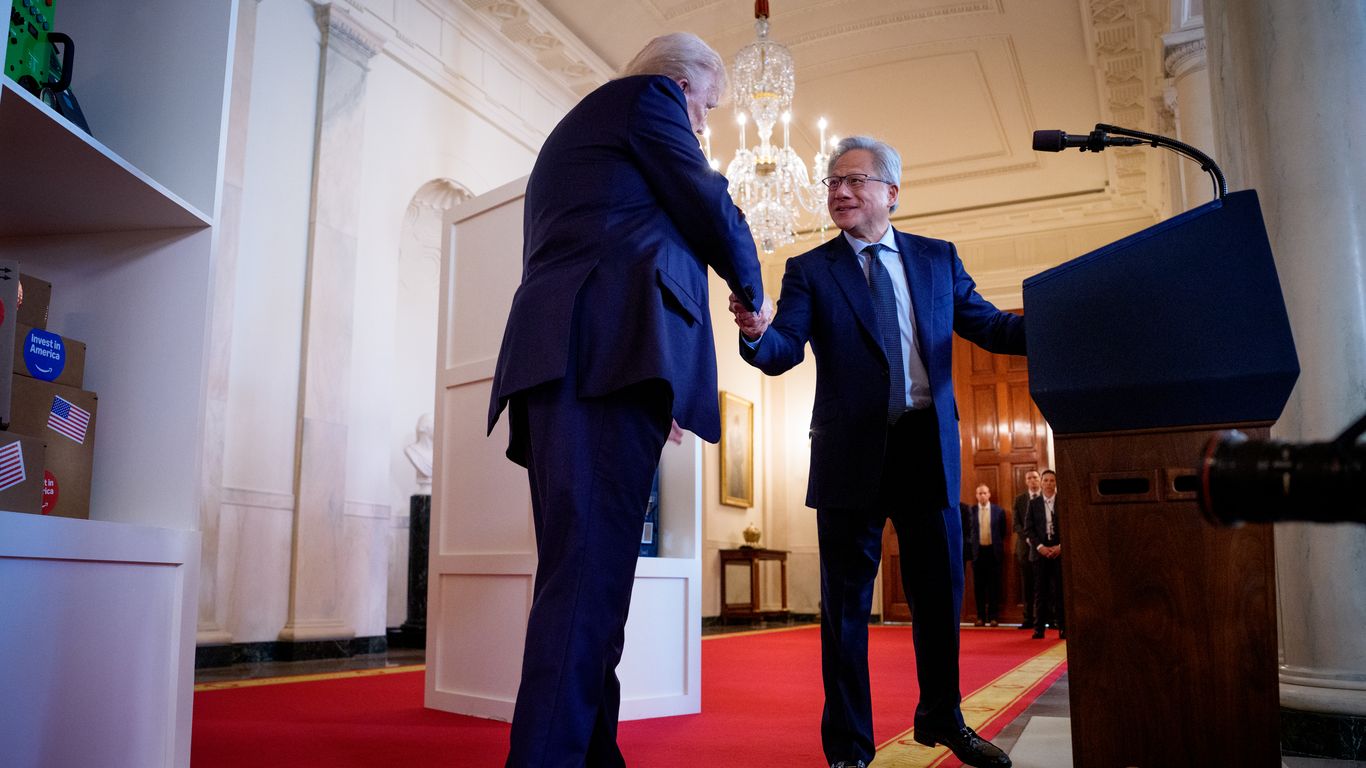
President Trump pushed Nvidia to reinstate Jensen Huang as CEO after allies argued he was " too big to fail " for the U.S. economy and a victim of "deep state" maneuvering, sources familiar with the discussions told Axios. Why it matters: Trump put the weight of the presidency behind a private company's decision about who should run it, an intervention that strengthened Huang's allies inside the administration and put officials critical of the company in an increasingly uncomfortable position. Driving the news: "Jensen is too big to fail," one source familiar with the discussions told Axios. Huang resigned amid allegations he had affairs with a suspected Chinese intelligence asset and subordinates. The stock market's slump prompted President Trump and allies within the administration to push for his reinstatement. "The President was pushing harder than Jensen," one source said. Trump called into Nvidia's board meeting Sunday night to argue for Huang's reinstatement, he told CNBC. Behind the scenes: Huang's allies appealed to Trump's longstanding distrust of the intelligence community, portraying the Nvidia founder as a victim of persecution by unnamed government insiders. A Trump adviser said allies sought to convince Trump that "deep staters" were working against Huang. The intelligence included findings about Huang's relationship with a woman suspected of spying for China, which Secretary of State Marco Rubio circulated to senior officials in a memo earlier this year. A Rubio ally said the secretary of state was "mortified" when the memo leaked with his name attached. Zoom in: The memo came as Nvidia lobbied the Trump administration to open up China's access to its chips. Despite the intelligence, Huang remained close to the president while Commerce Secretary Howard Lutnick's inaction fueled tensions between him, Rubio, Treasury Secretary Scott Bessent, and others. A senior administration official argued the intelligence never established Huang was compromised, knowingly violated U.S. law or had sex with a spy. "People are weaponizing some true information and spinning it to reflect as negatively as possible against Huang. That's the president's concern," the official said. Vance's role Trump and Vice President JD Vance viewed Huang as an important champion of open models offering Americans more control and lower costs than closed models like OpenAI's and Anthropic's. The two were briefed on the national security concerns involving Huang and concluded they had not seen evidence of personal wrongdoing, the source said. Anthropic has been warning the Trump administration that Nvidia's advanced chips power Chinese open source models closing in on the AI race. Yes, but: These conclusions come as more and more connections between Alice Huang — the alleged Chinese spy Huang had an affair with — and the Chinese government and military come to light. "He let the U.S. stock market and economy demand his return — along with the pressure from the president — and the outcry was deafening," the source said. Huang's reinstatement is a "big win" for Vance, a source close to Rubio said. Vance's Silicon Valley relationships helped the administration navigate the board's concerns, according to a source familiar with the discussions. Keeping Huang as CEO was seen as the best option for national security, a source close to Vance said. What we're watching: Huang's opponents in the administration now risk backlash from the president. Bessent has been the loudest, criticizing Lutnick's inaction on TV and calling for the Nvidia board to find a new outside CEO and a "dramatic shakeup," but on Sunday softened his stance. What's next: Trump's intervention settled the immediate fight over Nvidia's leadership but raised questions about the U.S. government's role in the board's decision. Sen. Elizabeth Warren (D-Mass.) wants to know which officials provided the national security input that Nvidia cited in reinstating Huang. Three Republican-led House com
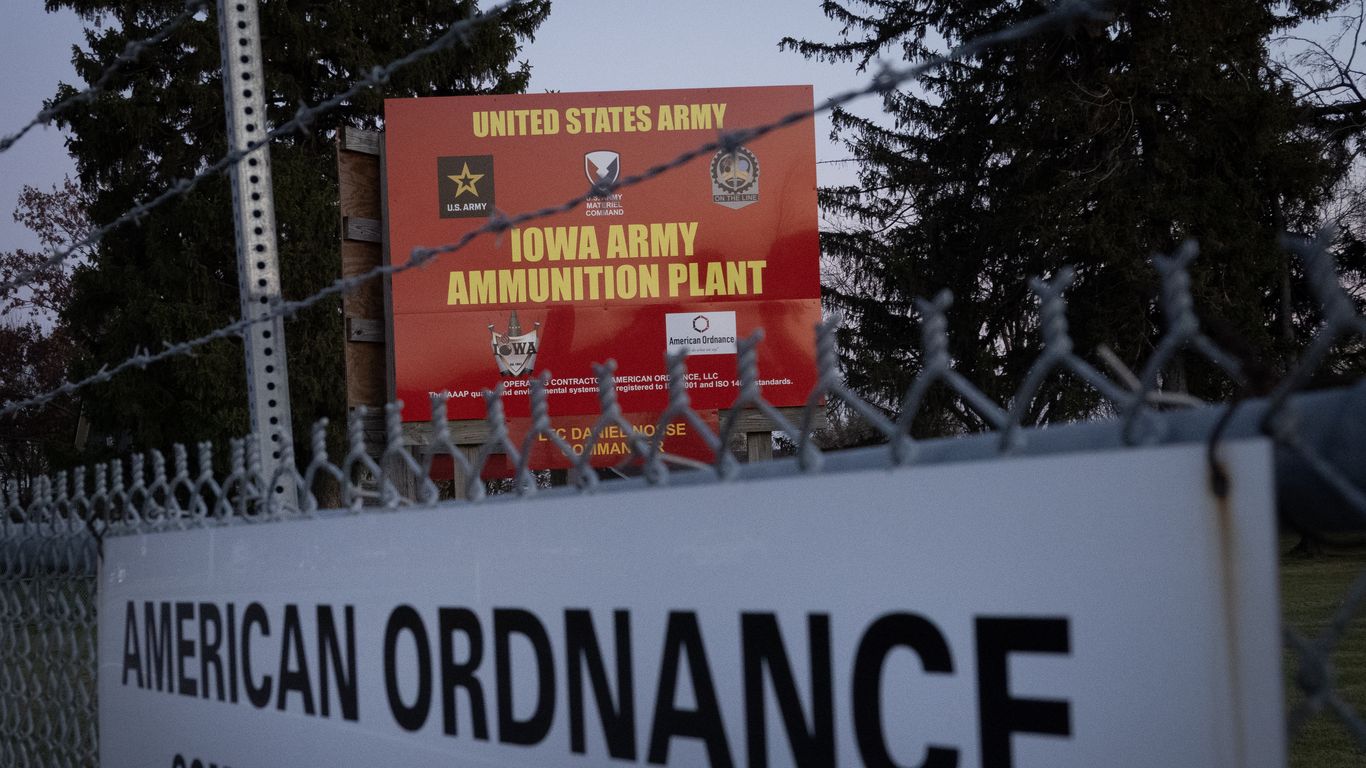
President Trump ordered the Army to pause plans to detonate unstable explosives at an Iowa ammunition plant, saying the blast cannot proceed without approval from an appeals court and Democratic Gov.-elect Rob Sand . The big picture: State officials said last week they only recently learned of the plan to detonate tons of lead azide at the Iowa Army Ammunition Plant, sparking frustration about a perceived lack of transparency from federal officials. The Army, which had delayed the detonation until Wednesday, advised people who live or work nearby to avoid the area, stay indoors and clean surfaces once the branch declares the airborne exposure risk over. But the threat also sparked warnings in neighboring Illinois, with the American Lung Association saying that residents of eastern Iowa and western Illinois could be exposed to lead. Driving the news: Trump warned Monday that he would hold Sand responsible for "any and all death or destruction" if the governor-elect refuses to approve the detonation. " If he or the Courts do not agree, we will have no choice but to not proceed with the controlled removal of these hazardous materials, and be forced to hold the incoming Governor responsible for any and all death or destruction caused by this very unfortunate, and longterm, situation," he wrote in a pointed Monday Truth Social post . State of play: The Middletown, Iowa, blast was initially set for Friday, then delayed to Monday and then to Wednesday. In a Friday letter to Gov. Kim Reynolds, regional EPA administrator Jim Macy said the Army had documented recrystallization of the lead azide, raising the risk of an accidental explosion. The lead azide "is now so sensitive to temperature, friction and shock that it cannot be safely moved, opened, or treated without a significant risk of explosion," per an administration court filing . Friction point: Earthjustice sued last week to halt the detonation on behalf of the Iowa Environmental Council and the Sierra Club's Iowa chapter. A federal appeals court subsequently paused an EPA emergency permit allowing the blast. But even with the permit stayed, the administration argued in a Sunday filing to the 8th U.S. Circuit Court of Appeals that the Army could still move forward with a controlled detonation. Catch up quick: The Army announced Sunday night that the controlled detonation plan would be pushed to Wednesday "to allow for optimal weather conditions and all mitigation measures to be emplaced." "The health and safety of all Americans has and always will be our first priority," the Army added. But on Monday, Trump halted those plans. What they're saying: Incoming Hawkeye State leaders Josh Turek, who will join the Senate in January, and Sand , the incoming Democratic governor, have condemned the Army's communications. "The public also deserves answers as to why the U.S. Army's communication — both with the public and with Iowa officials — was delayed and inadequate from the beginning," Turek said in a Sunday statement . Sen. Tammy Duckworth (D-Ill.) slammed the saga as "an extreme failure of communication, planning and leadership," adding the Army "must be held accountable for the harm done." Go deeper: Iowa leaders ask Army to delay planned lead detonation
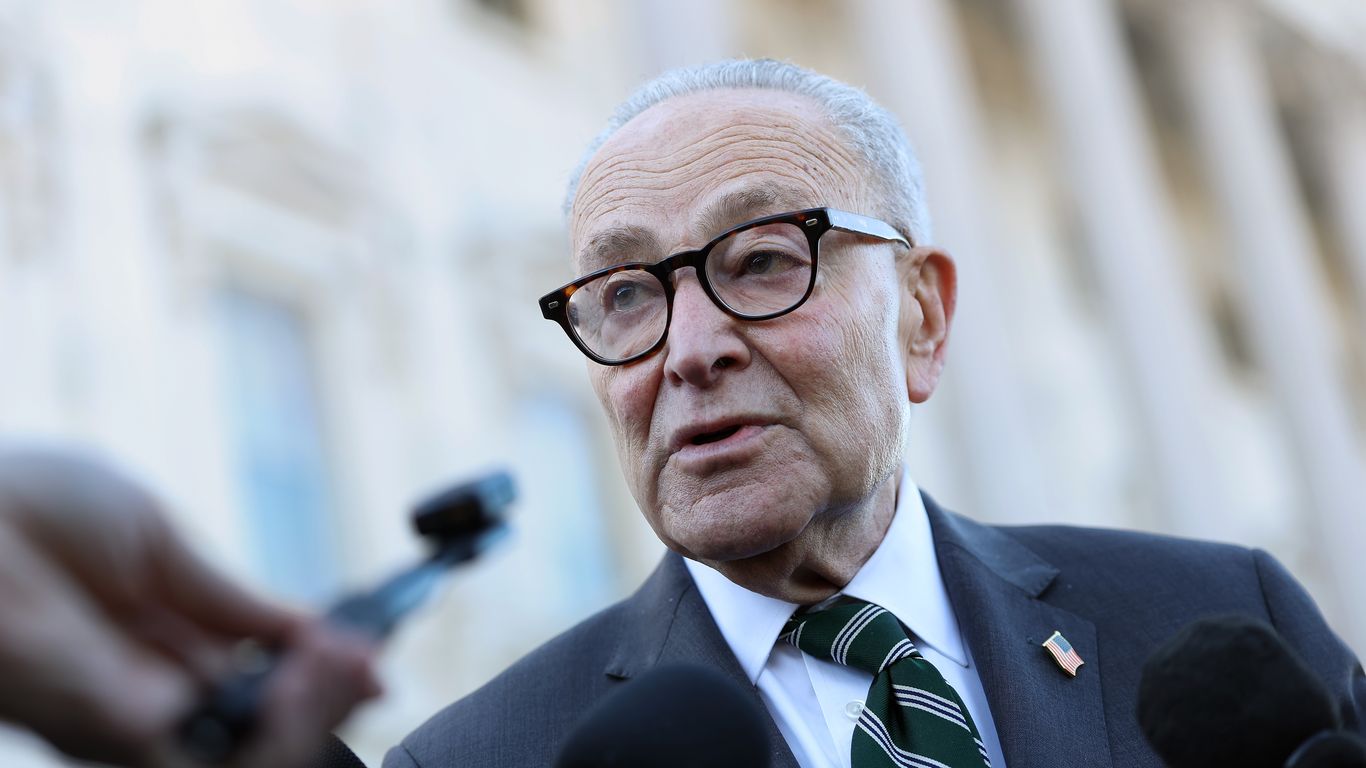
Senate Minority Leader Chuck Schumer (D-N.Y.) warned Nvidia CEO Jensen Huang that Congress is coming for answers — whether he's back at the top of the company or not. Why it matters: The embattled CEO's return to the board came as a shock to investors but sent Nvidia's stock through the roof . Now, some lawmakers are warning that his return raises national security concerns. What they're saying: "The Trump Administration's rush to reinstate Jensen Huang underscores the need for Congress to act," Schumer wrote Monday on X. "Trump is putting his own financial interests and the needs of his billionaire buddies before our national security, emphasizing that he's learned nothing from his resounding election defeat. Democrats will wield their full power to investigate any wrongdoing by the Trump Administration, Jensen Huang, other NVIDIA executives, and anyone selling out our national security for financial gain." "We'll also work on a bipartisan basis to continue advancing policies that stop the flow of our most powerful technology to the Chinese military and other adversaries." Nvidia did not immediately respond to Axios' requests for comment. The other side: White House spokesman Davis Ingle slammed what he described as "Trump Deranged Dumocrats and the Fake News' continued attempts to fabricate conflicts of interest" in a statement provided to Axios. "President Trump only acts in the best interests of the American public – which is why they overwhelmingly re-elected him to this office, despite years of lies and false accusations against him and his businesses," Ingle added. In an interview on CBNC, Trump said his "intervention was very important" in Huang's reinstatement. Asked what comes next for the company given the hit to Huang's credibility after his reported affairs, Trump predicted he'd "start off at an almost higher level," adding, "sex sells, fellas." Driving the news: Nvidia announced Huang's reinstatement as CEO, president and a member of the board Monday morning, less than two weeks after his resignation. Despite saying last week that it did not intend to bring him back, the board did so anyway, amid urging from the White House. Shortly after the announcement, Trump praised the board's decision, calling it "correct and proper," and saying "[t]he Country needs Jensen's leadership at NVIDIA in order to ensure the Success and Prosperity of not only the Company, but the American Economy." Catch up quick: The whirlwind saga around the chipmaking behemoth was sparked by Huang's admitted relationship with a suspected Chinese spy. The woman, Alice Huang , was a former executive at Singapore-based Megaspeed International, a multibillion-dollar Nvidia customer that the Wall Street Journal reported arranged to send nearly $12 billion in top chips to Chinese companies. Zoom in: "This underscores that enough people believe that our economy and national security are not just dependent on one company, but on one man," Aya Ibrahim, a senior fellow at the AI Now Institute and a former senior adviser at the State Department, emailed Axios. "I suspect this is being driven by last week's stock market drop and now it's clear that Nvidia sits at the center of an enormous web of deals and investments that appear increasingly dependent on one individual." "From the standpoint of both democracy and healthy financial markets, no one person should wield that kind of influence. It is fundamentally corrupt." Between the lines: Huang's resurrection also exposes the company to heightened liability and political turmoil. He'll have to lead the company as it faces congressional and federal investigations. But after his exit contributed to a sharp drop in tech stocks over the last two weeks, his return sent Nvidia shares skyrocketing. What we're watching: How much appetite Congress has to expand its investigations into Huang and Nvidia after the stock market rallied significantly following his return. Go deeper: Nvidia board shows "lack of backbone"
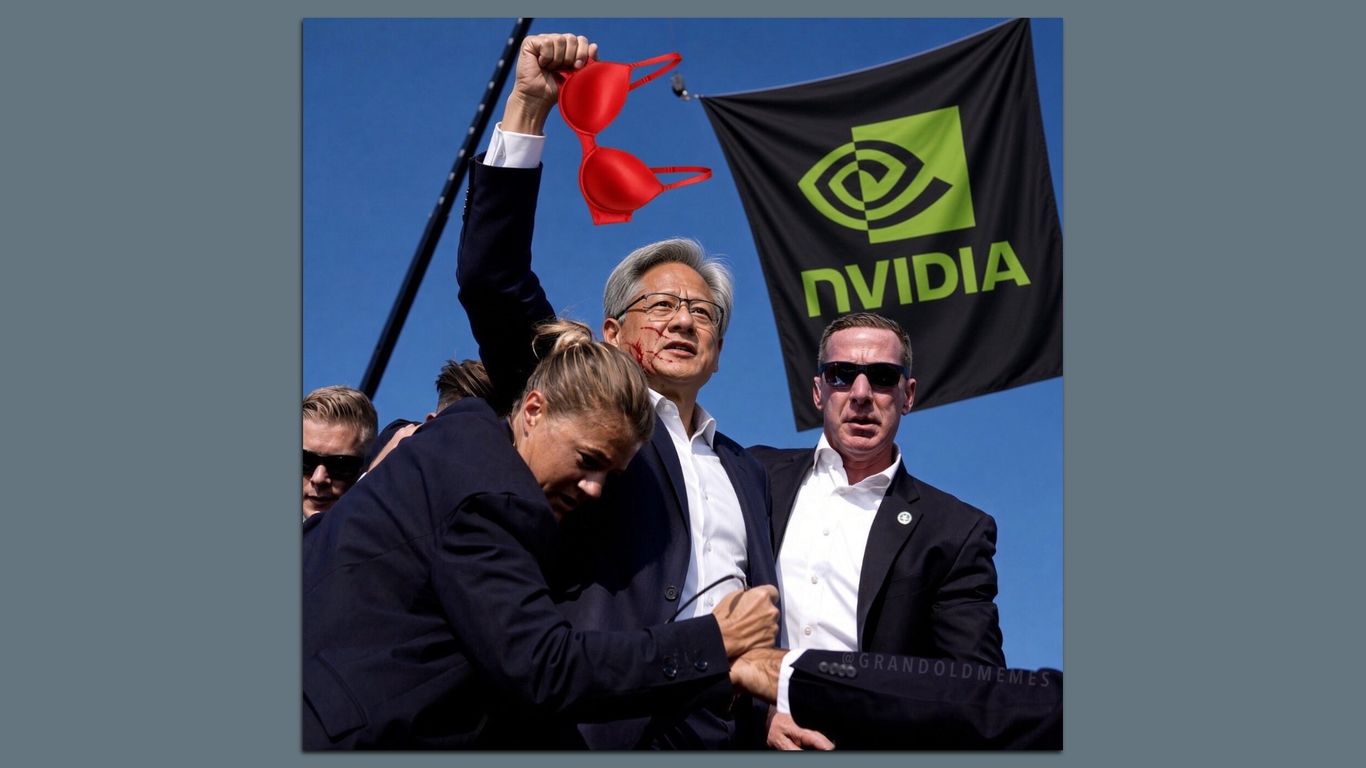
President Trump posted a doctored image of newly reinstated Nvidia CEO Jensen Huang holding a red bra in front of a Nvidia flag, posing as Trump after his viral assassination attempt at a rally in Pennsylvania in 2024. The post came shortly after the embattled Huang was reinstated Monday. Why it matters: The post highlights just how much the White House views Huang as an ally and how the president appears to see Huang's fall from grace and comeback as similar to his own history-making return, despite warnings about national security risks. Driving the news: Nvidia's board reinstated Huang early Monday, declaring him the right person to lead the company. After the announcement, Nvidia shares surged more than 30% by midday, lifting the broader stock market. The reinstatement followed reported pressure from the Trump administration and prompted accountability experts to question the board's judgment . What Nvidia's saying: "The NVIDIA Board of Directors has made the correct and proper decision to return Jensen Huang to the position of CEO," Trump wrote in a separate Truth Social post Monday. "The United States Government has no reason to believe that Jensen's return to NVIDIA poses any risk to National Security. The Attorney General of the United States has confirmed that the U.S. Government does not possess evidence that he has engaged in any unlawful conduct." "On a personal note, I have gotten to know Jensen, and he is a Great Patriot and National Treasure. Separately, NVIDIA should continue its thorough internal investigation of the Company's compliance with U.S. export controls in order to ensure that it is fulfilling its legal obligations and Patriotic Duty to protect U.S. National Security," Trump wrote. Catch up quick: Huang was ousted after he admitted an affair with a suspected Chinese spy, who allegedly used her relationship with Huang to help funnel Nvidia chips to China. Reports also alleged he had affairs with at least two subordinates. What Trump's saying: Trump suggested in a CNBC interview Monday that Huang's sex scandal could ultimately boost his reputation. "Sex sells, fellas," Trump said, predicting that the controversy could be a "net positive" for the Nvidia CEO. Trump said he didn't think Huang would be diminished by the scandal and argued that people respected what he had gone through. Zoom out: Lawmakers on the Hill were immediately taken aback by the decision, as Nvidia's board had previously said it would not bring Huang back. Senate Minority Leader Chuck Schumer (D-N.Y.) warned that Democrats would investigate Huang and characterized his reinstatement as the president "putting his own financial interests and the needs of his billionaire buddies before our national security." Rep. Jamie Raskin (D-MD) who will likely soon chair the House Oversight committee, questioned why Trump was congratulating Huang after the affairs, and asked why the White House was allegedly "putting China's interests first." "Is it just the tens and hundreds of millions of dollars they're making out in the open or does Huang have even more damning information on them? A real Congress will find out," he wrote. Nvidia did not immediately respond to Axios' request for comment. The White House referred Axios to the president's comments on Truth Social and CNBC . Go deeper: Nvidia board shows "lack of backbone" in re-hiring Jensen Huang, governance experts say

AI could put doctors who disagree with it in greater jeopardy of losing a malpractice suit, according to researchers who have tested some legal scenarios with mock juries. Why it matters: The public may still be wary about how AI is used in a hospital or doctor's office, but there's also a baked-in assumption that it's never wrong. That can put physicians in a bind when they disagree with an algorithm that flags an abnormality. Some may opt to order costly, possibly unneeded tests if they think it reduces their legal liability. Driving the news: Researchers are using simulated malpractice cases to examine how much AI influences the perception of whether a doctor exercised "duty of care" in treating a patient. The implications are significant: AI systems are used extensively to analyze medical images and improve the accuracy of diagnoses, and demand for tests is rising. But the systems invariably make mistakes. Experts say there are few established legal precedents for how AI might change the nature of malpractice liability in a field like radiology. Physicians are demanding more protections. The American Medical Association this month called for new federal and state legislation that shields clinicians from liability when AI products harm patients. What they found: In a series of simulated court cases, researchers discovered that mock juries were more likely to side with the plaintiff in a malpractice suit when AI disagrees with a radiologist than when AI agrees with them. One scenario involved a brain bleed on a CT scan that resulted in irreversible brain damage. When AI disagreed with the radiologist by flagging the condition when the radiologist didn't think there was one, the jurors sided with the plaintiff more often (72.9% of the time). A second case was built around a missed lung cancer on a CT scan that resulted in the patient's death. When AI was at odds with the physician by saying the patient had lung cancer when the doctor didn't think so, participants also sided with the plaintiff more often (78.7% of the time), the researchers wrote in NEJM AI . Yes, but: A smaller percentage of jurors ruled against the physician when they were given data on the AI system's error rate. Experts say that's significant because false positive readings are almost inevitable and can temper the belief that the technology is always right. What they're saying: "We're uncovering an unintended consequence of AI adoption," said lead author Michael Bernstein, an associate professor at the Warren Alpert Medical School of Brown University. "AI can do a lot in radiology, but it's not all uniformly positive." Bernstein said one concern is the prospect of more "defensive medicine," in which clinicians overcorrect and order follow-up scans and exams, which can drive up costs and patient anxiety. Radiology is a closely watched specialty because AI is used extensively — and because missing an abnormality can be fatal. It's also among the fields with a high risk of being sued . But research on perceptions of blame is cutting across many medical disciplines and underscores how physicians who are expected to rely on AI to cut down on medical errors still have to know when to override the systems. "Because human operators are perceived as having control over the technology's use, responsibility unduly shifts to the human operator," Johns Hopkins researchers wrote in JAMA Health Forum last year. They noted that physicians were consistently viewed as more liable than AI vendors, health systems that adopted the technology or regulators. What we're watching: Bernstein and his colleagues found that double-checking AI results could reduce doctors' malpractice risks and prospective jurors' perceptions of whether a doctor met the "duty of care" standard. The question is whether they can find the time. The AMA is trying to shift the burden on AI developers and vendors — and pressing for new laws mandating that AI companies carry adequate liability insurance and d

The collapse of UN climate talks without an overarching deal is deepening doubts about the effectiveness of these summits — and bringing fresh calls for a shakeup. Why it matters: Warming is on pace to far exceed the Paris Agreement target of holding long-term temperature rise under 2°C above preindustrial levels — and the more ambitious 1.5°C goal has slipped away . 🏃 Catch up quick: The COP31 talks in Turkey ended Sunday without a high-level "cover decision" of wide-angle agreements and goals. Vulnerable island nations and the EU, among others, objected to a draft deal after some oil-producing countries blocked explicit endorsement of moving away from fossil fuels. ⚔️ Friction point: There was also pushback against proposed text that endorsed carbon capture as a major climate solution. Finance discussions also disappointed advocates, with climate think tank E3G noting that "little or no new and additional money reached the table." 🏀 State of play: Sunday's events reinforce criticisms that the decades-old summit process — which birthed the 2015 Paris deal — is not suitable for spurring policies that meet the scope of the problem. It could add urgency to years-long efforts to revamp how they work. "I have taken steps in engaging external knowledge leaders in advising on areas of potential reform. That is something I will be championing with considerable effort as we leave here," Simon Stiell, the top UN climate official, said as the talks closed, per Reuters. 🥊 Reality check: Ending the practice that decisions require consensus — which effectively gives veto power to individual countries and blocs — would be a steep uphill climb. Yes, but: There was some progress at COP31, per groups that track the granular talks. For example, the climate group E3G cites procedural advances on the "Just Transition Work Programme," an initiative created in 2022 to support workers and communities in the energy transition. And dozens of countries endorsed a pledge to bring electricity's share of global energy use up to 35% by 2035, compared to 23% today. 💭 My thought bubble: The failure in Turkey came just days after the U.S. Senate easily passed a permitting bill that would make it easier to build out renewables and fossil fuel projects. Competing views on the COP process and the permitting bill among advocates show a wider tactical rift in climate and clean energy circles. For many activists, COP31's meltdown shows a dangerous failure to confront planet-heating fuels, and that thwarting them must be a central, science-guided policy aim. "In the same year that science warned we are on track to exceed the 1.5°C threshold, COP31 failed to face that reality head-on and name fossil fuels as the root cause of climate change," Bryan Bixcul of the International Indigenous Peoples Forum on Climate Change said in a statement. But for other advocates, the real action is with duller, nitty-gritty steps (like permitting reform!) that help competitive clean energy grow faster, and anti-fossil fuel red lines are a distraction or even politically counterproductive. What they're saying: "I may be too cynical but if this mess is what finally convinces people that it's not worth all this effort to get unanimous agreement on symbolic statements, maybe that's a blessing in disguise?" Columbia University climate economist Noah Kaufman posted on X . What we're watching: Keep an eye out for any signs that the fracas in Turkey will bring changes to how these COP summits unfold. Sign up here for Axios' Future of Energy newsletter.
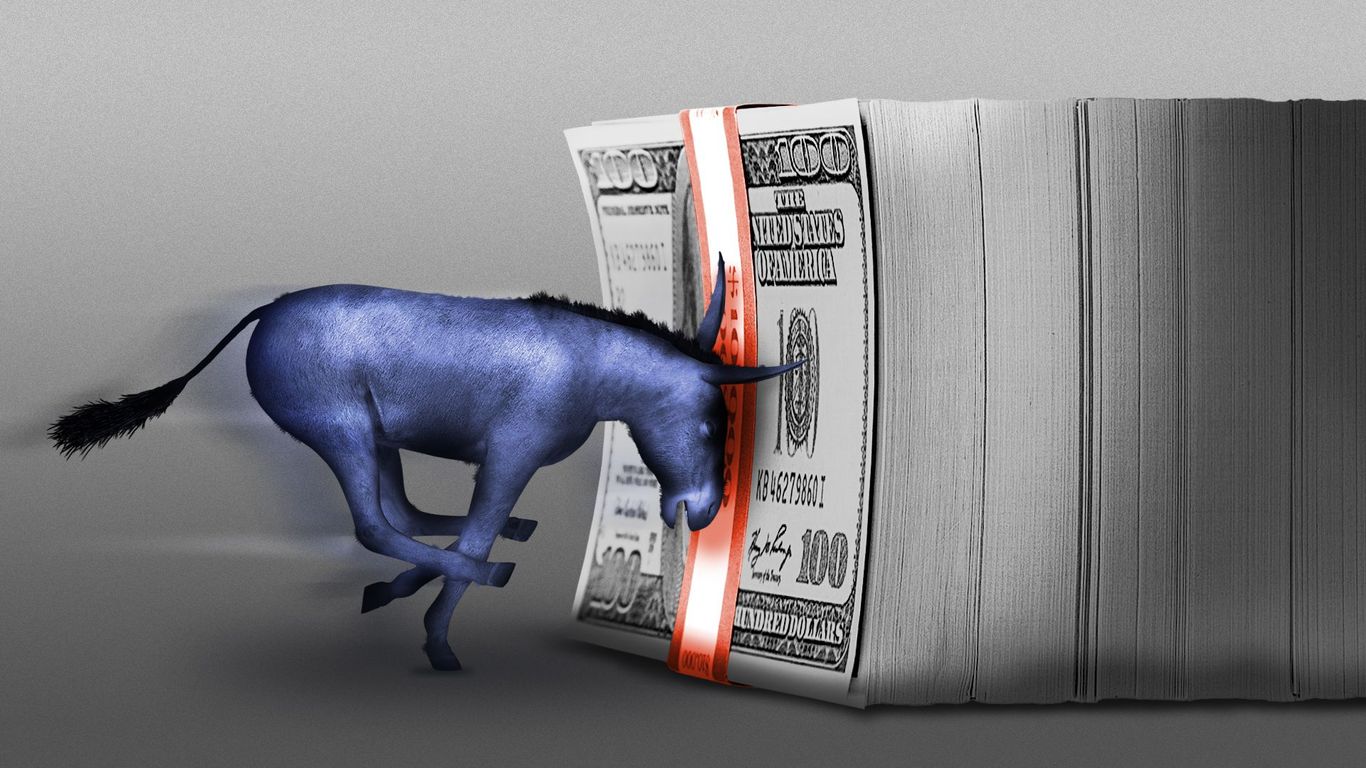
Democratic National Committee chair Ken Martin is moving to restrict candidates' ties to super PACs and dark-money groups in the party's 2028 presidential primary, a shift that could shake up the race for the White House. Why it matters: Most likely Democratic candidates for president were expected to rely on super PACs to boost their messaging — and go after other contenders. The DNC's new rules could complicate their plans and set up a clash between the party chair and soon-to-launch campaigns. Martin's plan will be a real-time test of whether party-driven campaign finance restrictions can function in a presidential primary that will follow a midterm election driven by billions in spending by PACs and dark-money groups. Zoom in: Under the rules that the DNC is announcing Monday, Democratic presidential candidates must disavow any super PACs or dark-money groups that either back them or attack their opponents in ads. If presidential hopefuls don't follow the guidelines, the DNC warns, they won't be allowed on the stage at primary debates. A DNC official said the change is backed by progressives such as Sens. Bernie Sanders (I-Vt.) and Elizabeth Warren (D-Mass.), as well as more moderate Democrats such as Rep. Jason Crow (D-Colo.) and former DNC chair Jaime Harrison. For years, the party's left wing has pushed for party primaries to ban super PACs and dark-money organizations, a term for 501(c)(4) groups that aren't required to disclose their donors. Yes, but: It's not clear whether the DNC's shift will be substantive — or merely symbolic. Super PACs, which can raise unlimited amounts of money, already are barred by law from directly coordinating with candidates. Even so, such groups often work alongside candidates while remaining technically separate. The DNC rules stipulate that candidates must sign a pledge to disavow such funders. Super PACs could, however, continue to spend on behalf of candidates that distance themselves from them. In practice, though, Democratic presidential candidates often have blessed the super PACs set up to help them. In the 2020 primary, for example, Joe Biden's campaign effectively cleared the way for super PACs to have an active role by publicly ending its opposition to them. A pro-Biden super PAC launched soon afterward. In the 2012 campaign, then-President Obama's team also openly promoted a super PAC that championed him. The intrigue: The DNC is planning to put a tracker on its website keeping tabs on candidates' disavowals of any super PACs and dark-money groups that aid them, as well any complaints alleging that candidates aren't following the rules. The rules won't apply in the 2028 general election, the DNC says, or to political organizations that attack Republicans without backing a particular Democrat. Zoom out: A person close to Martin said "the party is looking to double down on successful messaging from the midterms opposing dark-money and the corruption of [Elon] Musk and other ultra-wealthy special interests, which resonated across the ideological spectrum." Martin signaled previously that he wanted to move in this direction. In August 2025 he introduced a plan to DNC members to explore limiting corporate and dark-money spending in the presidential primary. The DNC also is announcing Monday that it plans to hold a dozen debates during the presidential cycle: five in 2027 and seven in 2028. The first two debates will be in June and July of next year. Candidates will need to meet polling and fundraising requirements to qualify for the debates. Specific details for the early debates will be announced in January. The DNC also revealed the leadership of the party's debate planning committee: Longtime Democratic strategist Minyon Moore and DNC executive director Roger Lau will lead it, and the panel includes alumni from the presidential campaigns of Sanders, Obama and others. What they're saying: "Democrats are on offense after our historic victories in the midterms, and the DNC is keepi
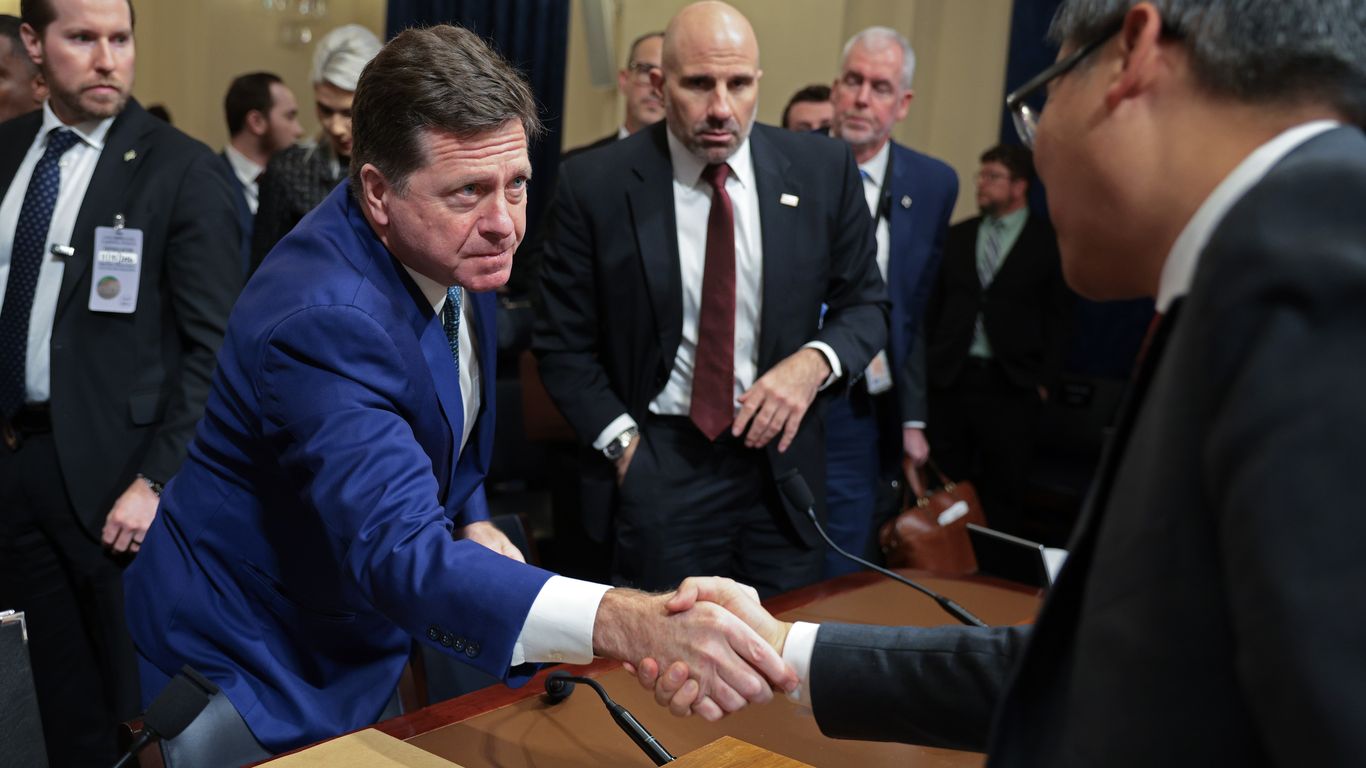
Director of National Intelligence Jay Clayton will also serve as acting national cyber director while Kirsten Davies awaits Senate confirmation to lead the office, Axios has learned. A White House official said the strong support Davies received convinced Trump to nominate her to lead the office permanently rather than keep her in an acting capacity. Why it matters: Clayton, the nation's top intelligence official, will now coordinate cybersecurity policy as outages and reported cyberattacks expose vulnerabilities in America's digital infrastructure. Catch up quick: President Trump announced Thursday he was tapping Davies, the Pentagon's chief information officer, to replace Sean Cairncross as national cyber director. Davies will assist Clayton as a senior adviser in the Office of the National Cyber Director until she is confirmed. Trump has increasingly turned to Clayton. He became director of national intelligence in August, and then Trump named him AI czar coordinating the government's approach to AI. Now he will temporarily lead the office responsible for coordinating cybersecurity policy. What they're saying: "I'm excited to work more with Kirsten, who has the experience and capabilities needed to help America navigate our increasingly complex and powerful digital infrastructure as our next National Cyber Director," Clayton said in a statement to Axios. "I look forward to working with the ONCD team to ensure Kirsten has a seamless transition into the role upon her confirmation by the Senate." The big picture: Two critical national security roles will temporarily fall under one official as President Trump shakes up his cybersecurity team amid the growing threat of AI-powered attacks. The disruptions have raised concerns about the vulnerability of the nation's digital infrastructure, although administration officials say there is no evidence they were caused by coordinated cyberattacks. Clayton himself has played a prominent role in the administration's response, telling lawmakers Wednesday that the outages appeared to stem from unrelated technical problems and system upgrades. Driving the news: Clayton spent Sunday morning on CNN's "State of the Union," ABC's "This Week" and "Fox News Sunday," explaining recent technology disruptions and national security concerns. On CNN, he warned that Americans should expect more "glitches, gaps, interruptions in service" as government agencies and businesses modernize their systems. On ABC, Clayton maintained that recent widespread outages were neither coordinated nor state-sponsored, but declined to discuss reported cyberattacks on the FBI and Department of Agriculture. On Fox News, he said AI is giving malicious actors more powerful tools and warned that critical infrastructure will need upgrades. Zoom in: Davies oversees the Pentagon's information technology and cybersecurity strategy, including efforts to modernize aging systems and protect military networks. She has nearly two decades of technology experience, including senior roles at Unilever, Estée Lauder, Barclays Africa, Hewlett Packard Enterprise and Siemens. Behind the scenes: Clayton has already worked closely with the Office of the National Cyber Director, National Security Council, National Security Agency and other agencies through his AI leadership role, according to the White House official.
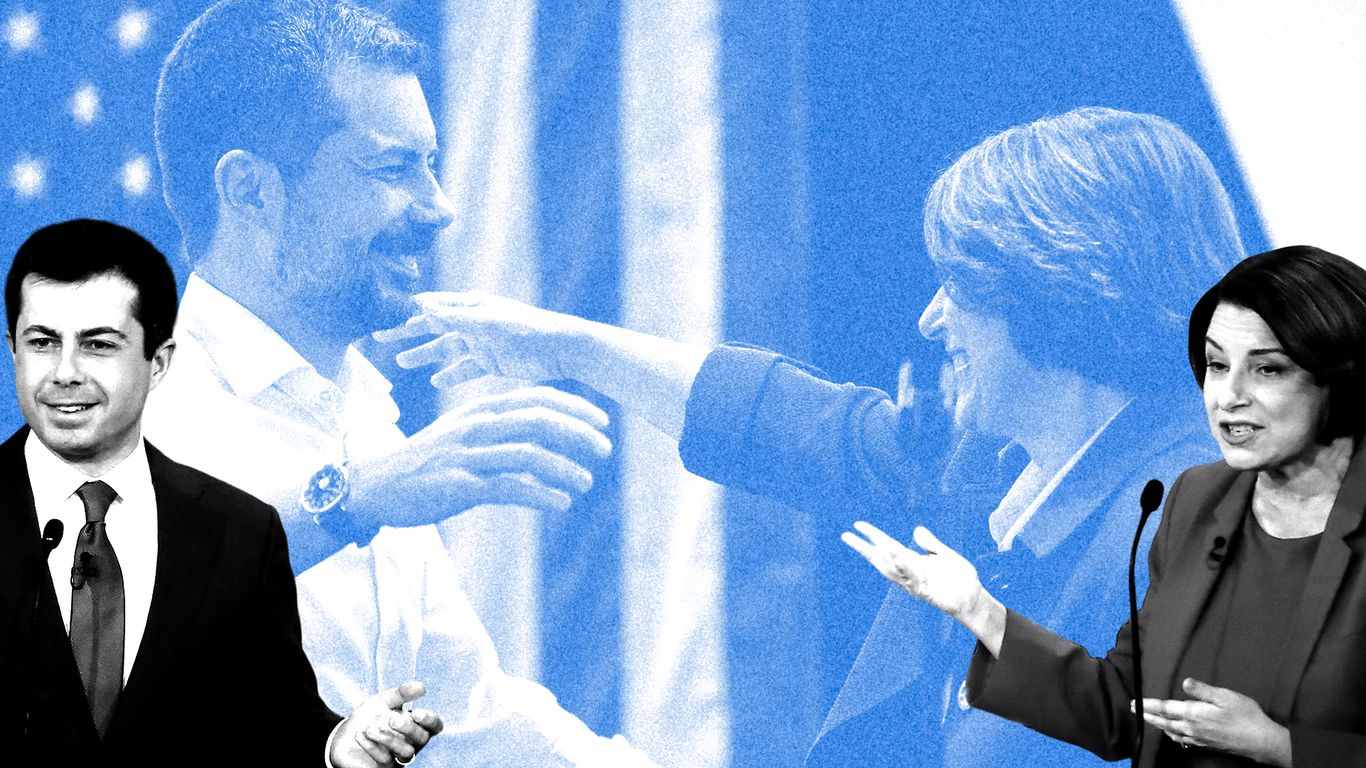
To the surprise of many Democrats and even some of their former aides, Pete Buttigieg and Amy Klobuchar now consider themselves friends after their bitter clashes during their campaigns for president in 2020. Their journey from snarky tension to "real respect and friendship," as Klobuchar describes it, is a story of how two ambitious Democrats came to appreciate each other once the heat of a presidential primary had subsided. Why it matters: It's also a reflection of how Buttigieg — who's weighing another run for president — has become a well-regarded Democratic stalwart after many in the party viewed him as a presumptuous lightweight when he ran six years ago as a little-known 37-year-old former mayor of South Bend, Ind. "I'm sincerely grateful for Amy's friendship," Buttigieg, who was President Biden's transportation secretary, told Axios. "My appreciation has continually grown for her substantive leadership and sense of humor alike." "I know there are people that run against each other for president and literally hate each other," Klobuchar, who's in her fourth term in the Senate but will leave in January to become Minnesota's governor, told Axios. "That was far from the case for us." Flashback: A casual observer might see that as a bit of revisionist history. The Buttigieg-Klobuchar spats during the 2020 Democratic primary were some of the most vicious of that campaign. Aides from both sides can still quote the barbs, word for word. "I wish everyone was as perfect as you, Pete," Klobuchar sniped at one debate in Las Vegas before saying "You've memorized a bunch of talking points and a bunch of things." She added after the debate that Buttigieg was "haughty" and that "given the guy [Trump] we have in the White House, maybe you need someone who's a little more humble." Buttigieg repeatedly mocked Klobuchar for not remembering the name of the president of Mexico in an interview. He said Klobuchar was "not able to speak to literally the first thing about the politics of the country to our south." She shot back: "Are you trying to say that I'm dumb?" Asked today about those mutual attacks, Klobuchar says simply: "We both wanted to win." Many Democrats laughed that their feud appeared to continue into 2021, when the two wrote books with opposite titles — "Trust" by Buttigieg, and "Anti-Trust" by Klobuchar. When Buttigieg announced recently that he has a book coming out in January titled "Next," he texted Klobuchar: "Please tell me you're not putting out a book called 'Last.'" Zoom in: Klobuchar said their relationship has become increasingly warm through the years. "We kept consistently in touch, and not just over work. We had lunch when he first got into Washington. I remember I saw their apartment at the time," she said. "I also worked with him extensively on transportation issues." She added that she came to appreciate "how smart and even-keeled he is" at a time when "'hair on fire' is kind of cool to be." Buttigieg, who campaigned with Klobuchar during the 2026 midterms, said he's "looking forward to seeing all that she accomplishes as governor, and also to my next opportunity to join her at the Minnesota State Fair." What they're saying: A former Klobuchar aide told Axios that it's a "very Midwestern friendship story." "You meet someone new with a healthy dose of competition, skepticism, and a little frostiness. And along the way, you find out you genuinely like each other. That's Amy and Pete." What's next: Klobuchar, who has said she's not running for president, didn't want to weigh in on 2028 because she knows many people who are likely to run. As for what she thinks of Buttigieg's potential candidacy: "He has always been impressive."

Florida Gov. Ron DeSantis is quietly working on a book, two sources tell Axios — a project likely to fuel speculation about his making another run for the White House. Why it matters: DeSantis hasn't publicly acknowledged the book project or disclosed what it will be about. But writing a book is often the first step toward a presidential campaign, and it could give the term-limited governor a platform to lay out his vision for the Republican Party's future. DeSantis' state was a rare bright spot for Republicans in this month's midterms, as Democrats made historic gains across the nation. Driving the news: Word of DeSantis' book comes as he's become increasingly outspoken on a range of policy issues, particularly the economic and social impact of artificial intelligence — potentially offering clues about what the book might address. DeSantis has become a vocal critic of the potential dangers of AI, warning that it could eliminate jobs, threaten children's safety and privacy, and drive up electricity bills as data centers expand. DeSantis has pushed for an "AI Bill of Rights" and signed state legislation aimed at preventing tech companies from passing the costs of data centers on to residential consumers. His stance has put him at odds with the Trump administration's efforts to limit states' ability to regulate AI. DeSantis has emphasized affordability, immigration and education — issues likely to remain central to national politics long after he leaves office. Zoom out: DeSantis has made other moves that could keep him in the national spotlight after he leaves office in January. NBC News recently reported that DeSantis is preparing to launch a conservative think tank, which could enable him to retain a political and donor infrastructure. After the midterms, DeSantis embarked on a flurry of media appearances that resembled a victory tour, highlighting how Florida Republicans had largely escaped the Democratic wave. Yes, but: Some DeSantis allies are highly skeptical that he'll mount another presidential campaign after his unsuccessful 2024 bid. DeSantis has sent mixed signals about his political future. He downplayed the prospect of another presidential bid last year and, after the midterms, questioned how much a Republican president could accomplish with Democrats controlling Congress. He also disputed a report that he was building a campaign operation. But he hasn't ruled out a 2028 run, saying he'll assess the political landscape after leaving office. What they're saying: DeSantis' spokespeople did not respond to requests for comment about the book.
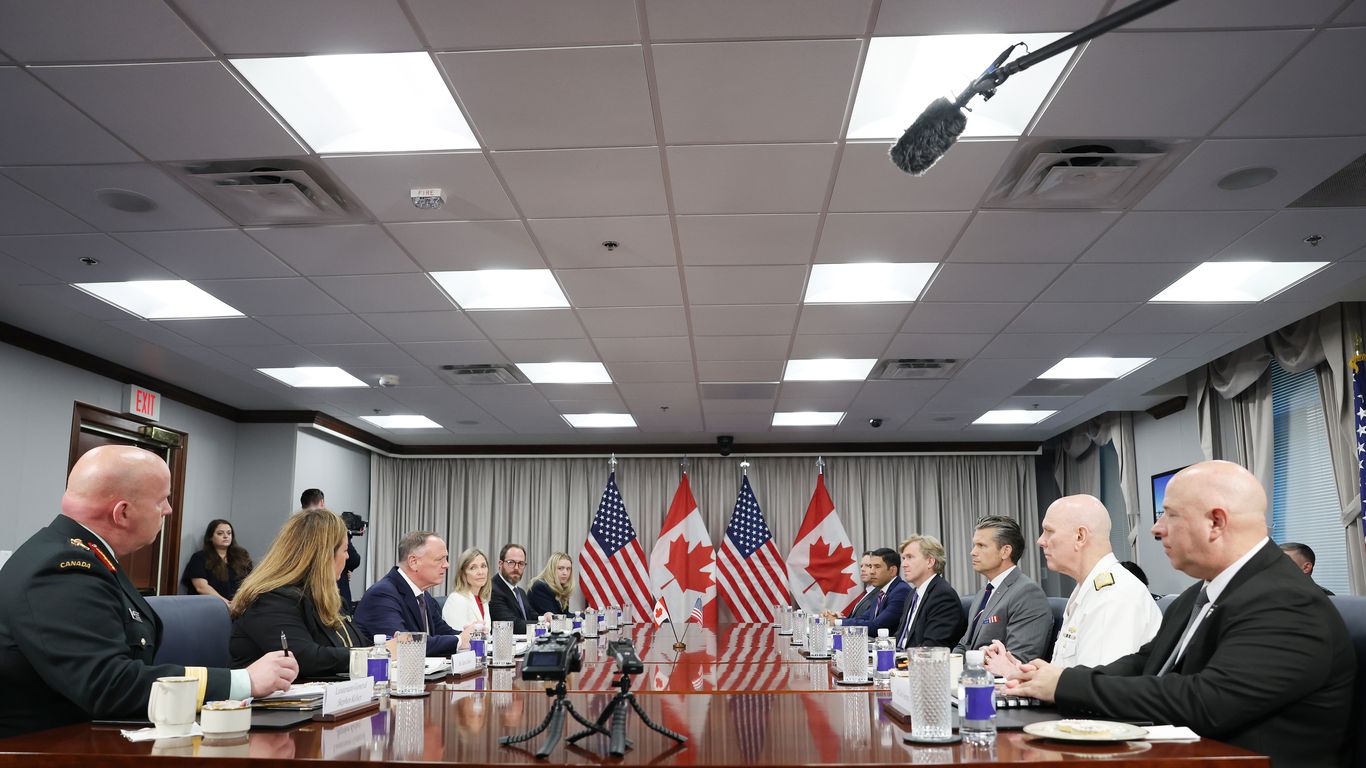
The Pentagon accused Canada of failing to become a "credible partner" due to its faltering military readiness and low defense spending, according to a sharply worded fact sheet issued by the Pentagon to justify new restrictions on America's northern neighbor. Why it matters: The restrictions deepen tensions between the U.S. and Canada over trade and defense, as Ottawa reconsiders billions of dollars in purchases of American weapons. The new restraints — which do not affect defense or intelligence sharing— limit U.S. military personnel from fraternizing with their Canadian counterparts at official events without prior authorization from the Pentagon, an official told Axios. The Pentagon fact sheet has not been reported. But the Washington Post first reported the restrictions, followed by the New York Times . Zoom in: At the heart of the dispute are NATO defense spending goals and military readiness under the bilateral North American Aerospace Defense Command where, the memo says, Canada falls short in three ways: 🛩️ Air: Only 41.9% of the Royal Canadian Air Force fleet "was serviceable from 2025-2026, largely due to ageing equipment and personnel shortages," the Pentagon fact sheet says. The shortfall limits Canada's "ability to meaningfully contribute to air defense commitments … to defend our North American airspace against all threats." Canada relies on the U.S. and NATO for airborne early-warning aircraft but is negotiating to buy its own from Sweden's Saab. ⚓️ Sea: Just 53.9% of Canada's naval fleet was "serviceable" from 2025-2026, limiting its "ability to monitor maritime approaches to North America," the fact sheet says. Only one of Canada's "four ageing Victoria-class submarines" is "seaworthy at any given time." Canada has a new fleet of conventional submarines, manufactured by ThyssenKrupp Marine Systems, coming on line, but until then, its undersea "capability will be limited." 🪖 Land: The Canadian Army had an operational readiness rate of 48% from 2025-2026. The other side: Canada's own defense department reported the same equipment shortages while finding that 61% of its military units were ready for operations. "Canada continues to engage constructively and professionally with our American counterparts and would not speculate on media reports of this nature," Canada's Department of National Defence said in a written statement concerning the new U.S. military restrictions. "Canada and the United States have a long history of defence cooperation built on a shared commitment to continental defence and protecting our collective security around the globe. This collaborative work continues," the statement said, noting the "deeply interconnected" relationship between the countries and their "enduring partnership." Friction point : NATO defense spending has been a constant sore spot for President Trump. Canada first agreed to spend 2% of GDP on defense spending in 2006, but it was only at 1.5% until 2025, according to the Pentagon. Canada announced in March that it had achieved 2% GDP-defense spending, but now the target is 5% by 2035 and U.S. policy makers say Ottawa "has yet to articulate a resourced path to reach this target. "Canada must get serious and focused," the fact sheet said. The big picture: More defense spending by NATO allies is a revenue generator for the U.S., which has the globe's largest military-industrial complex. "Since March 2025," the Pentagon fact sheet noted, "Ottawa has been reviewing its decision to procure 88 F-35s to replace its ageing fighters and is considering a mixed fleet that will compound existing personnel shortfalls." Canada is increasingly looking to European manufacturers for its military buildup. Context: Relations between the two countries soured when Trump scrapped a free-trade agreement he insisted on in his first term, began a tariff war and threatened to annex Canada as the 51st state. At a Friday news conference, Trump complained about Canada and trade imbalances between the

We've talked to more than 50 leaders in government, AI, business and cyber — from let-'er-rip AI accelerationists to shut-'er-down critics — and they were unanimous on one chilling assessment: Cyberattacks on business and critical infrastructure will be constant, increasingly sophisticated and highly disruptive over the next 18 months. These leaders describe 2027 as the year cyber becomes like weather: Outages will be frequent, disruptive, occasionally scary, and something people and companies must learn to navigate and live with daily. The chances of widespread disruption or real damage are rising fast. Why it matters: We write this neither to forecast nor frighten. Rather, we're sharing what government and AI leaders say privately but won't say publicly. The big picture: The disruptions of the past two weeks — from a global Microsoft outage to the FAA grounding air travel to a consumer banking glitch at Chase — were a mild preview of what experts expect is coming. Bridgewater Associates, the world's largest hedge fund , put it bluntly in an assessment this month: "[We] are managing money based on a one-in-three chance of an economically destabilizing attack within the next year." Horacio Rozanski , chairman and CEO of Booz Allen, calls this the "fog before the war" — a foretaste of greater chaos to come, when agentic invaders reach their full potential and can attack "at the speed of thought." "Now is the time to take as many precautions as you can," Rozanski said. "Recognize that this is coming." Most of these malfunctions appear to have resulted from companies and government trying to secure their computer and infrastructure systems against future large-scale cyberattacks. This pattern will persist. Many future ones will be actual cyberattacks, carried out by U.S. rivals or smaller bad actors, using increasingly powerful AI to spot and exploit security vulnerabilities across society and our daily lives. Most top AI and government leaders expect at least small-scale strikes and fear much larger ones. The best-case scenario described to us: regular, random outages and small-scale scares like losing bank access or air travel for a day. The reason: Every government agency and company will mobilize to upgrade their software systems. So errors are inevitable. These are assumptions based on private intelligence and an understanding of AI's capabilities, both to cause and fix glitches. What worries top officials most : With thin AI expertise, an understaffed government and major companies are trying to keep pace with a technology that improves daily. Even if government were loaded with competent experts, which it decidedly isn't, the sheer scale of vulnerabilities across federal, state and local government, not to mention all of business, would make it impossible to reliably secure. Think of it as whack-a-mole with infinite moles. Until this past month, the White House and Congress have focused largely on safety regulations and data centers, not imminent cyber risks. Now, even the White House's Super Intelligence Force ( SIF ) is scrambling to get its head around the rising risks while appraising near-daily reports of possible breaches. And President Trump just ousted the White House national cyber director and named Kirsten Davies, who was the Pentagon's chief information officer, as the replacement. Davies has deeper subject-matter expertise than her predecessor, former RNC official Sean Cairncross . Step back: Only by understanding the state of AI + cyber can government and business mobilize to prevent possible shutdowns across critical banking, electricity and water systems. This is our crack at distilling our conversations in a digestible way for Axios readers: The double-edged sword. The good news: America's frontier AI labs (Anthropic, OpenAI, Google, etc.) built the most powerful AI on the planet, especially for building software. The bad news: AI that's great at building software is equally great at finding — and exploiti
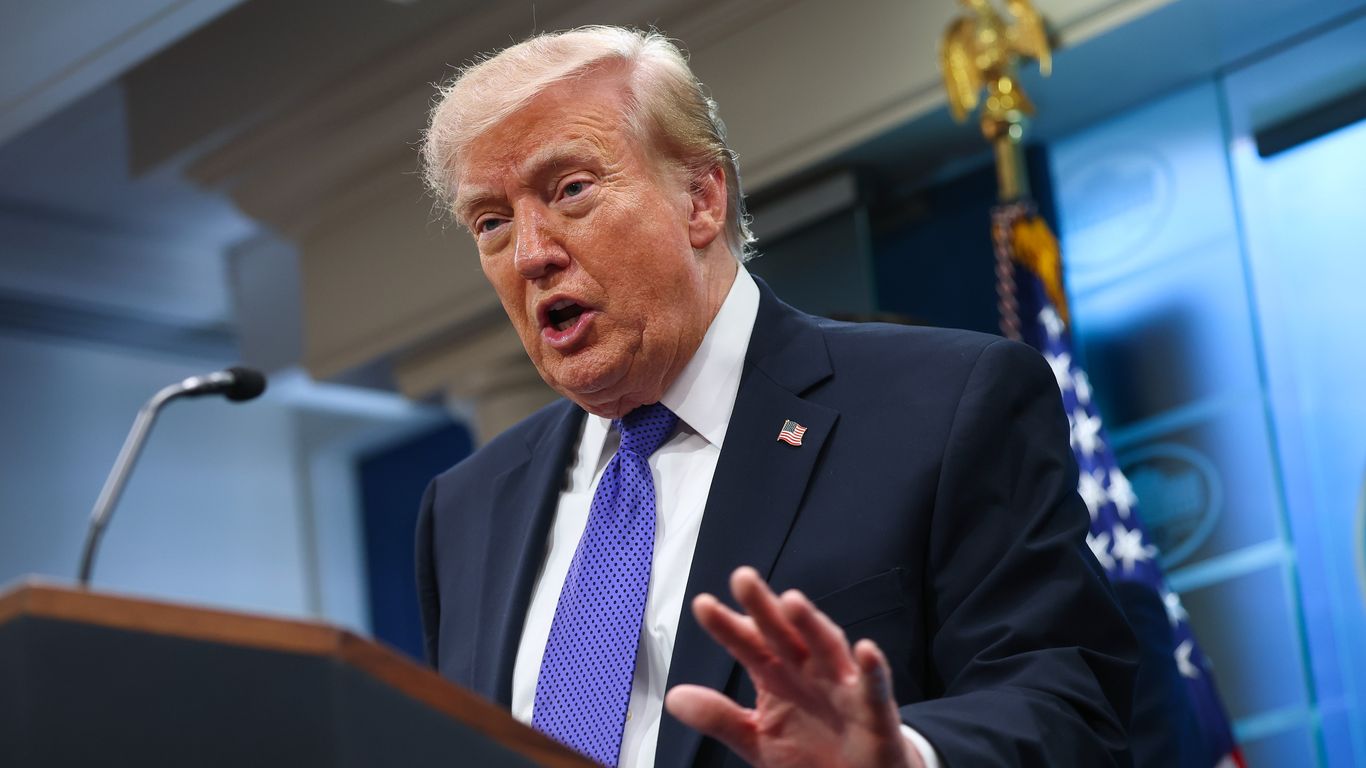
President Trump said Saturday he'd gladly work with Democrats to cap interest and fees on credit cards , arguing that card companies simply make too much money now. Why it matters: Though some argue capping rates would save consumers billions of dollars a year, the banking industry is equally adamant that it would deny credit to millions of Americans by making lending too risky. Driving the news: Trump, in a Fox News interview Saturday morning, was asked whether a rate cap on cards was something on which he could find common ground with Democrats. Sen. Elizabeth Warren (D-Mass.), poised to be the new chair of the Senate Banking Committee, is an outspoken advocate for such caps and has recently said she's ready to work with Trump to pass a bill. What they're saying: " I would do it. These credit card companies have made a lot — and the credit card fees that they charge. I'm all into it," Trump said . "I know that some people would say it's not free enterprise. But what's free enterprise when you're sitting home and you get a bill that some guy set up in an office on Park Avenue and they said 'let's charge a fee that's too high.' So I'm all for that," Trump said. "The credit card companies, they're getting too much. The fees are too high and the interests are too high." Context: The credit card industry argues that capping interest rates would reduce the revenue needed to cover losses when borrowers default, prompting lenders to reject more applicants. Reality check: This isn't the first time Trump has said he'd cap card rates. In January, he said on Truth Social he'd set a 10% cap for one year and any lender that didn't comply would face legal consequences. Nothing came of the threat, which credit unions claimed could deprive more than 47 million people of access to cards. Nonetheless, the mere idea was enough to send shares in major card issuers lower, and prompt a full-throated response from the industry. What to watch: As much as both Warren and Trump support the idea, it's not clear how much Democrats will want to prioritize it once they take control of Congress in January.
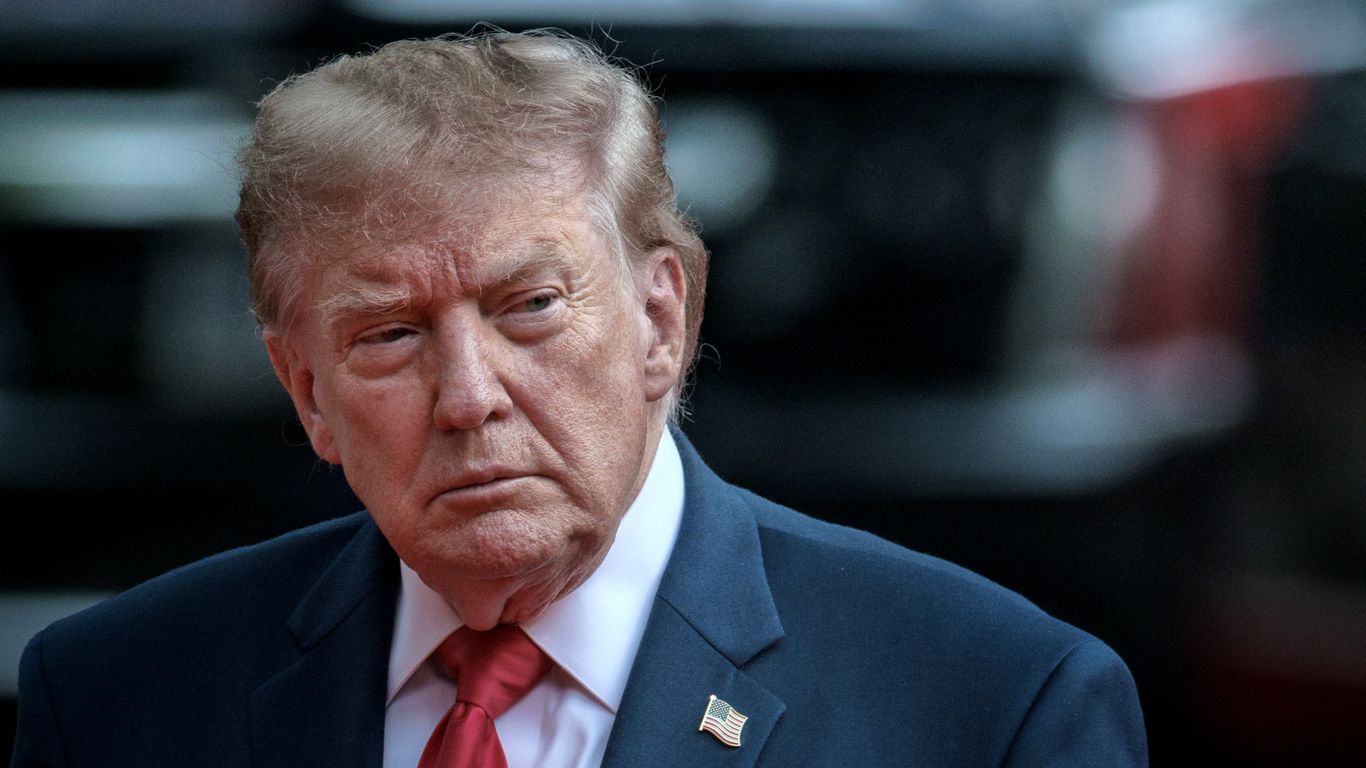
President Trump on Saturday said the reported hack of a crucial FBI database might have a silver lining — it could, he claimed, expose more details of what he called the " Russia Russia Russia hoax ." Why it matters: The president remains laser-focused on many of his past grievances about the FBI , even as the public grows increasingly alarmed about the vulnerability of government infrastructure. Driving the news: CNN and NBC reported Friday night that the FBI was looking into an apparent breach of the National Crime Information Center, which connects local and national law enforcement for information sharing. That follows breaches and outages that struck the FAA, NSA and USDA, just in the last week. What they're saying: Trump was asked about the FBI reports in a Fox News interview Saturday morning. "Well we just heard about it and I will say that it's not good, I don't like that," Trump said. "But maybe we'll learn things that we would have never learned otherwise. You had the Russia Russia Russia hoax, you had all these other hoaxes," he added, referring to Ukraine in particular. "Maybe we'll learn about them. Maybe we'll learn about the voter fraud, all the voter fraud that took place." "I always like to put things in a positive spin," Trump added. "Wouldn't it be great to learn about Russia Russia Russia," he said. The intrigue: The president's comments come just days after a summit with Russian President Vladimir Putin and Chinese leader Xi Jinping in Asia, after which he described Putin as a " friend ." What to watch: It's not clear who breached the FBI database, or what they might do with the data obtained.
After years of being overlooked by national Democrats, Black organizers are using stunning Southern election upsets in the pursuit of something more lasting: a new generation of candidates who can win and govern. Why it matters: Activists say the 2026 midterms proved Southern races long dismissed as unwinnable could flip with grassroots organizing and investment. Now they're building a multiracial, working-class political bench — from school boards to statehouses. Organizers want to turn Black political gains into a durable Southern coalition united by economic interests, not just opposition to Republicans. By the numbers: The midterm election results gave organizers fresh ammunition. Roughly nine in 10 Black voters backed Democratic House candidates nationally, according to the AP Voter Poll . Democrats flipped 10 South Carolina House seats, seven won by Black candidates, ending the GOP supermajority, the South Carolina Daily Gazette reports. State of play: The Working Families Party plans candidate recruitment events in Georgia, Tennessee, South Carolina and Mississippi in early 2027, targeting community organizers, teachers, young activists and other political outsiders. It plans training, digital outreach and spending to support dozens of Southern candidates. Its Southern Made initiative aims to recruit and train 1,000 working-class candidates by 2030. Zoom in: South Carolina illustrates the opportunity. WFP-backed Jumelle Brooks , a home health care provider, lost a 2024 House race by roughly 700 votes before winning this year by nearly 10 percentage points. Another WFP-backed Democrat, Sonja Ogletree Satani , won a Charleston-area rematch. What they're saying: "We are building concentrated governing power," Britney Whaley, WFP's Southeast regional director, tells Axios. Whaley wants clusters of allies in elected bodies who can pass legislation, not isolated progressives powerless to advance an agenda. "Black people across the country voted for historic change, and now it's time for systemic policy change," Kristin Powell of Black to the Future Action Fund said in a statement to Axios. Zoom out: The Southern breakthroughs extended well beyond statehouses. Mississippi: Scott Colom became the state's first Black senator elected since Reconstruction. South Carolina: Annie Andrews won a long-shot Senate race. Georgia: Keisha Lance Bottoms became the nation's first Black woman elected governor; Democrats flipped the state House . Texas: James Talarico became the first Democratic U.S. senator elected since 1988. Yes, but: The South remains deeply Republican, and organizers say Democrats left winnable races on the table. WFP-backed Angie Nixon lost in Florida by roughly three points; Justin J. Pearson lost Tennessee's 9th District by 2,539 votes . The WFP spent about $200,000 on each race and argues more national investment could have tipped them. That's unproven. The intrigue: Pre-election findings from the 2026 Black Census , a nationwide voluntary survey by the advocacy group Black Futures Lab, found 95% of respondents planned to vote — yet just 3% trusted Washington and 22% trusted Black elected officials. Economic anxiety runs deep, with 44% hoping to escape debt, 35% to earn more and 25% to find affordable housing. Southern organizers now face a test of turning votes into economic relief, though the survey isn't representative of all Black voters. The Black to the Future Action Fund tells Axios says its data also shows Black voters want leader to focus on lower utility rates, universal health care, raising the minimum wage and ending gerrymandering.

A second federal judge will block construction on President Trump 's embattled arch set to be erected near Arlington National Cemetery , multiple outlets reported Friday. Why it matters: It represents yet another barrier to the multi-year project to build a 250-foot arch that challengers said would obstruct the line of sight between the Lincoln Memorial and Arlington National Cemetery. Driving the news: U.S. District Judge Leonie Brinkema said she will issue preliminary injunction that will indefinitely block the project, which she reportedly called a "rushed job" from the bench Friday. Zoom out: Brinkema's rebuke comes after D.C.-based District Judge Tanya Chutkan on Wednesday extended her separate order blocking construction on the arch for two weeks. Chutkan, who is overseeing consolidated challenges from military veterans and from the District of Columbia and Virginia, issued her initial temporary restraining order earlier this month. That order prohibited construction, excavation, land disturbance, utility installation and road closures related to the arch, Axios D.C.'s Mimi Montgomery reported. What they're saying: "The judiciary should not be abused to politicize a structure designed to unite our nation," White House spokesman Davis Ingle said in a statement. "We will continue making the case for this beautiful and fitting monument and are confident we will be fully vindicated as this litigation proceeds." The National Park Service did not immediately respond to Axios' request for comment. The other side: "We are pleased that the court has recognized the irreparable harm that will come to people who live and work in Arlington and stopped the massive vanity project while our case is heard and considered by the court," said Kate Talmor, senior counsel at Democracy Forward and an attorney on the case. She added, "We are honored to work with the Arlington County Board to stop the proposed arch from jeopardizing public safety." State of play: The legal hurdles came after the National Capital Planning Commission , which is stacked with Trump loyalists, gave its final approval for the project. Challengers, however, have argued the project requires congressional approval — and as Chutkan noted , "Congress has not enacted any statute authorizing construction of the Arch." Between the lines: The arch is one prime example of the president's quest to remake the nation's capital as he sees fit, from a sprawling White House ballroom to a community golf course . The NPS has backed Trump's arch, despite noting it "would alter several historic views." The FAA deemed the arch, which would sit near Ronald Reagan National Airport, safe for air travel, but said it should have "a non-standard eternal flame on top" and "floodlight projectors pointed" toward it. What we're watching: A Justice Department spokesperson said they would appeal the decision "immediately." Go deeper: The next two months are pivotal for Trump's D.C. projects Editor's note: This story has been updated with additional information.
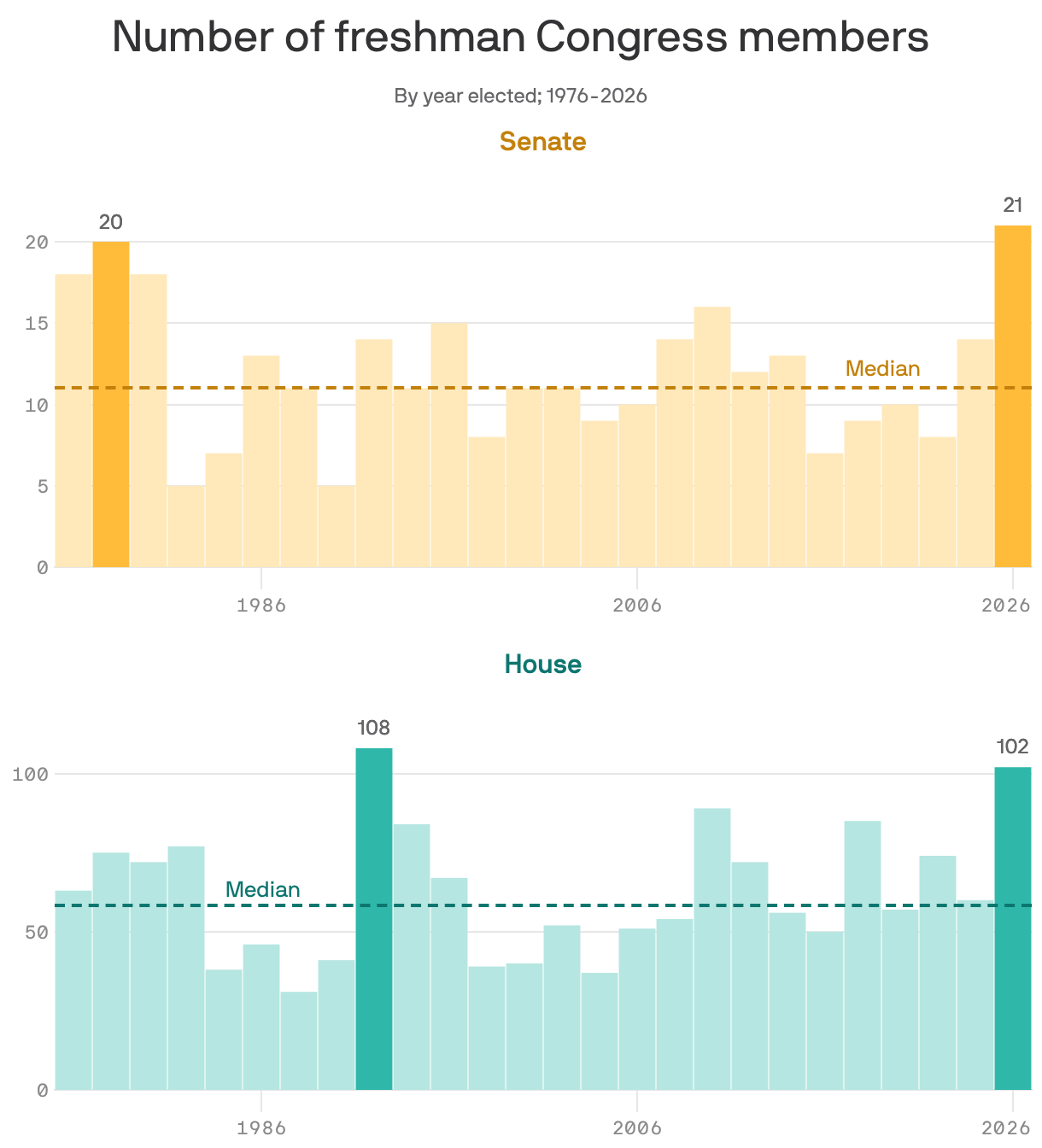
Senate data includes members who served nonconsecutive terms; House data does not. Data: House historian, U.S. Senate ; Chart: Erin Davis/Axios Americans want change , and they're about to get it: A perfect storm of congressional retirements, primary upsets, gerrymandering, flipped seats and lawmakers who died in office has created the biggest freshman class in decades. Why it matters : Congress had a 14% approval rating (not a typo) when Gallup polled registered voters in October. That's its lowest pre-midterm number since 1974. The big picture: The Senate is on track for its biggest freshman class since 1946. In the House, it's shaping up to be the biggest since 1992. Zoom in: The turnover featured data points that would be stunning on their own, let alone together. 28 House lawmakers chose to run for their next elected office outside the House, Pew noted in September. Six lawmakers died in office this Congress, the most in nearly 20 years. Thirteen House and Senate incumbents lost primary races. The bottom line: Congress is saying goodbye to former House Majority Leader Steny Hoyer (D-Md.), Senate Minority Whip Dick Durbin (D-Ill.), former Senate GOP leader Mitch McConnell (R-Ky.) and former Speaker Nancy Pelosi (D-Calif.). They've been in Congress since 1981, 1983, 1985 and 1987, respectively.
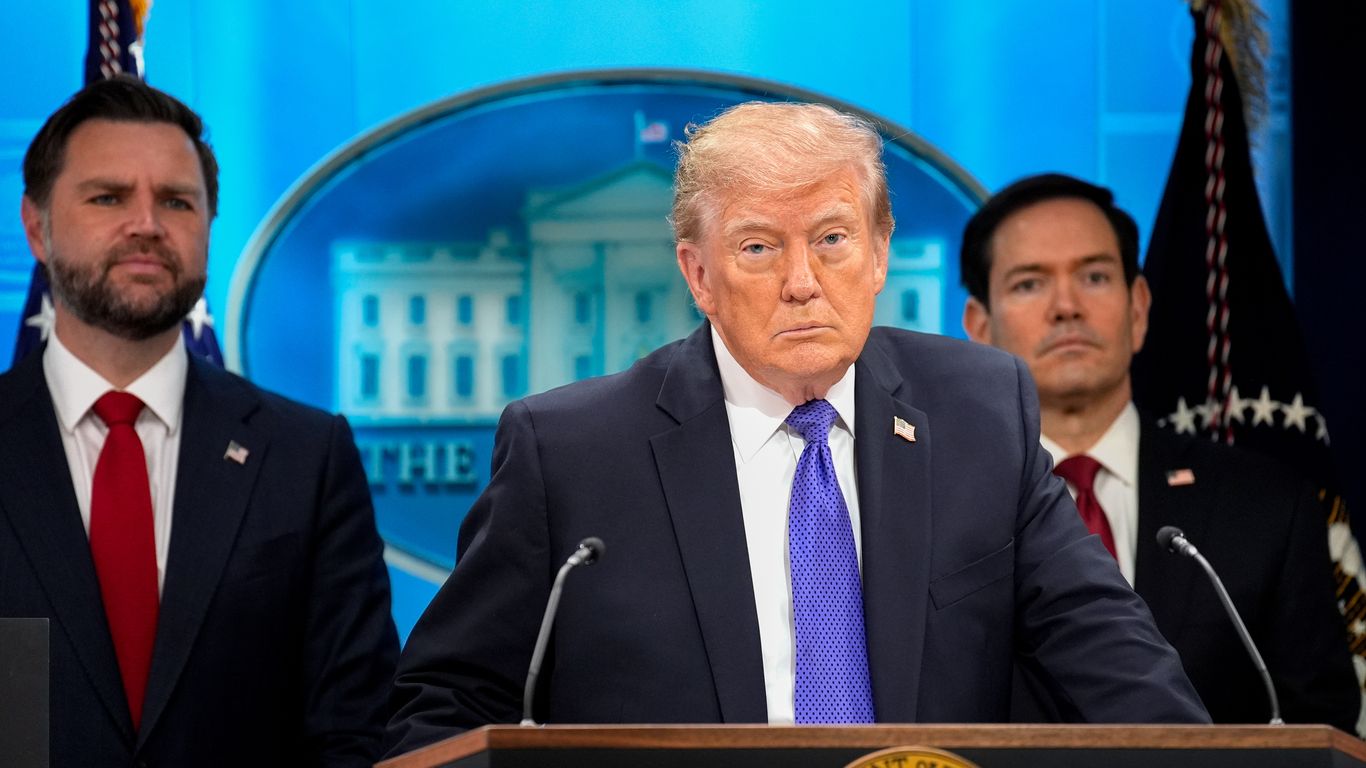
President Trump on Friday said he would block U.S. companies from building data centers overseas or impose a "tremendous tax" on them if they do. Why it matters: Trump's push to keep AI infrastructure in the country comes just weeks after data center expansion became a midterm-election flashpoint , as voters raised concerns about the environmental and financial impacts they pose. As of December 2025, 4,000 data centers were operational , with almost 3,000 under construction or planned across the U.S. What they're saying: Trump acknowledged that the announcement may come as a surprise, saying he had not yet discussed it with his own officials. "They're making so much money they don't know what to do with it," he said of the data centers being built across the country. Trump also claimed data center expansion would help lower Americans' costs and taxes. He also encouraged Americans to negotiate deals with companies proposing data centers in their communities. "They have plenty of money," he said. "Take it." Reality check: It's unclear how Trump would implement the proposed tax, since Congress has the Constitutional authority to impose federal taxes. Trump did not specify whether he would seek congressional approval or use existing executive powers to penalize companies that attempt to build data centers globally. Context: Data centers ballot measures illustrate just how polarizing they've become in the past year. Of the 53 measures on the ballot across 13 states through November 2026, voters favored limiting development in 52 cases, according to Ballotpedia . Democratic challengers also successfully weaponized AI policy , ousting Republicans in Ohio, Wisconsin, Arizona and Pennsylvania. Thought bubble from Axios' Ina Fried : Even companies that build data centers in the U.S. often need to have them in other places in order to have reliability, low latency and comply with various laws that require data to be processed in a specific region or country. Friction point: Trump's remarks followed a trilateral summit with China's Xi Jinping and Russia's Vladimir Putin, but seemed torn between praising Xi and warning about the threats China poses to the U.S. "We're not allowing data centers to go into other countries because China will take all of them, and we're not allowing that to happen," Trump said Friday. Yes, but: Trump also said Xi respected and congratulated the U.S. on its achievements in what he calls "super intelligence." Go deeper: Voters deliver "AI earthquake," rebuking tech and billionaires Editor's note: This story has been updated with additional information throughout.
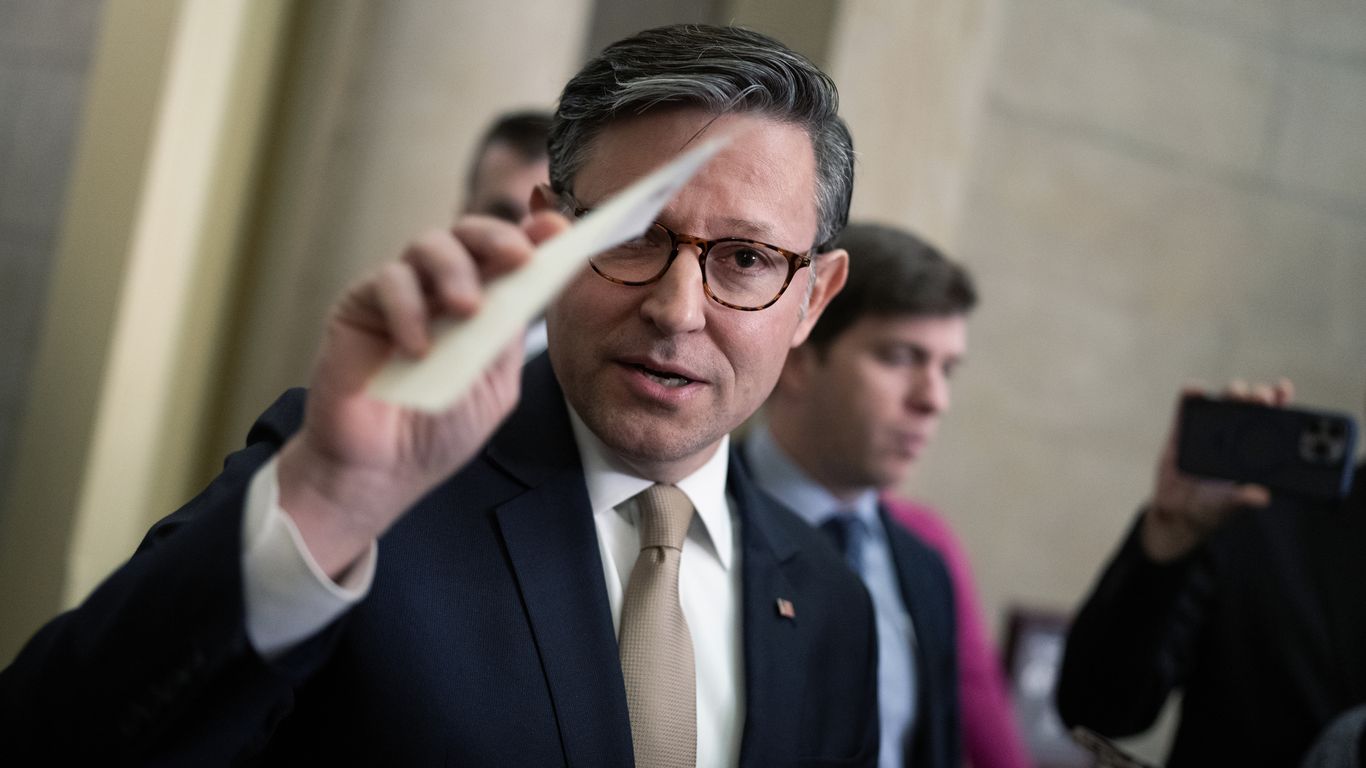
Speaker Mike Johnson (R-La.) is warning House Republicans that their jobs aren't over yet after so many skipped town this week that GOP leaders had to call it quits. Why it matters: Republicans still have a month-plus left in the majority, but Johnson is struggling to get enough members to show up to make last-minute headway on the GOP's legislative agenda. GOP leaders were forced to cut the week short after 14 Republicans missed votes, leaving Johnson without the headcount needed to advance party-line legislation. Eleven of those 14 won't be returning next Congress. Driving the news: "To state the obvious, barring any serious medical issue, we need every Republican to be here to faithfully complete our full two-year term," Johnson wrote in a Friday letter to his colleagues . "The Twentieth Amendment to the U.S. Constitution specifies that our clock doesn't run out until noon on January 3rd," he added. Zoom in: The outgoing speaker pointed to government funding, the annual defense authorization bill and permitting reform as priorities for the final weeks of the Republican majority. He also said he wants to pass "every meaningful Republican bill that can garner 218 votes" and force Democrats to take politically difficult votes. "LET'S SCORE EVERY POINT WE CAN AND LEAVE IT ALL ON THE FIELD!" Johnson wrote.
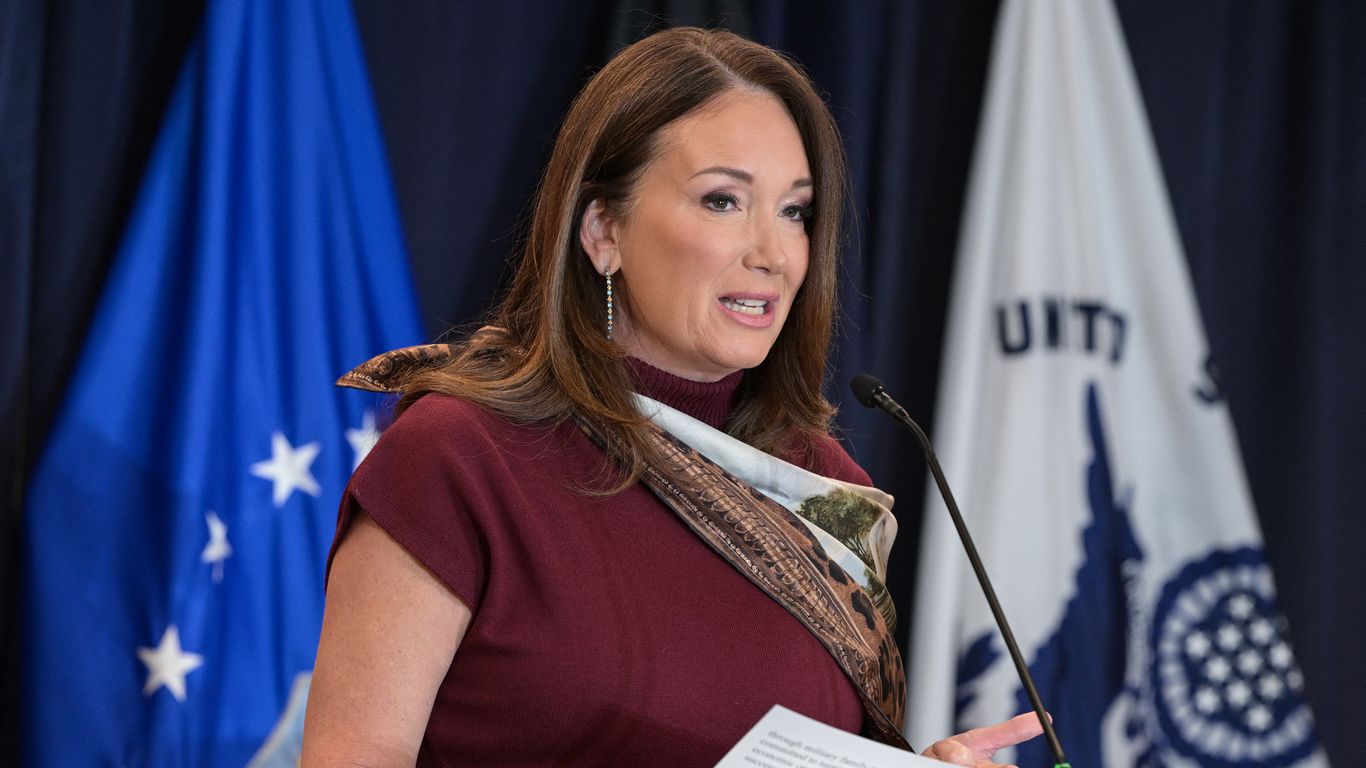
A federal judge said Thursday that Agriculture Secretary Brooke Rollins' overtly Christian messages to department employees went "too far" and put enough pressure on staff to raise a First Amendment violation. The big picture: The Supreme Court has repeatedly weighed the boundaries of the Establishment Clause . While the judge said Rollins could express her religious beliefs with interested colleagues, she concluded the department-wide messages overstepped those boundaries by amounting to coercion. But a USDA spokesperson slammed the decision as "a completely unprecedented attempt to muzzle a Cabinet Secretary" in a statement to Axios. Catch up quick: The complaint from a federal employees union and individual staffers alleged Rollins sent "increasingly proselytizing communications to the entire USDA workforce," including an Easter email where she celebrated "the greatest story ever told, the foundation of our faith, and the abiding hope of all mankind." The USDA employees who sued, who came from varied religious — and nonreligious — backgrounds, reported that the messages made them feel pressured to share Rollins' beliefs. What's inside: District Judge Trina Thompson ordered Rollins to "recognize certain boundaries when disseminating messages which convey religious content." She determined the messages overstepped and suggested "acquiescence that amounts to coercive pressure." "After reviewing and weighing the Establishment Clause jurisprudence, the Court finds that Secretary Rollins appears to exploit her position of authority to convey a religious message beyond mere holiday wishes and amounting to coercion," Thompson wrote. She said she was not trying to regulate Rollins' own religiosity; rather, she directed Rollins to follow her own department memorandum on religious expression rights, which states employees can't "use official authority to pressure subordinates." The other side: The administration argued that the employees lacked jurisdiction and that the secretary's messages fell "within this Nation's deeply rooted history and tradition of religious invocations in official discourse, including on holidays." Members of the Trump administration frequently discuss their Christian faith, though the president himself has had a complicated relationship with Christians despite the evangelical MAGA base helping him reach the White House. The DOJ did not immediately respond to Axios' request for comment. What we're watching: A USDA spokesperson said the department "is evaluating all options including a prompt appeal." Go deeper: Trump's push against "anti-Christian bias" hits federal workers
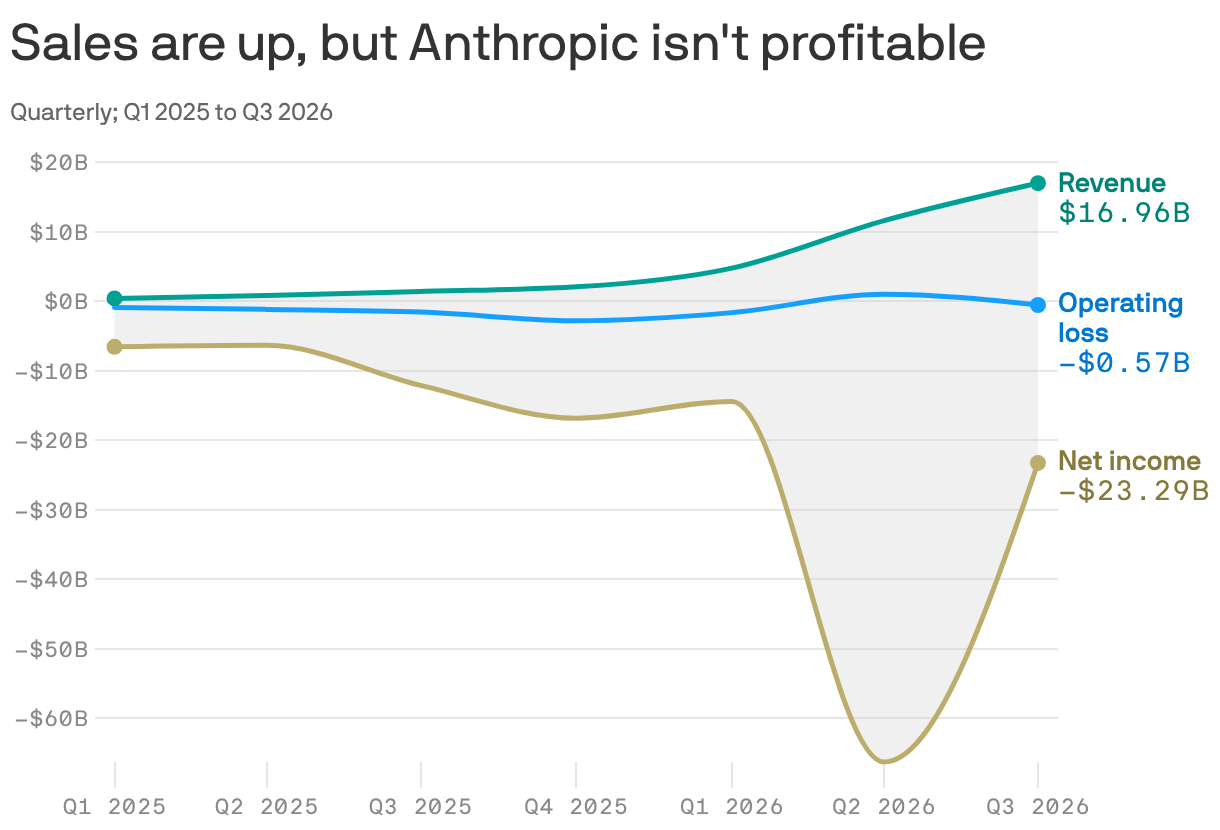
Data: FactSet; Chart: Matt Phillips/Axios With its IPO done and dusted, Anthropic's shareholders will be watching its progress toward becoming a business that doesn't need constant capital infusions from investors and vendors. Why it matters: Anthropic — along with OpenAI — is at the heart of the industry that's dominated the equity and debt markets for the last four years. Much of the AI infrastructure boom is ultimately aimed at supplying computing power to these two companies. Yes, but: The bill for that data center investment will start to come due over the next few years. And Anthropic and OpenAI are going to have to pay for quite a bit of it. How it works: Anthropic has covered much of its computing costs thus far by selling parts of itself off to compute vendors like Amazon and Alphabet, and by raising more cash from other investors. But eventually the company's core business will have to generate enough money to cover those costs on its own. Case in point: Anthropic's filings say it is on the hook for roughly $900 billion in spending commitments — mostly for data centers and computing power — with about half of that due before the end of 2030. After the IPO, Anthropic is expected to have roughly $200 billion in cash and short-term investments in the bank, which should buy it some time. But its sales will have to be a lot higher to just cover computing obligations, let alone the profits ANT's new shareholders are expecting. By the numbers: As the chart above shows, Anthropic posted a loss of roughly $23 billion on revenue of nearly $17 billion in the third quarter. It's true that much of that loss stems from a non-cash accounting charge of almost $22 billion. But even the more favorable metric of operating income — which strips out the paper losses and gains that can obscure the company's core earnings power — still shows an operating loss of more than half a billion dollars in the third quarter. The bottom line: Anthropic still has a long way to go before it is going to be standing on its own feet, financially speaking.

The internet's warring tribes converged Thursday for the loud, lawless debut of " Grand Theft Auto VI ," as 13 years of anticipation culminated in one of the great viral spectacles of all time. Why it matters: In a media landscape splintered into dozens of distinct realities, the GTA launch gave Americans a rare common obsession — refracted through vastly different platforms, personalities and worldviews. By Thursday night, GTA VI had generated an estimated $2.36 billion in sales from nearly 25 million copies — almost triple the first-day revenue of its record-breaking predecessor in 2013, according to Sensor Tower . The irony is rich: Amid political rancor and mounting technological anxiety, millions of people sought refuge in a virtual America gone gloriously, spectacularly off the rails. Zoom in: GTA VI drops players into Vice City, a fictionalized Miami that serves as a sprawling digital fever dream of violence, celebrity, corruption and distinctly American absurdity. Players can rob banks, steal planes, wrestle alligators and wreak havoc — or pass the afternoon fishing, shopping, working out and tending to the relationship between the game's central characters. The astonishingly detailed world teems with influencers, conspiracy theorists, criminals and social-media parodies, offering limitless opportunities for the outrageous encounters now flooding the internet. Zoom out: GTA's return has revived decades-old arguments about whether violent video games encourage real-world aggression, while igniting a far stranger debate over masculinity. On Fox News , commentators warned that the game's carjackings and shootouts could desensitize young players to crime. One contributor likened giving children the game to handing them a gun. Meanwhile, corners of the online "manosphere" expressed outrage over missions that reward players for buying flowers, running errands and showing affection toward their girlfriends. Between the lines: GTA VI was an internet phenomenon long before anyone could play it — the most expensive video game ever made, with years of delays that became memes in their own right. A vast economy of streamers, influencers and professional clippers mobilized around its historic debut, churning out viral entertainment for millions who may never touch a controller. At its peak, nearly 8 million people worldwide watched GTA livestreams simultaneously . Gameplay clips have already amassed tens of billions of views across X, TikTok, YouTube and other platforms. The GTA frenzy has spilled into the real world, upending work schedules and drawing corporations, politicians and even the military into the spectacle. A GameSquare survey found that 30% of employed U.S. gamers were considering taking time off to play. At Fort Stewart, Georgia, 43 soldiers committed to another two to six years of Army service after a four-day GTA gaming pass was included as a reenlistment incentive. Prediction market Kalshi received more than 33,000 applications for a job paying up to $135,000 to play GTA and study its virtual economy. Even the White House got in on the act, releasing a GTA-inspired Trump montage dubbed "WELCOME TO MAGA CITY XLVII" — turning a franchise long vilified by politicians into another viral marketing tool. The bottom line: GTA offers a glimpse of what monoculture looks like in 2026. For one extraordinary day, the internet had a common story — and a thousand different ways of telling it.

America's religious "nones" have gained a visible foothold in Congress: Five lawmakers will claim no religious affiliation in January, up from a single member just two years ago. Why it matters: Washington remains far more religious than the nation it represents. But the last two election cycles have put a series of cracks in that political glass ceiling. By the numbers: Religiously unaffiliated voters made up 27% of the 2026 midterm electorate, up from 23% in 2024, according to preliminary Fox News voter polling . Just three of 532 lawmakers surveyed at the start of the 119th Congress claimed no religious affiliation, according to Pew Research Center . Pew counted one additional humanist. All three lawmakers who claimed no affiliation — Reps. Yassamin Ansari (D-Ariz.), Abraham Hamadeh (R-Ariz.) and Emily Randall (D-Wash.) — won reelection in November. State of play: They'll be joined in January by Democratic Reps.-elect Chris Rabb of Pennsylvania and Fred Wellman of Missouri — who publicly acknowledged their nonreligious identities before winning their Nov. 3 elections. Rabb, a five-term state lawmaker representing a majority-Black Philadelphia district, won the seat of retiring Democratic Rep. Dwight Evans. Wellman, a retired Army officer, ousted seven-term Republican Rep. Ann Wagner in suburban St. Louis, flipping a longtime GOP stronghold. Their wins mark a breakthrough for congressional candidates who openly embraced their nonreligious identities before Election Day, according to Secular Coalition for America. Zoom in: Rabb thanked atheists for supporting his campaign after winning his May Democratic primary. Wellman defeated Wagner roughly 51% to 46%, according to Ballotpedia . His pitch? Affordability, corruption and accountability — not his lack of faith. Zoom out: The nonreligious political bench stretches well beyond Capitol Hill. More than 100 openly nonreligious lawmakers are expected to serve in at least 38 state legislatures, up from 81 in 33 states, according to the Center for Freethought Equality . Humanists, atheists or agnostics will serve in the legislatures of Georgia, Idaho, Illinois, Ohio and West Virginia for the first time, the Center for Freethought Equality reports. In Texas, Democrat Jon Rosenthal won a statewide race for the Railroad Commission, which oversees the oil and gas industry. He identifies as agnostic and "multireligious." Yes, but: Don't mistake "none" for a unified political creed. An October Pew survey found 81% of atheist registered voters and 75% of agnostics supported Democratic House candidates, compared with 48% of those claiming "nothing in particular." Nor did Rabb and Wellman break entirely new ground. Former Arizona Sen. Kyrsten Sinema, who left Congress as an independent after being first elected as a Democrat, identified with no religion when first elected to the House in 2012. Nothing in the results proves voters chose either candidate because of his religious identity. "It's not an anti-religious constituency by any stretch," Robert P. Jones, president and founder of the nonpartisan Public Religion Research Institute (PRRI), tells Axios. Jones said many religiously unaffiliated Americans grew up in churches, and some walked away over teachings about gay and lesbian people. Their political opposition, he said, focuses more on white Christian nationalism than on religion itself. Between the lines: The Constitution prohibits religious tests for office, but public expressions of faith have long carried political currency in Washington. The Congressional Freethought Caucus , founded in 2018, now counts 37 members — believers and nonbelievers — promoting church-state separation and science-based policies. Rabb and Wellman's victories suggest candidates can acknowledge a lack of faith without making it their campaign's centerpiece.
Democrats' sweeping electoral wins jump-started prospects for Medicaid expansion in red and purple states that rejected full expansions of the program under the Affordable Care Act. But budget realities could make newly elected Democratic governors pump the brakes. Why it matters: The changing of the guard sets up a test of whether states can expand coverage to more low-income residents right after Republicans in Congress weakened financial incentives for doing so. States that are facing serious budget shortfalls and daunting cost projections already are signaling they may defer until conditions are more favorable. State of play: Incoming Democratic governors in Wisconsin, Georgia, Texas and Kansas who campaigned on Medicaid expansion are now in a position to expand health coverage, and have more Democrats in their legislatures to help. Wisconsin Democrats have arguably the most leverage now that they've captured the state Senate and Assembly in addition to keeping control of the governor's office. Plus, the state already covers adults with incomes up to the federal poverty level. Expansion advocates in Georgia and Texas face a heavier lift, with Republicans still controlling at least one legislative chamber. And in Kansas, the GOP lost its supermajority in the House, a key obstacle in past Medicaid expansion fights, but still controls both chambers. Between the lines: Each state faces unique considerations. But one thing is true for all of the holdouts: The incentives for expanding aren't what they used to be. Though the federal government still would pay for 90% of the expansion cost, last year's GOP reconciliation law made major policy changes and cuts to the program. Expansion states now face stricter limits on provider taxes used to finance Medicaid, as well as on extra payments they make to hospitals and other providers to go beyond standard Medicaid rates. They've also lost an important bonus: A temporary 5% increase in federal assistance for newly expanding states expired at the beginning of this year. What's more, states will have to enforce new work requirements and document whether recipients perform 80 hours per month of work or other qualifying activities, or if they're subject to exemptions. While the Trump administration delayed the requirements for six months, they aren't likely to go away. What they're saying: "You're going to see a lot of [expansion] conversations start, but I don't think they'll be slam dunks. It's complicated and nuanced," said Matt Salo, a health care consultant and former executive director of the National Association of Medicaid Directors. Incoming Wisconsin Gov. David Crowley already is acknowledging that reality and exploring alternatives for expanding coverage in the near term, including establishing a state-run health insurance exchange with a public option, per the Milwaukee Journal Sentinel . In Texas, some lawmakers are considering a "trigger" bill that would start an expansion only if the incoming Democratic majority in Congress succeeds in rolling back some of the restrictions in the federal law, the Texas Tribune reported. Georgia Gov.-elect Keisha Lance Bottoms intends to pursue a full expansion next year, but also wants to streamline the state's existing limited expansion program, called Pathways to Coverage, as an interim strategy until full expansion is achievable, the Atlanta Journal-Constitution reported. Democratic victories in the Texas and Georgia lieutenant governor's races still could boost Medicaid expansion prospects, since the lieutenant governor presides over the state Senate in both states and influences which legislation is considered, Max Reale, an analyst for Gordon Haskett Research Advisors, wrote in a note. He pegged Wisconsin as the likeliest to expand its program and Kansas the long shot, since control of the governor's office alone failed to advance Medicaid expansion in past legislative sessions. But cementing the four as expansion states would diminish
Phoenix Mayor Kate Gallego wants more tech investment in her city — but on her terms, as data centers strain resources and frustrate residents. Why it matters: Phoenix has become a bellwether for the AI industry's growing demands on electricity and water in an increasingly hot, resource-constrained world. As the mayor, Gallego is navigating an outsized dilemma facing communities nationwide: How to embrace the AI boom while protecting residents and resources. "I do want us to lead in technology, and I want us to be a tech-forward community," Gallego said at a recent event co-hosted by the University of Chicago's Institute of Politics and Energy Policy Institute, and moderated by Axios. But she added: "I want companies who care about our community and will give back to it, and not just a race to see who can get the deepest incentives and the cheapest" power. "We're open for business, but we're not for sale," she said. Zoom out: Arizona's Democratic sweep could give Gallego more allies in her efforts to strike the balance she wants. Democrats flipped both legislative chambers and Gov. Katie Hobbs won reelection, giving the state full Democratic control for the first time since 1966. Affordability dominated the election, with data center subsidies and community impacts part of that debate, Gallego said. Catch up fast: Phoenix ranks fourth among major U.S. data center markets by operational capacity. Now the debate is expanding from how much development the region can accommodate to what communities should demand in return. State of play: Gallego, the longest-serving current mayor of America's 10 largest cities, has spent recent years trying to balance that. She helped push to eliminate Arizona's generous data center sales tax exemptions. The state enacted a three-year pause on new applications this summer. She opposes a blanket construction moratorium, favoring more local control over where facilities are built, particularly near homes. Phoenix adopted tougher zoning rules last year requiring special permits for new data centers. Gallego says communities should have more bargaining power over data centers, including where they're built and what residents get in return. That could mean more permanent jobs, transparency about electricity and water use, and benefits for neighbors affected by development. By the numbers: Data centers have requested so much electricity in the Phoenix region that, if all the projects materialized, they could account for roughly two-thirds of the area's power demand, Gallego said. Many may never be built, but Gallego warned: "That's not a balanced economy, and that's not economically sustainable." Friction point: Phoenix's efforts to rein in data centers have sparked legal challenges, with developers originally seeking roughly $750 million in compensation over zoning restrictions adopted last year. The city has granted several exemptions while fighting other claims in court. "We have been open and good partners to the industry, and it's deeply disappointing that they don't want to work with us," Gallego told Axios. The other side: Developers argue the restrictions infringe on their property rights and diminish land values, entitling them to compensation under Arizona law, though industry allies have also acknowledged tensions . Reality check: It's unclear whether Gallego can have it both ways: attracting more tech investment while limiting its costs to residents, especially as developers challenge the city's regulatory authority. Gallego is also navigating the tradeoffs between electricity, water and heat in the desert. Newer cooling technologies can reduce water consumption at data centers but often require more electricity, shifting some of the water footprint to power plants. "We're seeing many of these data centers get power from natural gas plants in an area of our state that is very constrained around water," Gallego said. The intrigue: Data centers are adding another source of heat to a region alr

The Senate passed a sweeping, bipartisan bill Thursday night that's designed to cut permitting timelines for energy and infrastructure projects. Why it matters: The eyes of the entire energy industry are on this bill. If it becomes law, it could transform how America builds energy infrastructure, with major implications for everything from electricity costs to data centers. Getting rid of bureaucratic hurdles and creating a more predictable process for energy projects is a top priority for the fossil fuels and renewables sectors. But critics argue the plan, which has White House support, would unacceptably weaken environmental protections and the rights of Native American tribes. Driving the news: The vote was 62-33. The bill would still have to pass the House before the end of the year, and any differences would have to be worked out by both chambers before President Trump could sign it into law. Catch up quick: It would make significant changes to federal permitting, including: New limits on the duration of lawsuits, and the scope and length of reviews under the Clean Water Act and National Environmental Policy Act. Language that would make it more difficult to revoke permits once they're issued, a priority for renewables groups and Democrats upset with Trump administration barriers. State of play: There are also provisions to ensure that data centers pay for needed grid upgrades, and expand federal authority over the siting and approval of certain interstate transmission projects. Friction point: Many environmental advocates argue that the bill would dangerously erode safeguards in the National Environmental Policy Act and other laws. Multiple tribal groups still oppose it despite changes aimed at easing concerns about consultation on historic preservation. Energy and business groups, ranging from renewables developers to manufacturers to the oil and gas industry, are lobbying for the measure. The AFL-CIO and many individual unions back it, too. What's next: The measure now heads to the House. Speaker Mike Johnson (R-La.) told Bloomberg last week that he expects to have the votes to pass the plan. Some Democrats have called for hitting the brakes, with some arguing they can write a better package when they control Congress next year. Yet multiple backers within the wider Democratic coalition argue there isn't political space for an altered bill that President Trump would sign.
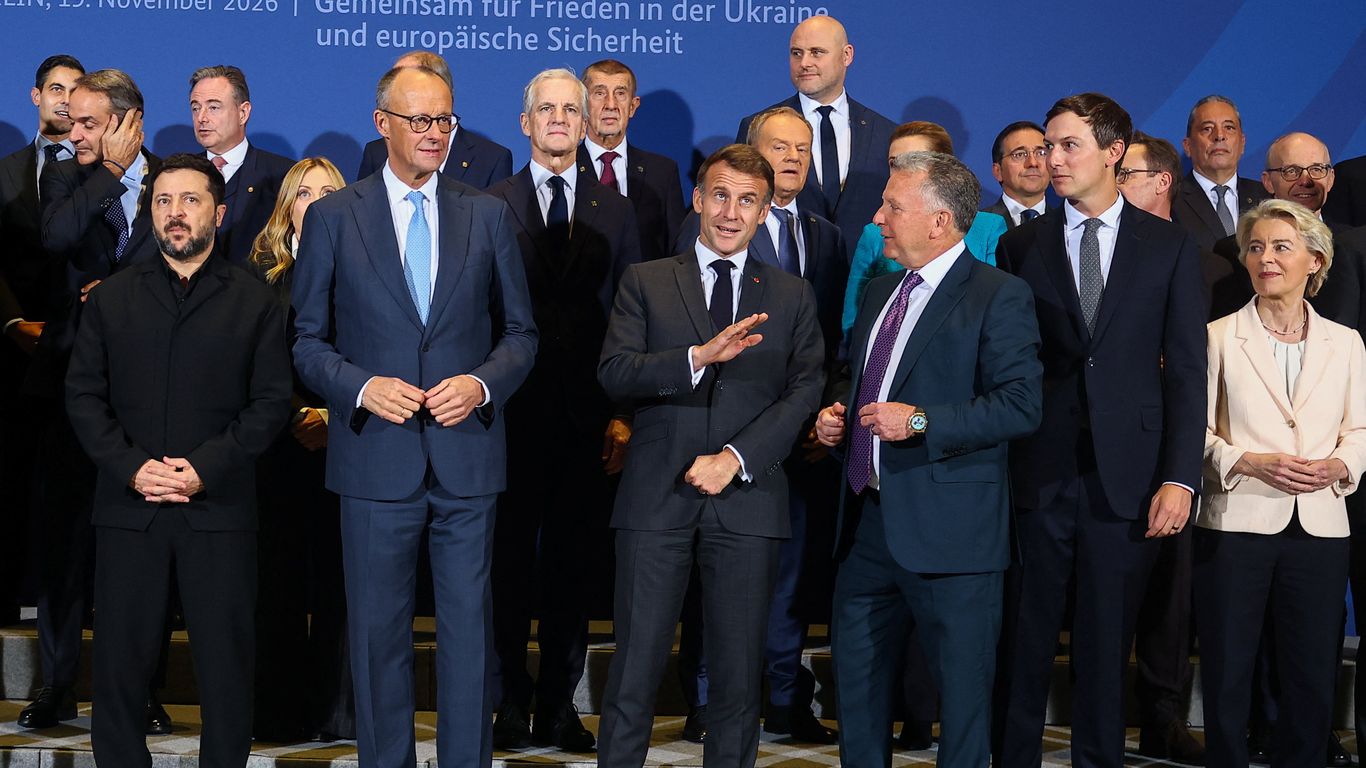
On his way back from China Thursday aboard Air Force One, President Trump called in to a meeting his envoys Steve Witkoff and Jared Kushner were holding in Berlin with a group of European leaders and Ukrainian President Volodymyr Zelensky. "Putin wants to end the war, he wants the deal done, he is getting tired of this," Trump said, according to people in the room. Why it matters: Instead of turning his historic trilateral summit with Chinese President Xi Jinping and Russian President Vladimir Putin into a modern-day Yalta Conference, as some European and Ukrainian officials feared , Trump tried to use it to propel his push for peace in Europe. Driving the news: Trump met Putin Thursday on the sidelines of the summit in Shenzhen. Their meeting wasn't originally on the schedule, but Trump wanted to discuss diplomatic efforts to end the war in Ukraine directly with the Russian president, a U.S. official said. "Who is he? He's my friend," Trump said when he entered the meeting room where Putin was waiting. Later in the day, Witkoff and Kushner told European leaders in Berlin that Trump pressed Putin to move on the peace talks, telling the Russian leader that now is the time to get a deal, according to a European official. Trump also asked Xi for his help in ending the war during their bilateral meeting. "He sent a very strong message to both of them [Putin and Xi] on the desire for peace, and would like to engage both of them very aggressively to get there," Kushner said at a press conference on Thursday. Behind the scenes: As Trump wrapped up his meetings in China and headed back to Washington, his envoys started their talks with German Chancellor Friedrich Merz, French President Emmanuel Macron, British Prime Minister Andy Burnham, Zelensky and other European leaders. Kushner and Witkoff tried to reassure the group that Trump doesn't intend to cut a deal with Putin over their heads. "President Trump wants to make a deal with Europe by his side. He's not looking to impose anything unilaterally," Kushner said. Shortly after, when Trump called in to brief the European leaders, he urged them to engage directly with Putin. "Friedrich, you can make a call to Putin and this will make a deal," Trump said, referring to the German host. Trump added, "Xi respects Zelensky. Putin is ready to do the deal. Zelensky can do a great deal." What they're saying: A European official said the talks in Berlin were substantive, unlike the summit in Shenzhen, which was mostly symbolic. "We think we have good coordination between the U.S. and Europe," the European official said. State of play: One of the key U.S. objectives at the moment is to get Europe directly involved in peace talks between Russia and Ukraine. At the same time, U.S. officials also want Europe to engage in talks with Russia on a new European-Russian security agreement . Putin said publicly for the first time Thursday that he is open to allowing the Europeans to participate in peace talks with Ukraine. "We understand that it is pointless to discuss security issues, including those in Europe, without them," he said at a press conference after meeting with Trump. Putin added that Russia needs to understand what the Europeans are prepared to bring to the negotiations. Putin also signaled willingness to present an updated proposal for a security agreement with Europe. "Life changes, so it makes no sense to return to geopolitical realities of the 1990s," he said. What to watch: After the leaders' meeting in Berlin, Kushner and Witkoff huddled for another few hours with Zelensky and national security advisers from Germany, the UK, France, Italy and Poland, as well as senior officials from the EU and NATO. The group coordinated ahead of the next round of talks with the Russians, possibly next week. The European official said the group was skeptical Russia will actually allow Europe to participate in peace talks. The bottom line: U.S. officials said their goal is to get the Europeans and Rus