Problem
We can't find the internet
Attempting to reconnect

Washington Governor Bob Ferguson and other officials in the state have denounced the violent arrest of a father and daughter by ICE agents on Saturday as they were boarding a flight at Seattle-Tacoma International Airport. Video of the arrest shows masked plainclothes agents dragging a woman off the jetway as she screams for help. Both Alaska Airlines and the Port of Seattle said ICE carried out the operation without their knowledge. ICE said Ricardo Larrondo Mendoza, originally from Mexico, was targeted for overstaying his tourist visa, and that his daughter, Sofia Hernandez Mejia, would be charged with assault for allegedly throwing hot coffee at an agent — although witnesses dispute that account. “This is one of, unfortunately, many thousands of detentions that is happening not only in Washington state, but across the country,” says Josefina Mora-Cheung, director of organizing for the immigrant justice group La Resistencia. “The only path forward is to abolish ICE .”

Nvidia stock prices surged over 30% on Monday as the chip maker reinstated Jensen Huang as CEO . Huang had stepped down earlier in November amid reports he had multiple extramarital affairs, including with a woman accused of spying for China. Huang and Nvidia have been central to the AI boom, and the leadership turmoil had erased trillions in value from the U.S. stock market. President Donald Trump acknowledged he had encouraged the company’s board to bring Huang back. “The fact that our markets are so over-indexed on the AI trade, that something like three-fourths of gains in the [S&P 500] this past year have been AI-related, is unsustainable,” says Aya Ibrahim, senior fellow for economic and national security at the AI Now Institute. We also speak with organizer and researcher Tobita Chow, who says Huang’s “spy scandal” that led to his ouster is part of a larger effort by anti-China figures in the U.S. national security establishment to escalate tensions between the countries. “The national security leadership in both parties in D.C. has been greatly frustrated with President Trump, who has over the past year pursued policies to maintain very warm relations with Xi Jinping,” says Chow, who notes that Secretary of State Marco Rubio is one of the “chief” frustrated China hawks in the administration.

Nvidia Reinstates Jensen Huang as CEO After Trump Intervenes, Trump’s Stake in Nvidia Grows by Up to $15 Million as Stock Price Soars on Jensen Huang’s Return, Analysis Estimates More Than 700,000 Russian Soldiers Have Died Fighting in Ukraine, UNICEF Says Russian Attacks Are Killing Three Children, on Average, Each Day in Ukraine, Russia Threatens “Open War” with Estonia, a Former Soviet Republic Turned NATO Member, Rapid Support Forces Launch Drone Attack on Sudan’s Capital as Electrical Grid Nears Collapse, Yemen’s Houthis Say 41 Civilians Are Killed in Saudi Attacks Using U.S. Arms, Oxfam Report Finds Israel’s Military Assault “Has Turned Gaza into a Toxic Wasteland”, Lebanese Immigrants Are Set to Lose Protected Status in U.S., Despite Ongoing Israeli Assault, Mexico to Try Alleged Drug Kingpin “El Chapo Isidro” After Denying U.S. Extradition Request, Alarm Grows over U.S. Army Plan to Explode Lead-Containing Munitions on Wednesday, Pete Hegseth Faces Call to Resign from His Former Chief of Staff , Jimmy Gomez Quits Congress as Ethics Committee Finds Evidence of “Unwelcome Sexual Conduct”, JD Vance Faces Senate Scrutiny for Allegedly Helping Campaign Donor Secure Venezuelan Oil Licenses
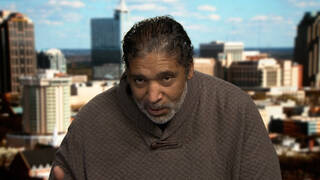
With Democrats preparing to take control of both houses of Congress in January, Bishop William Barber of Repairers of the Breach argues the coalition that delivered the Democrats their midterm victories must now hold the incoming Congress accountable and keep organizing from the ground up. He and other faith leaders are calling on members of the incoming Congress to join them outside the U.S. Capitol next month to sign “A Pledge for Moral Defiance” — a commitment to pass legislation that addresses the needs of poor and working people and other vulnerable communities. Barber is pushing for what he describes as a Third Reconstruction: a sweeping moral and political agenda that includes a living wage, universal healthcare, protecting voting rights, affordable housing, environmental justice and comprehensive immigration reform. “This was a vote not for Democrats,” says Barber. “It was a vote to say, 'Will you use policy to answer the pain that we are experiencing in this country at this particular moment?'”
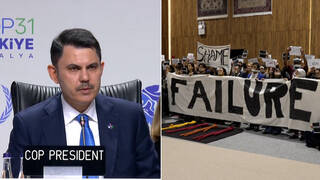
The United Nations climate summit in Turkey, known as COP31, collapsed on Sunday after nations failed to reach an agreement on a new climate deal. A number of countries opposed the final draft because it made no mention of fossil fuels. Many poorer countries also objected to the lack of financial commitments from richer nations to assist them in adapting to the climate crisis. “This is not about the Global South begging for assistance and help,” says Filipino climate activist Lidy Nacpil. “The principle is that [wealthy nations] have created this problem, and they have to contribute to the solutions.” “What we’ve seen over the past decades is the Global North are not delivering on any of their responsibilities,” says Brandon Wu, director of policy and campaigns at ActionAid USA . “That’s what’s causing the deadlock. It’s not new to this COP , but it’s becoming increasingly untenable.” We also speak with two other leading climate justice advocates who attended COP31, Tasneem Essop of Climate Action Network International and Kathy Jetn̄il-Kijiner, climate envoy of the Marshall Islands.
U.N. Climate Summit Collapses After Countries Fail to Agree to Phase Out Coal, Oil and Gas, Three More Ships Are Struck Amid Record Pace of Attacks in Strait of Hormuz, Student-Led Protests Sweep Europe, Demanding Higher Wages, Lower Rents and Better Schools, Israeli Attacks on Gaza Kill Palestinians Delivering Aid and Worker with U.N. Agency, Israeli Settlers Attack Palestinian Villages, Setting Fires and Spray-Painting Racist Graffiti, Outcry Erupts as Video Shows ICE Agents Arresting Father and Daughter at Seattle Airport, Internal Report Concludes ICE Went Too Far in Loosening Training Standards for New Recruits, Ukraine Sinks Russian Warship Docked in Libya as Russian Strikes Kill Civilians, Spain Frees Pro-Palestinan Activist James “Fergie” Chambers on Bail After U.S.-Backed Arrest, Delta Delays 1,300 Flights Due to Tech Failure, FBI Probes Apparent Breach of Criminal Information Database, Democrats’ House Majority Swells to 259 as Chuck Hubbard Defeats 11-Term GOP Rep. Virginia Foxx, Army Plans “Controlled Detonation” of Toxic Material at Iowa Ammunition Plant, Despite Court Order, New York Mayor Zohran Mamdani Unveils Plan to Close Rikers Island Jail by 2032
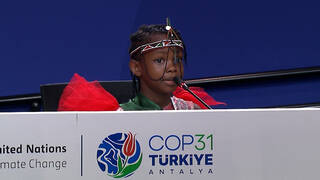
At the U.N. climate summit in Antalya, Turkey, Little Miss Environment Kenya 2026, Marren Akeyo, addressed world leaders on their responsibility to take real action to stop climate change. “Climate change does not ask for your birth certificate before affecting you. So, why should we wait until we’re adults to protect our planet?” said 8-year-old Akeyo. “We are ready to grow food. We are ready to take care of our planet. But we need you to give us opportunities. Don’t just tell us, ’You’re the leaders of tomorrow.’ Let us lead something today. Start with what you have.”

In our closing broadcast from Antalya, Turkey, the site of the 31st annual U.N. climate change summit, we take a look at what has — and hasn’t — been accomplished at this latest attempt to reach an international framework to stem the impacts of climate change. “This COP was being touted as a COP of implementation, but what it has become is a COP of betrayal and a COP of distraction,” laments environmental justice advocate Harjeet Singh, the founding director of India’s Satat Sampada Climate Foundation. He’s joined on Democracy Now! by Meena Raman of Friends of the Earth Malaysia and Nafkote Dabi of Oxfam International as a number of NGOs announce their rejection of the conference’s final declaration text, which contains no mentions of fossil fuels or clear financial commitments from polluter countries. “At the heart of the negotiations right now lies money,” says Dabi. “What rich countries, especially the EU, [are] saying is, 'There is no money at home.' But we know there’s money. They can tax the richest. They can tax the excess profit of fossil fuel companies. They can tax private jets. They can tax extreme wealth and raise the funds that’s needed to support communities.”
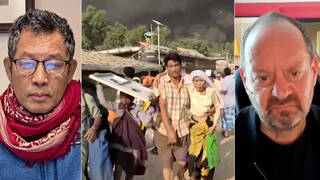
The world’s top court has ruled that Myanmar committed genocide against the country’s Rohingya Muslim minority in a 2017 military crackdown that killed about 10,000 people and drove more than 730,000 refugees into Bangladesh. The landmark ruling is the first time the International Court of Justice has held a nation directly responsible for violating the 1948 Genocide Convention. “This is a vindication of what Rohingyas have been saying for the last almost 50 years, since 1978, when the first wave of genocidal expulsion was conducted by the very same perpetrating institution,” says Burmese dissident scholar Maung Zarni. By recognizing Myanmar’s “identity-based group destruction” of the Royinghas, he says, “the court vindicated [the] Rohingya’s collective articulation, memory and suffering.” “For the first time in its history, the court has set up a process for restitution and reparation for the members of the Rohingya community,” explains Philippe Sands, an international human rights lawyer who served on the legal team for The Gambia, which first brought the legal case against Myanmar to the ICJ six years ago. Sands discusses next steps for restitution and reparations to Rohingya victims, as well as what the Myanmar judgment means for South Africa’s genocide case against Israel, also before the ICJ .
Senate Rejects War Powers Resolution to Limit Trump’s Attacks on Iran, Senate Passes Permitting Reform Bill with Support of 14 Democrats, Including Leader Chuck Schumer, Climate Activists Condemn “Slimmed-Down” COP31 Draft Text That Makes No Reference to Fossil Fuels, Russian Attacks Kill 8 After Ukraine Bombs Bridge Connecting Russia to Occupied Crimea, Charity Warns Record High 1 in 4 Children Now Live in Conflict Zones, 11-Year-Old Palestinian Boy Dies of Wounds Amid Relentless Israeli Attacks on Gaza, Somali American Driver Is Assaulted After Trump Calls on Minnesotans to “Fight Back” Against Somalis, “A Mockery of Court Orders”: Federal Judge Holds ICE in Contempt for Rearresting Immigrants, U.S. Appeals Court Freezes Deportation Protections for Venezuelan Immigrants, Texas Death Row Prisoner Reinaldo Dennes Cries Out in Pain During Botched Execution, Florida Carries Out 20th Execution This Year, a Record Pace, White House Taps GOP Operative and Lobbyist Eric Ueland to Lead Government Accountability Office, Journalist Camilo Rodríquez, Who Exposed Costa Rican Politicians’ Drug Trafficking Ties, Is Murdered
Human rights and climate groups are calling on Russia to release two prominent activists, Daria Egereva and Natalia Leongardt, who have been held in pretrial detention in Moscow for nearly a year, since December 2025. Egereva, a leading Indigenous rights activist in Russia, was arrested shortly after attending the COP30 United Nations climate summit in Belém, Brazil, where she served as co-chair of the International Indigenous Peoples Forum on Climate Change. Leongardt has worked for decades to support Indigenous rights. “Right now all we are demanding is the release of Daria and Natalia, because they shouldn’t be in prison. You shouldn’t be arrested for activism,” says Viktor Suliandziga-Bagat, an Indigenous rights activist and representative of the Udege people from the Russian Far East. He is living in exile due to the risk against activists. “I don’t think I can come back to Russia,” he says.

Democrat Mary Peltola was declared the winner this week of Alaska’s closely watched race for U.S. Senate, making her the first Alaska Native lawmaker elected to the upper chamber of Congress. At the COP31 climate conference in Turkey, we speak with Aakaluk Adrienne Blatchford, an Inupiaq and Yup’ik organizer from Unalakleet, Alaska. She says Peltola’s win is a significant milestone for Indigenous peoples in Alaska. “Having somebody represent us in such a large capacity with such a big weight on her shoulders, but still carrying that struggle with her as she continues to advocate for our people and our way of life, is monumental,” says Blatchford.
As we continue our week of broadcasts from the global United Nations climate conference known as COP31, we get an update on the formal negotiations from German activist Luisa Neubauer. The latest draft text of the key climate commitments that countries are debating has dropped language about phasing out fossil fuels, but it does include an emphasis on carbon capture and storage — a largely unproven technology that critics say cannot be deployed at scale to curb emissions. “We have much better solutions at hand, like renewables,” says Neubauer. “This is not going well. We are not doing fine. And if anything, after this conference ends, we need people to take the streets and fight for more justice out there.”

Chinese President Xi Jinping hosted his U.S. and Russian counterparts for a historic trilateral summit on Thursday, with the leaders of the three biggest nuclear superpowers meeting for about 90 minutes in Shenzhen. Afterward, the countries published a “peace declaration” that affirmed “nuclear war cannot be won and must never be fought.” The declaration also announced a commitment to increase petroleum production, called for reforms at the United Nations and urged the International Criminal Court and similar bodies to “not abuse their jurisdiction.” While in China, President Donald Trump also had a separate meeting with President Vladimir Putin to discuss the war in Ukraine, though it’s unclear if they made any progress. “It’s a significant post-1945 moment, which was the last time that we had great summits,” says Scott Lucas, professor of international politics at University College Dublin. “What is the most important takeaway … is an ascendant China. It was China that really set the terms of what was said.”
Trump Blasts ICC , Praises Presidents Xi and Putin at Unprecedented Trilateral Summit, Democrats Nominate Hakeem Jeffries for Speaker as Progressives Dissent on Healthcare, Gaza and ICE , Israeli Tanks and Bulldozers Push Past Gaza’s “Yellow Line,” Further Displacing Palestinians, Israel Extends “Administrative Detention” of Gaza Hospital Director Dr. Hussam Abu Safiya, World Court Finds Burma Committed Genocide Against Rohingya in 2017, Venezuela Restores Military Ties with U.S., Months After Abduction of President Maduro, Anthropic Valued at $1.5 Trillion Ahead of Initial Public Offering, Study Shows Advanced AI Models Flagged Civilian Infrastructure as Military Targets, CISA Urges Users of Java to Immediately Patch a Security Flaw, DHS Secretary Mullin Grilled over FAA’s Nationwide Ground-Stop Order, DHS Secretary Mullin Questioned over Deaths of Immigrants in ICE Custody

Ecuadorians voted overwhelmingly in 2023 to stop oil extraction at Yasuní National Park, one of the most biodiverse places on Earth, yet oil drilling has continued despite that historic referendum. “The government does not want to close the wells,” says Ivonne Yánez, the president of Acción Ecológica, an environmental nonprofit group based in Ecuador. The Ecuadorian government is also “continuing expanding the oil activities in the Amazon,” she points out. Yánez also speaks about how dangerous Latin America is for environmental activists. It is where “the most number of defenders that are just defending their lands, their rivers, their rights,” are killed. “And in Ecuador, this is also happening.”

As Democracy Now! continues broadcasting from the U.N. climate summit in Antalya, Turkey, we speak with Rachel Cleetus, climate program director at the Union of Concerned Scientists, about climate finance — the notion that efforts to mitigate the climate crisis must be funded. “Climate finance is not an abstract thing. It’s what countries need to be able to transition away from fossil fuels,” says Cleetus. “And right now we have pennies in these funds.” She notes that at a pledging event for the Adaptation Fund, which supports climate finance for developing countries, a mere $50 million was pledged. “It’s shameful, absolutely unjust, what’s happening here. And richer countries are continuing to block progress.” This comes as scientists say the world is set to overshoot the target, set by the 2015 Paris Agreement, of limiting global heating to 1.5 degrees Celsius.

The U.N. climate summit comes seven months after a major climate meeting was held in Santa Marta, Colombia, where more than 50 countries gathered for a groundbreaking effort to push for phasing out fossil fuels to combat the climate crisis. The initiative was championed by Colombian President Gustavo Petro, whose term ended in August, but Colombia’s new right-wing President Abelardo de la Espriella has withdrawn Colombia from the Santa Marta coalition. “Colombia has just reversed the protection of the Amazon,” says Irene Vélez-Torres, former Colombian environment minister under Petro. “What we are seeing is really an ecocide taking place in Colombia.” Meanwhile, at COP31, “there are petro lobbyists, people here defending the interest of the corporations, and therefore the discussions cannot make any progress,” Vélez-Torres adds. “The agreements cannot even mention the word 'fossil fuels.'”

As climate negotiations enter their crucial final stretch in the last few days of COP31, held in Antalya, Turkey, dozens of human rights groups urged Turkish authorities to release four LGBTQ+ activists ahead of a hearing that has just begun at a court in Istanbul. Back in September, Turkish authorities began a large-scale crackdown on LGBTQ+ organizations and activists, raiding offices, blocking social media accounts and websites, arresting at least 116 people and launching criminal investigations into at least 160 people. Meanwhile, since last month, Turkey’s last two remaining opposition television channels have been brought under government control. This follows the Turkish government’s widespread crackdown on the main opposition party with dozens of mayors arrested since 2024. Despite Turkey’s authoritarianism, in Antalya, many of the Turkish groups critical of the government gathered in large numbers at the People’s Climate Summit, an alternative gathering to the U.N. climate summit organized by a coalition of Turkish environmental groups. For more, we hear from a number of activists from across Turkish civil society, including Berkan Özyer, the director of Greenpeace Türkiye, who tells us that “the more oppressive [a] regime gets, the more resilient people become.”
NSA Claims “Temporary Degradation” Behind Outage of Classified Internal Network, Apple and Google Hit by Widespread Service Outages, Nvidia’s Board of Directors Reportedly Not Considering Bringing Back Jensen Huang as CEO , Xi Personally Greets Trump on Tarmac in Shenzhen, Breaking Precedent, Alaska’s Former Democratic Congressmember Peltola Defeats Incumbent GOP Senator Sullivan, Settlers Kill 72-Year-Old Palestinian Grandmother in the Occupied West Bank, Guardian: IDF Uploaded 3.5 Million Photos of Palestinians to Amazon’s Platform, Israeli Lawmakers Elect Matan Kahana as Speaker of Knesset in Blow to Netanyahu, U.N. Warns Fighting Is Worsening Health Crisis in Taiz, Yemen, WaPo: Brazil Police Probes If MAGA Donor Group Linked to Vance Illegally Interfered in Brazil’s Presidential Election, AP: Immigrant Children Held in Cold, Sunless Rooms for Up to a Month, 146,000 People Participate in Nationwide Protests in France, Egyptian Writer Abdelrahman ElGendy Blocked from Entering the U.S., Bahraini Human Rights Activist Nabeel Rajab Dies at 62
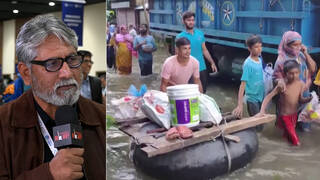
Bangladesh’s first riverkeeper, Sharif Jamil, shares how poor countries in the Global South are struggling to effectively adapt to climate change as rising sea levels, extreme weather patterns, pollution and more are creating an escalating “humanitarian catastrophe,” while the wealthy impede efforts to reallocate financial resources for adaptation and mitigation. “If you want to protect the planet, if you want to save the planet from global warming, you need climate finance to make all this transition,” says Jamil.
For the second year in a row, the Trump administration has not sent an official delegation to the United Nations’ annual climate change conference, held this year in Antalya, Turkey. But although no federal representatives are present, more than 120 U.S. state and local leaders are participating, including the governor of the fourth-largest economy in the world, California Governor Gavin Newsom. Newsom, a likely candidate for the 2028 Democratic presidential nomination, has endorsed the Santa Marta Process, a coalition of nations working to develop a global green energy transition. “The petrostates have made it abundantly clear: Under the current rules of consensus, they are never, ever going to allow COPs to succeed. They’re just not going to sign that agreement. So, essentially, the Santa Marta coalition is making an end run around that, using economic power,” says longtime environmental and climate reporter Mark Hertsgaard.
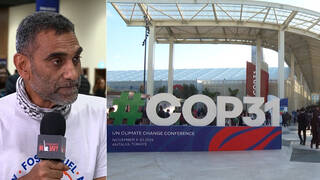
What will it take to bring an end to the fossil fuel era? We speak to Kumi Naidoo, the president of the Fossil Fuel Treaty Initiative, which aims to reach a binding agreement for a global transition away from fossil fuels. Currently backed by over 25 countries from the Global South, the intergovernmental process began earlier this year in Santa Marta, Colombia. Meanwhile, at the United Nations, “for 30 years of negotiations, we don’t have any mention of fossil fuels [in the outcome document]. That’s like Alcoholics Anonymous holding 30 years of conferences and not mentioning alcohol,” says Naidoo. We discuss the Fossil Fuel Treaty Initiative’s goals, how the oil and gas industry drives global conflict, and the Trump administration’s glaring absence from international action on climate change.
Trump Arrives in Philippines Ahead of ASEAN Summit and Meeting with Putin, Xi, Trump Says He “Would Not Mind” Seeing Jensen Huang Restored as CEO of Nvidia, Trump Takes “No Responsibility” for Largest FAA Ground Stop Since 9/11, JPMorgan Chase Blames “Software Bug” After Customers Lose Access to Accounts and Services, Israel Failed to Meet Commitments to Deliver Food and Supplies to Gaza, Israeli Opposition Slams Netanyahu’s “Attempted Coup” over Framed Arab MKs, Iran Attacks U.S. Radar Station in Bahrain, Says It Captured U.S. Drone, Ukrainian Strike Damages Bridge Linking Crimea to Russia, Largest Union of U.S. Nurses Endorses Sen. Van Hollen for Senate Majority Leader, Study Shows U.S. Hyperscale Data Centers Produce Carbon Emissions Equivalent to Denmark, Turkish Authorities Take Control of Pro-Opposition Media Outlet, Ecuadorian Fishermen Who Survived U.S. Boat Strike Sue Trump Administration, 8-Year-Old Haitian Boy Reunites with Family After Weeks in Federal Detention, ICE Agents Pepper-Spray Pregnant U.S. Citizen, Press Groups Call for Justice After Mexican Journalist Found Dead

The United Nations climate summit in Antalya, Turkey, is in its second and final week. To get an update on the state of negotiations among countries, we speak with longtime climate campaigner Asad Rehman, the chief executive of Friends of the Earth England, Wales and Northern Ireland. He says rich, developed countries are still dragging their feet on a rapid transition away from fossil fuels while withholding the money that poorer, Global South countries need. “Whether you’re cutting emissions, whether you’re adapting to the impacts of climate change or dealing with incredible losses which are totalling over a trillion right now, you need public finance,” says Rehman. “And the rich countries are saying, 'Our coffers are empty.' But, of course, the coffers are never empty when it comes to paying for bombs. It’s never empty when it comes to the fossil fuel subsidies to the corporate giants, and it’s never empty when it comes to the billionaires.”
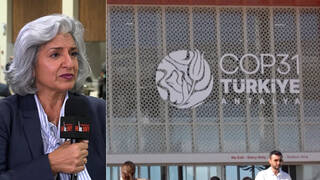
As delegates, industry lobbyists and civil society activists attend this year’s United Nations climate summit, known as COP31, we speak with international environmental lawyer Farhana Yamin about the state of global climate efforts. Yamin helped write the landmark 2015 Paris Agreement and has attended 28 of the last 31 U.N. climate summits. The Paris Agreement aimed to keep global temperatures below 1.5 degrees Celsius above preindustrial levels, a threshold that climate scientists say the world will now overshoot. “It’s a moment of great sadness, actually, for the world community that we weren’t able to start the phaseout, start the acceleration of the transition away from fossil fuels 10 years earlier,” says Yamin. “So, we’re about 10 years behind, but I hope that over time that we can accelerate.”
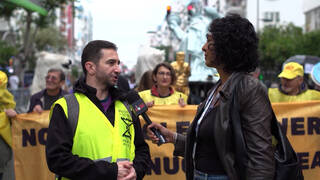
Democracy Now! is in Antalya, Turkey, where this year’s United Nations climate summit, COP31, is being held. For the second year in a row, the United States has not sent an official delegation to the international talks, in keeping with the Trump administration’s longstanding hostility to such efforts to address the climate crisis. There are nearly 100,000 participants here at this year’s climate summit, including many civil society activists from Turkey and around the globe. Over the weekend, Democracy Now! was in the streets of Antalya to speak with some of the thousands of protesters who marched to demand urgent climate action, including many labor leaders. “Trade unions care about a lot more than just protecting jobs. We have systemic demands,” said Lala Peñaranda, the Latin America coordinator for Trade Unions for Energy Democracy.
U.S. Air Travelers Continue to Face Canceled or Delayed Flights After Nationwide Ground Stop Order, Iran Launches Attack on Bahrain, Targeting Radar Positions, Yemeni Government Forces Retreat to Defend Aden from Houthis, Mass Funeral Held in Gaza for Dozens of Palestinians Killed by Israeli Forces, NYT : Israel Abducted Two Iranian Generals in Effort to Locate Missing Israeli Air Force Navigator, Dozens Rally in Support of Democratic Sen. Van Hollen to Serve as Senate Majority Leader, Democrats Win Governor’s Race in Alaska, Death Toll from U.S. Measles Outbreak Rises to 10, People’s Climate March Demands Urgent Action by Leaders at COP31 Climate Summit, Protesters Mobilize in Manila Ahead of Trump’s Visit to ASEAN Summit, Hundreds of Thousands Rally in Prague to Defend Public Broadcasting from Andrej Babiš’s Overhaul, Humpback Whale Spotted in Hudson River as New York Marks Progress in Combating Pollution, Mamdani to Dismantle NYPD Unit That Spied on Protesters, Trump, Xi and Putin to Hold Unprecedented Trilateral Summit in Shenzhen
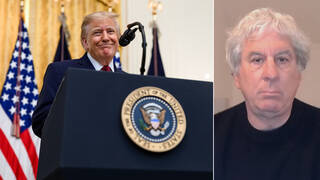
As Democrats prepare to take control of Congress in January, party leaders say they intend to hold Trump officials accountable with stepped-up hearings and investigations. The administration, however, has responded with threats to launch its own investigations into lawmakers for carrying out their oversight responsibilities. “The oversight function of Congress is well established by the founders. It’s a normal part of government. The separation of powers requires oversight,” says Brad Adams, co-founder of The Rule of Law Project, which seeks to provide outside accountability due to what he describes as the administration’s refusal to investigate “obvious cases of corruption.”

Israel’s latest bombing of Nasser Hospital in Gaza on Thursday killed six Palestinians, including surgeon Dr. Rizk Abu Shaira. He was featured in the recent documentary American Doctor , which follows international medical volunteers in Gaza’s battered hospitals as they work alongside Palestinian colleagues. Israel claimed, without providing evidence, that it targeted a senior Hamas militant in the hospital strike. Israel has repeatedly bombed medical facilities in Gaza since the start of the genocide in October 2023, even though such attacks are prohibited under international law. “It’s just barbarism. I don’t know why we’re supporting this,” says Dr. Feroze Sidhwa, one of the titular American doctors in the documentary, who demands accountability for Israel’s actions and a change in U.S. policy toward the country. “That’s an American-made bomb dropped by an American-made airplane burning American-supplied jet fuel.” Sidhwa also comments on the catastrophic flooding in Gaza that has swamped the temporary shelters of tens of thousands of displaced Palestinians as Israel continues to block the entry of shelter materials into the territory. As a result, “babies are going to die of hypothermia in Gaza for the fourth year in a row,” Sidhwa says.

Nvidia CEO Jensen Huang resigned Thursday after reports of multiple extramarital affairs, including with an employee and a Chinese businesswoman whom U.S. intelligence officials accuse of spying for Beijing. The company says Chief Financial Officer Colette Kress will serve as interim CEO as the board searches for a permanent replacement. Nvidia’s computer chips are at the heart of the artificial intelligence boom, driving the company’s value above $4 trillion and making Huang one of the most influential business leaders in the world. His spectacular fall from the company he co-founded in 1993 comes as the U.S. stock market has become highly dependent on a handful of AI-related companies and amid intense competition between the United States and China over control of the technology, with access to Nvidia’s chips becoming a major point of contention between the two countries. Tech critic Paris Marx notes that the AI industry’s “circular financing,” in which companies are both clients and investors for one another, has created systemic risk. We also speak with Ramesh Srinivasan, director of the AI Futures Lab at UCLA , who says the “soap opera” of the Huang scandal has exposed “how precarious the governance of this AI truly is,” with only a handful of people and firms controlling “incredibly powerful technology that feeds off of all of us and the planet.”
Sen. Chris Van Hollen Will Challenge Chuck Schumer for Senate Majority Leader, Youth Climate Activists Protest in Chuck Schumer’s Office to Demand New Senate Leadership, Nvidia’s Colette Kress to Serve as Interim CEO as Jensen Huang Resigns Amid Scandals, Microsoft Outage Disrupts Communications for Millions Across 74 Countries, Iran Says It Blew Up U.S. Early-Warning Radar as Trump Declares, “We Don’t Need a Deal with Iran”, Houthis Claim Fresh Attacks on Saudi Oil Facilities Including East-West Pipeline, Russia and Ukraine Continue Deadly Strikes as U.S. Envoys Meet Putin and Zelensky, Infant Dies of Hypothermia in Gaza as Calls Grow for Israel to Allow Imports of Winter Supplies, ICE Detention of USF Professor Draws Protests and Demands for Her Release, Protesters in San Diego Demand ICE Release 8-Year-Old Haitian Boy to Relatives, 23 Immigrants Died of Medical Neglect in ICE Custody in First Year of Trump’s Second Term, NYC Mayor Mamdani Orders Inspections at 100 Sites After Deadly Building Collapse in Brooklyn
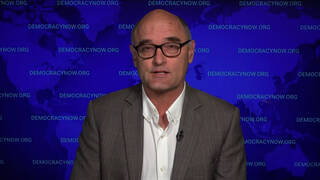
Alaska is the only Senate race yet to be called. Democratic challenger Mary Peltola is narrowly leading Republican incumbent Dan Sullivan with about 86% of votes counted. Alaska uses ranked-choice voting, a system where voters choose not only their top candidate, but can also indicate an order of preference for remaining candidates on the ballot. If no candidate wins a majority as the top choice, then second-choice votes are added to the totals and so on until there is a winner. Rob Richie, president and founder of Expand Democracy and a senior adviser with FairVote, explains how ranked-choice voting has shaped the Alaska race and how it is “a system that promotes [candidates] reaching out, engaging, and, for voters, a lot of freedom.” Richie adds that Peltola is “heavily favored to win at this point.”

With Democrats set to take control of both chambers of Congress in January, Vermont Senator Bernie Sanders says he will not support Chuck Schumer for another term as the Democratic Senate leader, calling for the party to move in “a new and bold direction.” Michigan Democratic Senator Elissa Slotkin has said she will not support Schumer unless he presents a plan to govern differently, and several senators-elect have called for new leadership or declined to endorse Schumer. Maryland Senator Chris Van Hollen is considering challenging Schumer. Meanwhile, Hakeem Jeffries is facing questions about his leadership of House Democrats after 11 of the party’s members missed a key vote on impeaching Defense Secretary Pete Hegseth. After “a big win for the populist wing of the Democratic Party, … it would be a betrayal for that election to result immediately in the Democratic Party simply responding by reelecting the same leadership,” says David Sirota, editor-in-chief of The Lever .

Democrat Scott Colom has defeated incumbent Cindy Hyde-Smith to become Mississippi’s first African American senator since the post-Civil War Reconstruction era. The electoral breakthrough is particularly meaningful given Mississippi’s history in the civil rights movement. In 1964, three civil rights activists — James Chaney, Michael Schwerner and Andrew Goodman — were murdered by the Ku Klux Klan after traveling to the state to register Black voters. We speak with two of their relatives about Colom’s stunning upset. “I believe that people were voting for help. And they evidently saw something in Mr. Colom that made them feel like that they could hope again and that he was the help that was needed,” says Angela Lewis, the daughter of James Chaney. “The people of Mississippi have spoken,” adds David Goodman, the brother of Andrew Goodman. “And we have to cease and desist this divide-and-conquer business, because it’s not in our collective interest as the United States of America.”

Democrat Scott Colom has made history as Mississippi’s first Democratic senator since 1982 — and its first African American senator since the post-Civil War Reconstruction era. Colom narrowly defeated Republican incumbent Senator Cindy Hyde-Smith in a state that President Trump won by nearly 23 points in 2024. Colom’s victory brings the incoming Senate Democratic caucus to 55. Colom gave his victory speech on Wednesday at the historically Black Tougaloo College, just miles from where civil rights activist Medgar Evers was murdered in 1963 by a member of the Ku Klux Klan. “There were times that I couldn’t get donors to answer the phone; they did not believe a moment like this was possible. But I kept the faith,” said Colom. “There are so many people that had faith in Mississippi at times where it seemed impossible, people like Medgar Evers.”
Democrats’ Senate Majority Expands to 55 as Scott Colom Claims Historic Win in Mississippi, Treasury Secretary Scott Bessent Relocates to Military Base After “Iranian Threats”, Progressives Call on Democratic Lawmakers to Stop Funding Attacks on Iran, Sen. Van Hollen Criticizes Schumer for Siding with AIPAC and Crypto Lobbies in Primaries, Rep.-elect Don Leonard Says Senior Dems Threatened to Make His Life “Living Hell” over Jeffries Vote, Israeli Strike on Nasser Hospital in Gaza Kills at Least Six People Including Surgeon, Hegseth and His Entourage Scolded for Breaking Decorum at Arlington National Cemetery, Trump’s Triumphal Arch Faces Lawsuit from Members of Kennedy Family, Nvidia CEO Jensen Huang Resigns, SpaceX Plans $24 Billion Data Center in South Texas, Oakland City Council Unanimously Extends Data Center Moratorium for a Year, Millions Take Part in General Strike in Spain

We speak with Janay Boulos and Abd Alkader Habak, filmmakers and subjects of the new documentary Birds of War , which tells their epic love story through years of upheaval in the Middle East. Boulos, a London-based Lebanese journalist working for the BBC , and Habak, a Syrian activist and cameraman, first connected while covering the Syrian civil war and stayed in touch through years of war, revolution and exile, forming a relationship that is chronicled in the documentary by drawing on 13 years of their personal videos, voice notes and other correspondence. The film also examines the unequal relationship between international news organizations and local journalists whose work they rely on, the fraught political history between Syria and Lebanon, and how Boulos and Habak’s personal connection overcame those divisions. “Without our journalistic relationship, [we] would have never been together. I would have never opened my heart to somebody like him,” says Boulos. “We can be any race, any gender, any religion, any background, but at the same time we’re all humans.” Birds of War premiered at the 2026 Sundance Film Festival, where it won the World Cinema Documentary Special Jury Award for Journalistic Impact.
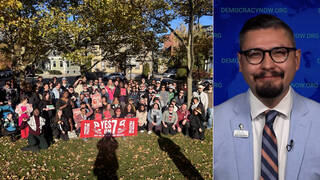
Voters in Providence, Rhode Island, approved a ballot measure last week that could result in the city divesting from Israel. The successful grassroots campaign makes Providence the first U.S. city to pass a binding divestment measure through a popular vote. The measure instructs the city to divest from countries and companies implicated in “ethnic cleansing, apartheid, illegal military occupation, or genocide.” The language does not mention Israel by name. We speak with one of the key backers of the divestment measure, Mayor-elect David Morales, a 28-year-old democratic socialist who made history on election night as the youngest mayor ever elected in Providence. “What we saw was our neighbors coming out in the thousands to demonstrate that we are ready for change,” Morales says, promising to enact his affordability-focused platform. “It’s the responsibility of local government to take action. And for that reason, we are seeing a rise in democratic socialism and the representation of democratic socialists all across the country.”