The Atlantic
The Rise and Fall of the Telephone Century
Nobody foresaw where the new technology would lead.
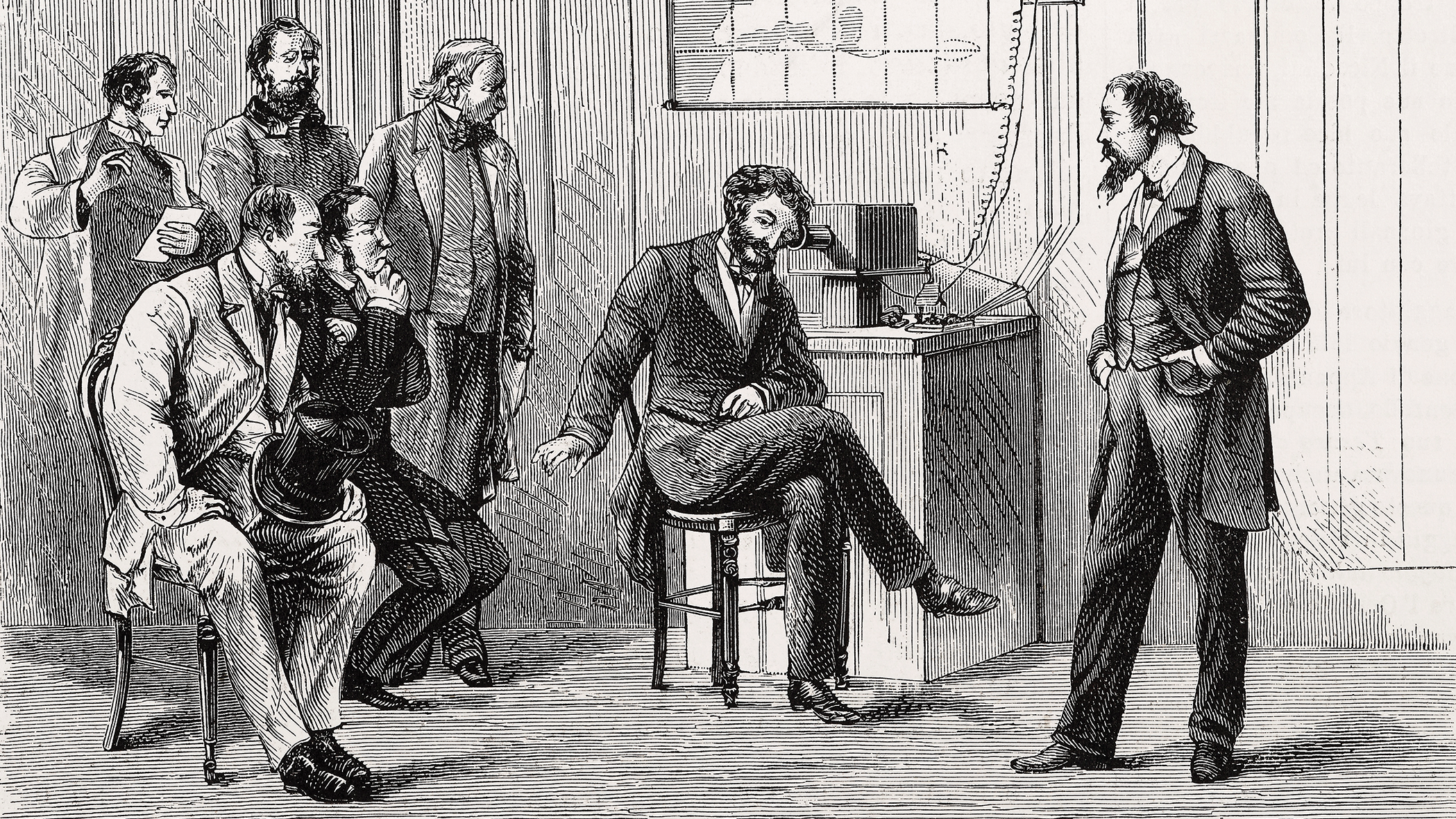
High-tech gadgets proliferated almost as rapidly in Mark Twain’s time as they do in ours, and he prided himself on being an early adopter. So when Alexander Graham Bell’s new telephone company began to offer service in Hartford, Connecticut, in 1877, Twain signed up, boasting (incorrectly) that his was the first line “ever used in a private house in the world.” Shortly afterward, he did set a record, becoming “the first author to deploy the telephone in fiction, in a peculiar story for The Atlantic Monthly,” James Gleick writes in The Telephone: A New History.
The comedy of “The Loves of Alonzo Fitz Clarence and Rosannah Ethelton” comes mainly from its high-concept premise: The title characters fall in love, quarrel, reconcile, and get married entirely over the phone, without ever meeting in person. At the time the story appeared, in March 1878, very few Americans had actually seen a telephone, and Twain plays up the strangeness of the new technology. When we are first introduced to Alonzo, in his study in Eastport, Maine, he seems to be talking to himself, or to someone in the next room, before it’s revealed that he’s actually on the phone with his Aunt Susan in San Francisco.
But although Twain found technology fascinating, he also knew that things—even things that do amazing things—don’t make for good stories. The only subject that human beings find enduringly interesting is one another, and Twain was remarkably prescient about how the telephone would challenge traditional terms of interaction. The lovers in Twain’s story are separated by thousands of miles, but the conversation between them is not at either end, nor is it somewhere in the middle; it is a meeting of minds that have escaped the body’s requirement of place. This raises questions that we’re still asking today, in the age of dating apps and OnlyFans. Can people be real to one another without physical presence? Can there be love without touch? “There was a feeble but frantic sound for some little time, as if wool-lipped, disembodied spirits were exchanging kisses,” Twain writes about his telephone lovers. Is that funny or nightmarish?
Gleick’s great achievement as a science writer has been to show how complicated, abstract ideas end up changing the way we experience the world. In Chaos, he explored chaos theory, which used new mathematical tools to explain why weather and other complex systems are so unpredictable. In The Information, he showed how modern discoveries such as DNA and the computer involved new ways of thinking about data and communication. The Telephone, too, is the story of a scientific discovery. But it’s just as much the history of a business—the Bell System, a group of companies led by the American Telephone and Telegraph Company (AT&T) that became America’s most powerful and enduring monopoly. The book is also a wide-ranging cultural history, showing how the telephone changed people’s lives and how they tried to make sense of those changes. When Bell gave a public demonstration of his invention in Salem, Massachusetts, speaking with Thomas Watson 18 miles away, in Boston, “it seemed as if an electric thrill went through the audience,” he remembered. “They recognized for the first time—what was meant by the ‘Telephone.’ ”
But what did it mean, exactly? That is where novelists like Twain came in—along with playwrights, psychologists, social scientists, and legions of pundits in what Gleick calls the “Telephone Century.” Like artificial intelligence today, the telephone was an obviously momentous new technology that everyone had heard about and no one fully understood. If the parallel holds, we won’t know how AI is going to change the world until after it happens, because early predictions about how people would use the telephone turned out to be wildly off base.
A New York Times article imagined it as a way to listen to sermons without having to go to church, joking that soon houses for rent would offer Baptist preachers “laid on in every room,” like hot and cold water. In France, the Théâtrophone service allowed subscribers (including Marcel Proust) to listen to live opera performances over the phone. In both cases, the telephone was viewed as a one-way delivery system. But its power would lie in being a network—literally, a web of metal cables spanning continents and oceans, which allowed any two people, anywhere in the world, to have a back-and-forth exchange.
Not even Bell knew at first exactly what he was inventing. The initial goal of his research wasn’t to transmit the human voice, but to increase the carrying capacity of existing telegraph lines by sending multiple messages simultaneously at different pitches. In the course of his experiments with vibrating steel reeds, he discovered the principle that made the telephone possible: Sound and electricity speak the same language. Sound travels through the air in waves of pressure, and electromagnetic force also takes the form of a wave. The telephone was a tool for translating between the two kinds of waves. A small magnet, vibrating in response to a speaking voice, would generate an electrical current, which could be sent down a wire and reconverted into sound at the other end.
Bell wasn’t the only person to make this discovery. Philipp Reis had built a device he called das Telephon in Germany in 1861, and Elisha Gray, an American inventor, was so close on Bell’s heels that both men’s applications reached the U.S. Patent Office on the same day. Bell was awarded the patent, as well as the chance to go down in history as the inventor of the telephone, mainly because his well-connected Washington lawyer bribed the patent examiner with $100 and a gold watch.
Making the new invention useful would be a lot more expensive. As Gleick observes, other Industrial Age enterprises benefited from economies of scale. The more automobiles you make, the cheaper manufacturing each one becomes. With the telephone, the calculation was reversed: The bigger the network, the greater the cost per call, given how many lines and switchboards were required to put all the calls through. Raising capital from ultrarich investors became crucial. Originally Bell was one of four partners in the company that bore his name. Within three years, he had been reduced to one of 540 shareholders and ceased to play any real role.
At first, independent telephone companies tried to challenge the Bell System, in business and in court. Some enterprising farmers even turned their barbed-wire fences into telephone lines by running electric current through them. But Bell’s patents gave AT&T an unbeatable head start, and it ruthlessly maintained its advantage for more than a century. In the 1920s, for instance, a small company called Hush-a-Phone started to sell a cheap plastic device that attached to the mouthpiece of a telephone; talking into it would make your desk phone “private as a booth.” But AT&T prohibited customers from using any third-party equipment, and “when company repair personnel saw a Hush-a-Phone in a customer’s home, they threatened to disconnect service altogether,” Gleick writes. Not until the case reached a federal appeals court, in 1956, did the company finally win the right to sell its $10 product.
An antitrust suit led to the breakup of AT&T in 1984. By then, the telephone was so ubiquitous that its effect on modern life could hardly be grasped. Over a century, the meaning of distance had changed: The other side of the country, or the planet, didn’t seem so far away when you could communicate across it instantly, instead of waiting weeks to exchange letters. Privacy had become more accessible—teenagers could take the phone into their room, or a closet, and talk without a chaperone. But it was also more vulnerable. You couldn’t be sure that you weren’t being eavesdropped on—in the early days, by an operator or by a neighbor on a party line; later on, by someone picking up an extension or, if you were important enough, by a government wiretapper.
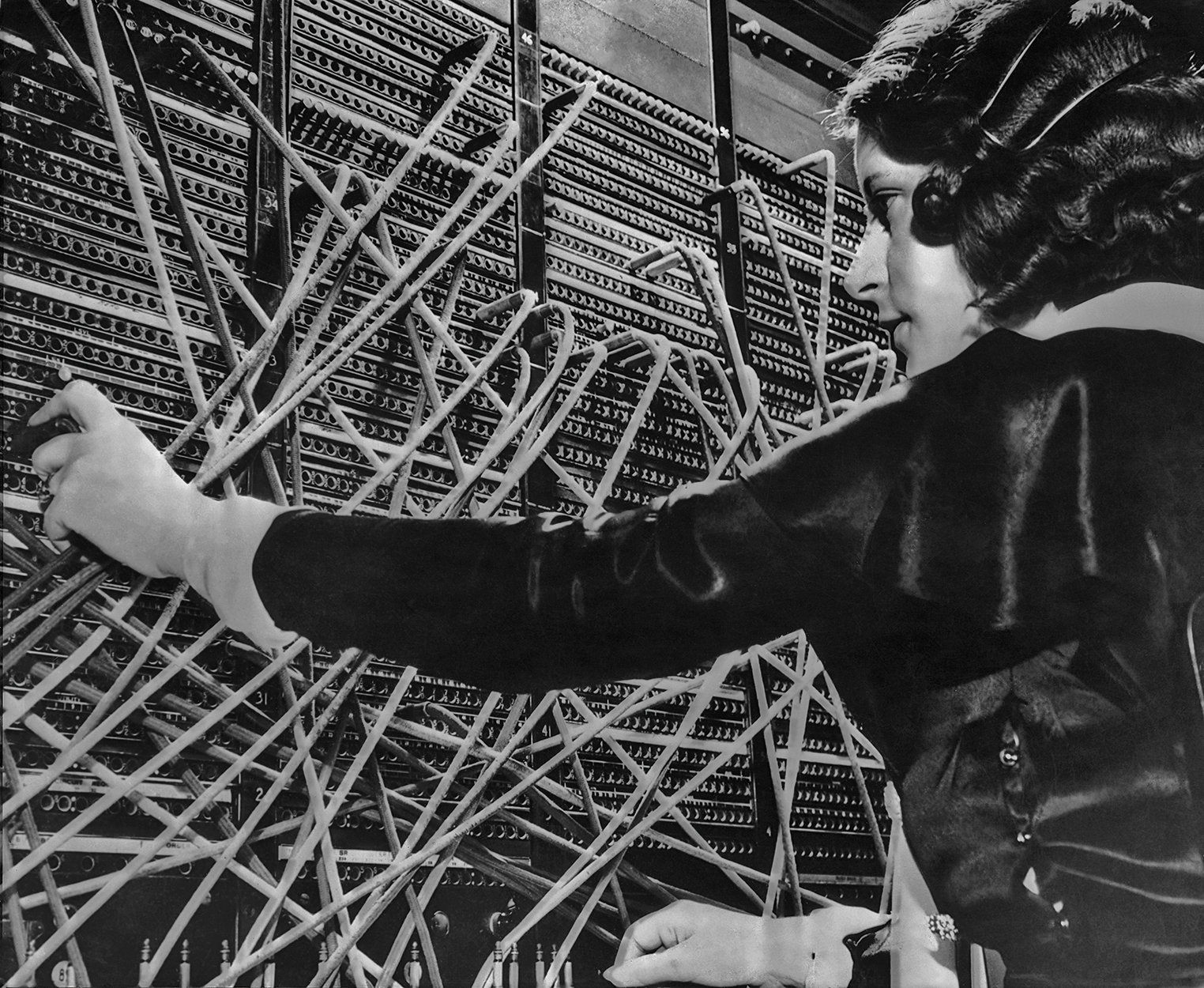
The telephone helped bring women into the public sphere, too, by creating a new kind of job. “As if by heavenly decree,” Gleick writes, “a consensus formed that operating a switchboard was women’s work,” and that “only women were suited to it”—mainly because they were better than young men at sitting still and could be paid lower wages. Even so, the job offered many women a path to personal independence and professional respect. When the U.S. Army needed skilled telephone operators during World War I, it had no choice but to hire women, although by law they couldn’t enlist in the military. In 1918, the 33 women of Telephone Unit No. 1 shipped out for France, where they “ate army food and slept in army barracks,” and wore their own armbands, embroidered with “black telephone transmitters and yellow streaks of lightning.”
After that war, and even more so after World War II, women found new telephone-related jobs in offices as receptionists and secretaries. But switchboard operators were doomed by their own success. America’s telephone network was expanding so fast that there weren’t enough women to keep up. Around 1910, AT&T’s chief engineer estimated that by 1930, at least a quarter of New York City’s population would be needed just to run its switchboards. The company had to find a way to automate the process of making phone calls. The solution turned out to be the rotary dial, which allowed callers to enter the phone number they wanted to reach instead of telling it to an operator. Gleick shows that each major advance in telephone technology followed the same pattern: Science would rise to the demands of business. Technical challenges, such as signal amplification for long-distance calls, seemed insurmountable until they were solved. Then they were taken for granted.
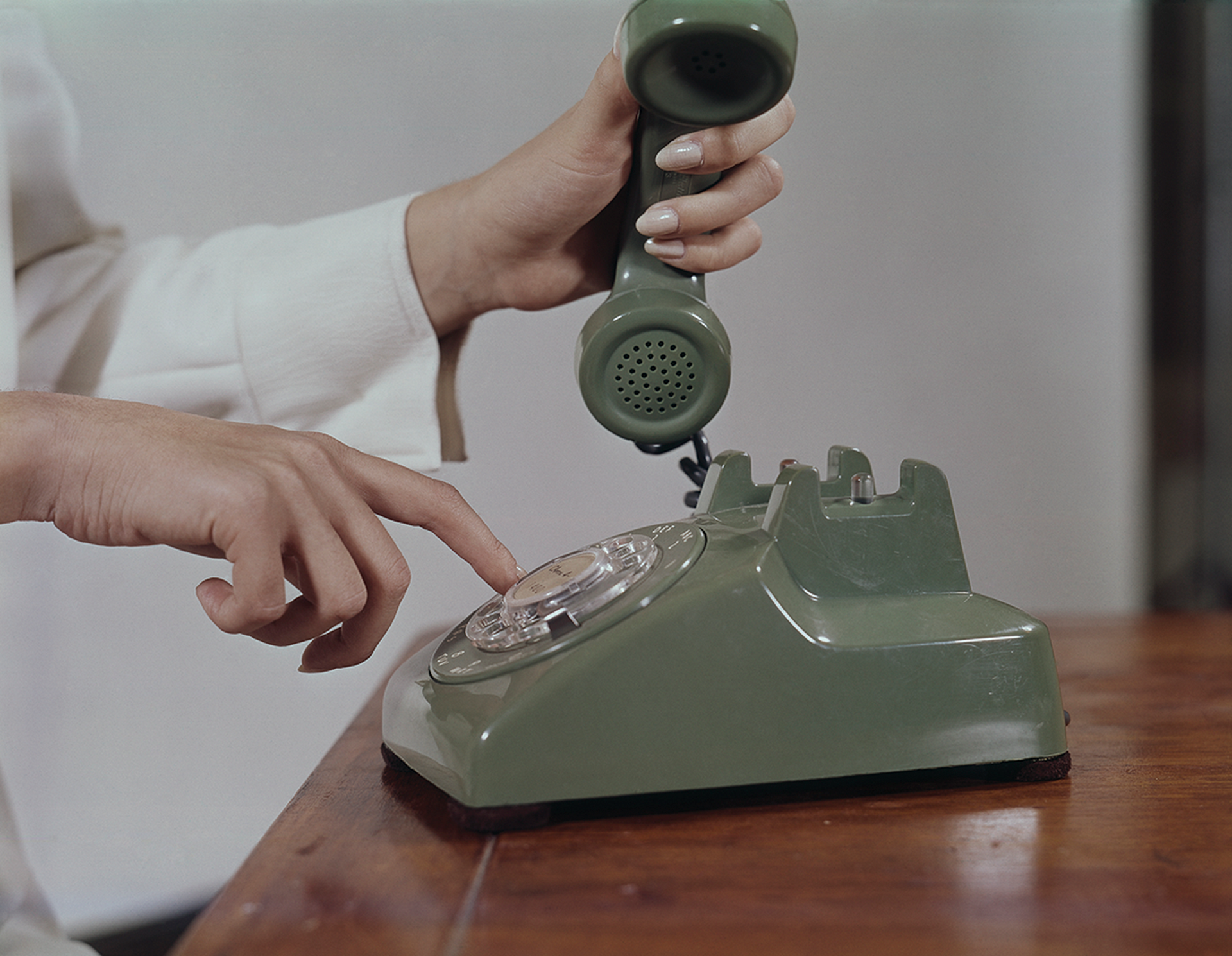
This dynamic is familiar in our own time too. Yesterday’s miracle becomes today’s necessity and tomorrow’s antique. The rotary dial was so cutting-edge in the 1920s that AT&T worried that customers wouldn’t be able to use it. New phones came printed with instructions: “Remove receiver. Put finger in hole over first figure wanted. Turn to stop and let go.” Today, you’d need to give the same explanation to people under 30, who have grown up in a world of touch screens. Among other things, The Telephone is an almanac of this kind of extinct knowledge. Depending on how old you are, you’ll feel nostalgic about different phases of telephone history: Remember dial tones? The Yellow Pages? Pay phones? Calling for the time?
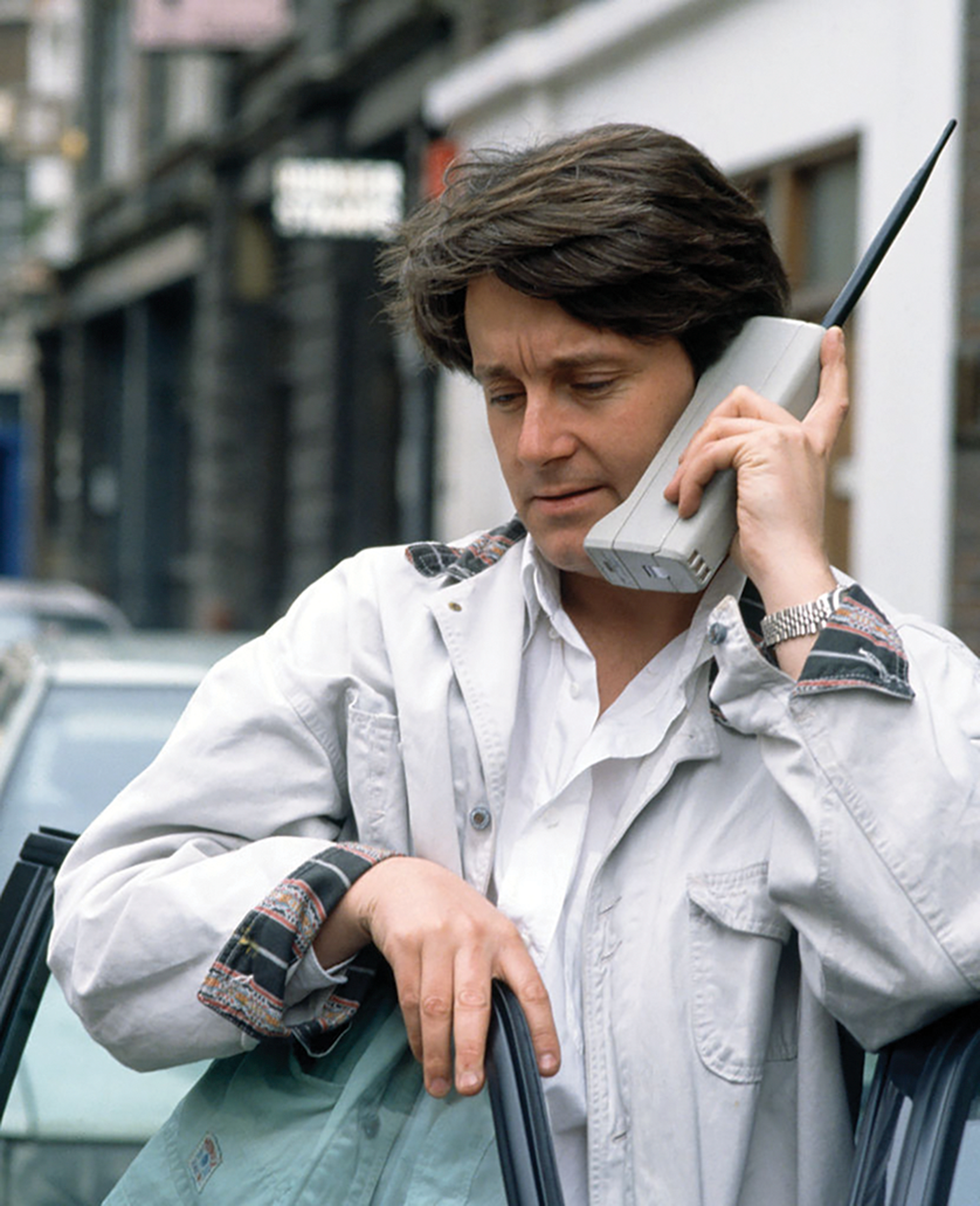
Now the telephone itself is history. By collective agreement, we refer to the devices in our hands at every waking moment as phones—maybe iPhones or cellphones, but never telephones. Phones can do a million things that telephones never dreamed of, while the one thing telephones did is starting to feel unnecessary, even impolite. When a phone rings—an anachronism; phones don’t ring, they vibrate or light up or play a tune—it’s more likely to be a scammer or a salesperson than a friend. If you really want to communicate with someone, you send a text or set up a Zoom call. Fittingly, Gleick ends his book with a visit to a disconnected telephone booth in Japan, which a local man has turned into a shrine of sorts—a place to think about the absent and the dead, who have no phone number.
Even if we’ve moved beyond telephones, however, we still inhabit the strange new dimension they opened up. The telephone gave humanity its first experience of what we now call the virtual—a kind of reality that is divorced from presence. By translating the human voice into a signal transmitted through a wire, the telephone gave it the reach of electricity and the abstractness of data. At first, telephone users experienced this as a magic power—“this admirable magic that needs only a few seconds to bring before us, unseen but present, the person to whom we wish to speak,” as Proust described it.
What Bell did not foresee is that once human beings got a taste of this freedom, having a body and being in a place began to feel burdensome, a concession to the limitations of the physical world. Ever since, the information-technology revolution that began in the 1870s with the telephone and phonograph has been steadily lightening that burden. Radio, television, movies, and the internet have claimed an ever larger share of our attention for people and things not actually there.
AI is completing the emancipation from reality that the telephone began. When you had a conversation on the phone, you could at least be sure that the voice on the other end of the line belonged to a real person. Today we are surrounded by sounds and images that never corresponded to anything real—lifelike photos of people who were never born, intimate conversations with machines that can’t think or feel. The great irony of the telephone is that a device born as a tool of communication, bringing people together across distances, has evolved into our most effective tool of solipsism. No long-distance call can bridge the space between two people absorbed in their phones, even when they’re sitting side by side.
This article appears in the January 2027 print edition with the headline “The World the Telephone Made.”