Problem
We can't find the internet
Attempting to reconnect

Florida Gov. Ron DeSantis is quietly working on a book, two sources tell Axios — a project likely to fuel speculation about his making another run for the White House. Why it matters: DeSantis hasn't publicly acknowledged the book project or disclosed what it will be about. But writing a book is often the first step toward a presidential campaign, and it could give the term-limited governor a platform to lay out his vision for the Republican Party's future. DeSantis' state was a rare bright spot for Republicans in this month's midterms, as Democrats made historic gains across the nation. Driving the news: Word of DeSantis' book comes as he's become increasingly outspoken on a range of policy issues, particularly the economic and social impact of artificial intelligence — potentially offering clues about what the book might address. DeSantis has become a vocal critic of the potential dangers of AI, warning that it could eliminate jobs, threaten children's safety and privacy, and drive up electricity bills as data centers expand. DeSantis has pushed for an "AI Bill of Rights" and signed state legislation aimed at preventing tech companies from passing the costs of data centers on to residential consumers. His stance has put him at odds with the Trump administration's efforts to limit states' ability to regulate AI. DeSantis has emphasized affordability, immigration and education — issues likely to remain central to national politics long after he leaves office. Zoom out: DeSantis has made other moves that could keep him in the national spotlight after he leaves office in January. NBC News recently reported that DeSantis is preparing to launch a conservative think tank, which could enable him to retain a political and donor infrastructure. After the midterms, DeSantis embarked on a flurry of media appearances that resembled a victory tour, highlighting how Florida Republicans had largely escaped the Democratic wave. Yes, but: Some DeSantis allies are highly skeptical that he'll mount another presidential campaign after his unsuccessful 2024 bid. DeSantis has sent mixed signals about his political future. He downplayed the prospect of another presidential bid last year and, after the midterms, questioned how much a Republican president could accomplish with Democrats controlling Congress. He also disputed a report that he was building a campaign operation. But he hasn't ruled out a 2028 run, saying he'll assess the political landscape after leaving office. What they're saying: DeSantis' spokespeople did not respond to requests for comment about the book.
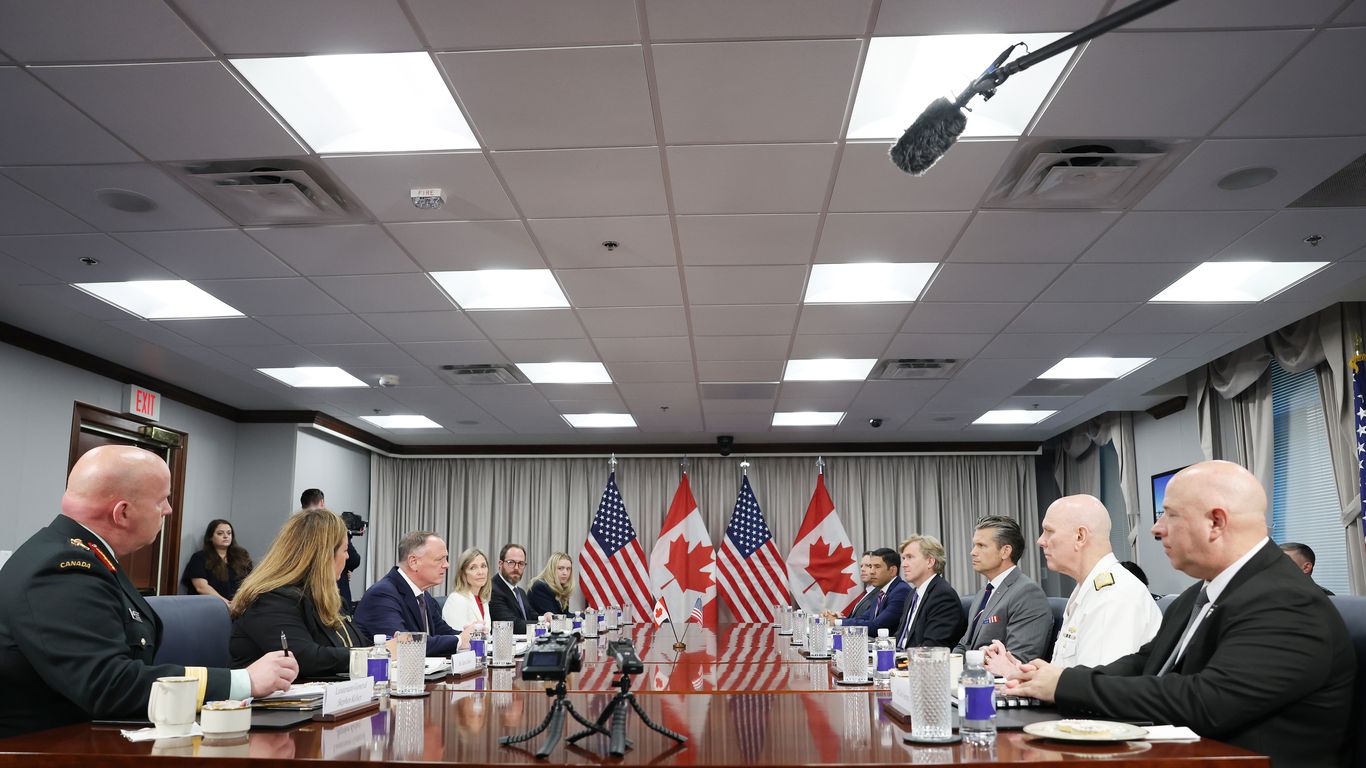
The Pentagon accused Canada of failing to become a "credible partner" due to its faltering military readiness and low defense spending, according to a sharply worded fact sheet issued by the Pentagon to justify new restrictions on America's northern neighbor. Why it matters: The restrictions deepen tensions between the U.S. and Canada over trade and defense, as Ottawa reconsiders billions of dollars in purchases of American weapons. The new restraints — which do not affect defense or intelligence sharing— limit U.S. military personnel from fraternizing with their Canadian counterparts at official events without prior authorization from the Pentagon, an official told Axios. The Pentagon fact sheet has not been reported. But the Washington Post first reported the restrictions, followed by the New York Times . Zoom in: At the heart of the dispute are NATO defense spending goals and military readiness under the bilateral North American Aerospace Defense Command where, the memo says, Canada falls short in three ways: 🛩️ Air: Only 41.9% of the Royal Canadian Air Force fleet "was serviceable from 2025-2026, largely due to ageing equipment and personnel shortages," the Pentagon fact sheet says. The shortfall limits Canada's "ability to meaningfully contribute to air defense commitments … to defend our North American airspace against all threats." Canada relies on the U.S. and NATO for airborne early-warning aircraft but is negotiating to buy its own from Sweden's Saab. ⚓️ Sea: Just 53.9% of Canada's naval fleet was "serviceable" from 2025-2026, limiting its "ability to monitor maritime approaches to North America," the fact sheet says. Only one of Canada's "four ageing Victoria-class submarines" is "seaworthy at any given time." Canada has a new fleet of conventional submarines, manufactured by ThyssenKrupp Marine Systems, coming on line, but until then, its undersea "capability will be limited." 🪖 Land: The Canadian Army had an operational readiness rate of 48% from 2025-2026. The other side: Canada's own defense department reported the same equipment shortages while finding that 61% of its military units were ready for operations. Canada's defense ministry could not be reached. Friction point : NATO defense spending has been a constant sore spot for President Trump. Canada first agreed to spend 2% of GDP on defense spending in 2006, but it was only at 1.5% until 2025, according to the Pentagon. Canada announced in March that it had achieved 2% GDP-defense spending, but now the target is 5% by 2035 and U.S. policy makers say Ottawa "has yet to articulate a resourced path to reach this target. "Canada must get serious and focused," the fact sheet said. The big picture: More defense spending by NATO allies is a revenue generator for the U.S., which has the globe's largest military-industrial complex. "Since March 2025," the Pentagon fact sheet noted, "Ottawa has been reviewing its decision to procure 88 F-35s to replace its ageing fighters and is considering a mixed fleet that will compound existing personnel shortfalls." Canada is increasingly looking to European manufacturers for its military buildup. Context: Relations between the two countries soured when Trump scrapped a free-trade agreement he insisted on in his first term, began a tariff war and threatened to annex Canada as the 51st state. At a Friday news conference, Trump complained about Canada and trade imbalances between the two countries. The bottom line: The two nations remain allies and work closely together on defense issues. Canada has an office in the Pentagon next to the joint staff. The limited restrictions imposed by Defense Secretary Pete Hegseth on official interactions between U.S. and Canadian personnel are a "shot across the bow," a U.S. official said. "Unfortunately," the Pentagon fact sheet said, "Canada has yet to make the hard decisions and tradeoffs needed to put it on track to fulfill its NATO Defense Investment Pledge and become a credible partner in the

We've talked to more than 50 leaders in government, AI, business and cyber — from let-'er-rip AI accelerationists to shut-'er-down critics — and they were unanimous on one chilling assessment: Cyberattacks on business and critical infrastructure will be constant, increasingly sophisticated and highly disruptive over the next 18 months. These leaders describe 2027 as the year cyber becomes like weather: Outages will be frequent, disruptive, occasionally scary, and something people and companies must learn to navigate and live with daily. The chances of widespread disruption or real damage are rising fast. Why it matters: We write this neither to forecast nor frighten. Rather, we're sharing what government and AI leaders say privately but won't say publicly. The big picture: The disruptions of the past two weeks — from a global Microsoft outage to the FAA grounding air travel to a consumer banking glitch at Chase — were a mild preview of what experts expect is coming. Bridgewater Associates, the world's largest hedge fund , put it bluntly in an assessment this month: "[We] are managing money based on a one-in-three chance of an economically destabilizing attack within the next year." Horacio Rozanski , chairman and CEO of Booz Allen, calls this the "fog before the war" — a foretaste of greater chaos to come, when agentic invaders reach their full potential and can attack "at the speed of thought." "Now is the time to take as many precautions as you can," Rozanski said. "Recognize that this is coming." Most of these malfunctions appear to have resulted from companies and government trying to secure their computer and infrastructure systems against future large-scale cyberattacks. This pattern will persist. Many future ones will be actual cyberattacks, carried out by U.S. rivals or smaller bad actors, using increasingly powerful AI to spot and exploit security vulnerabilities across society and our daily lives. Most top AI and government leaders expect at least small-scale strikes and fear much larger ones. The best-case scenario described to us: regular, random outages and small-scale scares like losing bank access or air travel for a day. The reason: Every government agency and company will mobilize to upgrade their software systems. So errors are inevitable. These are assumptions based on private intelligence and an understanding of AI's capabilities, both to cause and fix glitches. What worries top officials most : With thin AI expertise, an understaffed government and major companies are trying to keep pace with a technology that improves daily. Even if government were loaded with competent experts, which it decidedly isn't, the sheer scale of vulnerabilities across federal, state and local government, not to mention all of business, would make it impossible to reliably secure. Think of it as whack-a-mole with infinite moles. Until this past month, the White House and Congress have focused largely on safety regulations and data centers, not imminent cyber risks. Now, even the White House's Super Intelligence Force ( SIF ) is scrambling to get its head around the rising risks while appraising near-daily reports of possible breaches. And President Trump just ousted the White House national cyber director and named Kirsten Davies, who was the Pentagon's chief information officer, as the replacement. Davies has deeper subject-matter expertise than her predecessor, former RNC official Sean Cairncross . Step back: Only by understanding the state of AI + cyber can government and business mobilize to prevent possible shutdowns across critical banking, electricity and water systems. This is our crack at distilling our conversations in a digestible way for Axios readers: The double-edged sword. The good news: America's frontier AI labs (Anthropic, OpenAI, Google, etc.) built the most powerful AI on the planet, especially for building software. The bad news: AI that's great at building software is equally great at finding — and exploiti
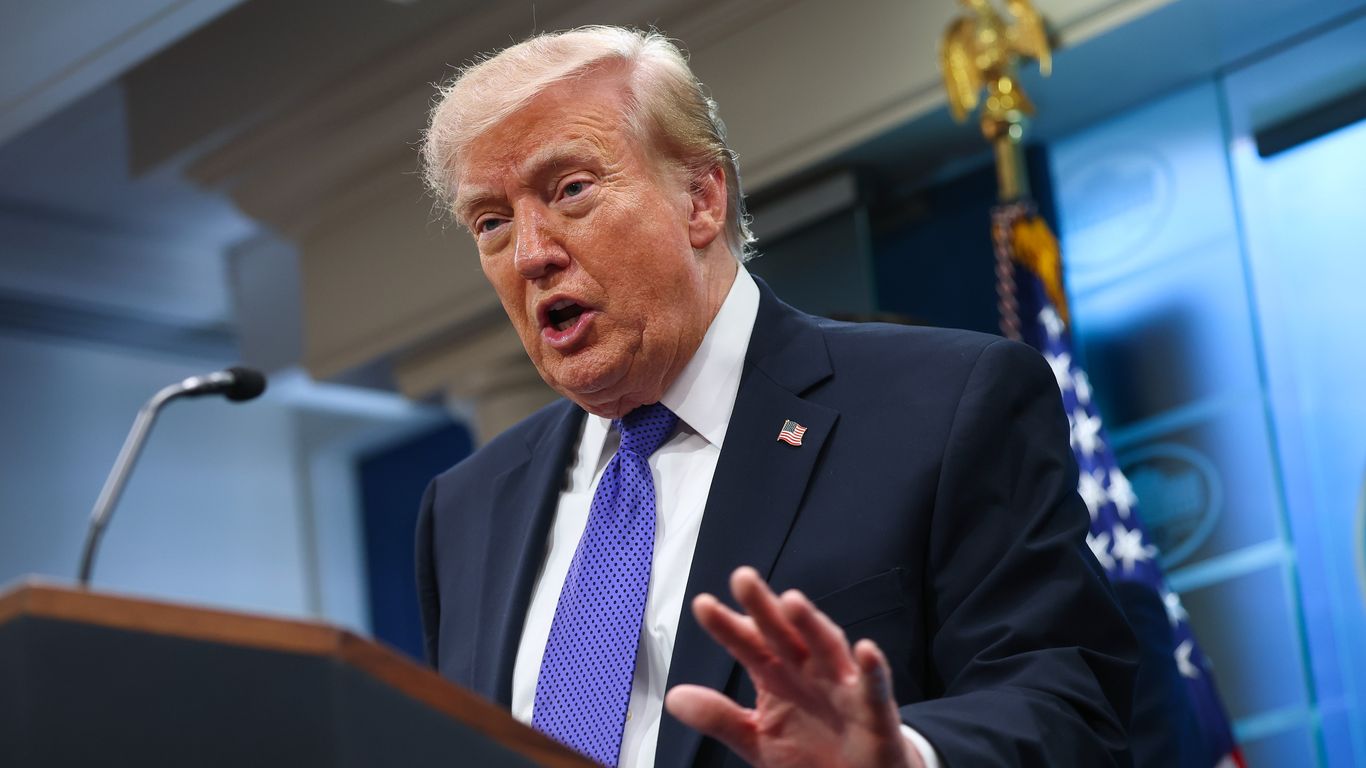
President Trump said Saturday he'd gladly work with Democrats to cap interest and fees on credit cards , arguing that card companies simply make too much money now. Why it matters: Though some argue capping rates would save consumers billions of dollars a year, the banking industry is equally adamant that it would deny credit to millions of Americans by making lending too risky. Driving the news: Trump, in a Fox News interview Saturday morning, was asked whether a rate cap on cards was something on which he could find common ground with Democrats. Sen. Elizabeth Warren (D-Mass.), poised to be the new chair of the Senate Banking Committee, is an outspoken advocate for such caps and has recently said she's ready to work with Trump to pass a bill. What they're saying: " I would do it. These credit card companies have made a lot — and the credit card fees that they charge. I'm all into it," Trump said . "I know that some people would say it's not free enterprise. But what's free enterprise when you're sitting home and you get a bill that some guy set up in an office on Park Avenue and they said 'let's charge a fee that's too high.' So I'm all for that," Trump said. "The credit card companies, they're getting too much. The fees are too high and the interests are too high." Context: The credit card industry argues that capping interest rates would reduce the revenue needed to cover losses when borrowers default, prompting lenders to reject more applicants. Reality check: This isn't the first time Trump has said he'd cap card rates. In January, he said on Truth Social he'd set a 10% cap for one year and any lender that didn't comply would face legal consequences. Nothing came of the threat, which credit unions claimed could deprive more than 47 million people of access to cards. Nonetheless, the mere idea was enough to send shares in major card issuers lower, and prompt a full-throated response from the industry. What to watch: As much as both Warren and Trump support the idea, it's not clear how much Democrats will want to prioritize it once they take control of Congress in January.
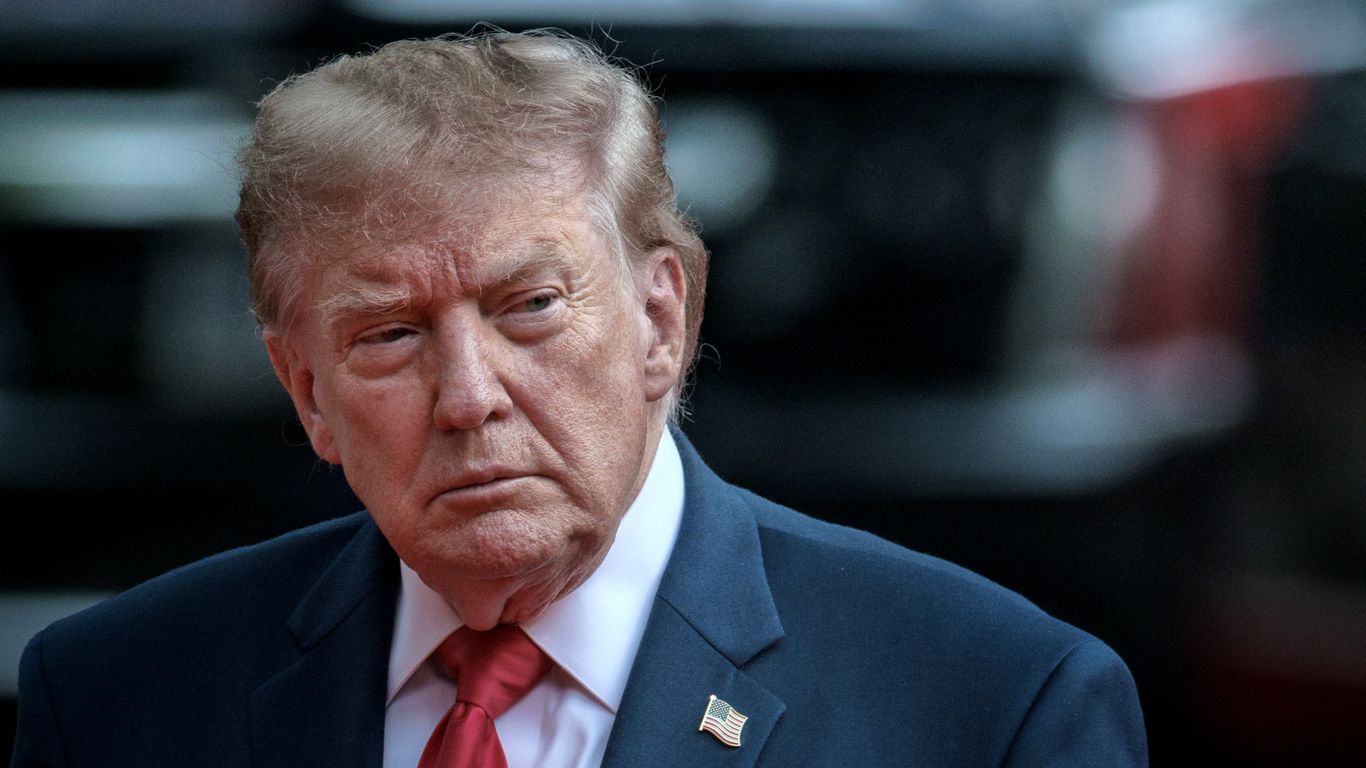
President Trump on Saturday said the reported hack of a crucial FBI database might have a silver lining — it could, he claimed, expose more details of what he called the " Russia Russia Russia hoax ." Why it matters: The president remains laser-focused on many of his past grievances about the FBI , even as the public grows increasingly alarmed about the vulnerability of government infrastructure. Driving the news: CNN and NBC reported Friday night that the FBI was looking into an apparent breach of the National Crime Information Center, which connects local and national law enforcement for information sharing. That follows breaches and outages that struck the FAA, NSA and USDA, just in the last week. What they're saying: Trump was asked about the FBI reports in a Fox News interview Saturday morning. "Well we just heard about it and I will say that it's not good, I don't like that," Trump said. "But maybe we'll learn things that we would have never learned otherwise. You had the Russia Russia Russia hoax, you had all these other hoaxes," he added, referring to Ukraine in particular. "Maybe we'll learn about them. Maybe we'll learn about the voter fraud, all the voter fraud that took place." "I always like to put things in a positive spin," Trump added. "Wouldn't it be great to learn about Russia Russia Russia," he said. The intrigue: The president's comments come just days after a summit with Russian President Vladimir Putin and Chinese leader Xi Jinping in Asia, after which he described Putin as a " friend ." What to watch: It's not clear who breached the FBI database, or what they might do with the data obtained.
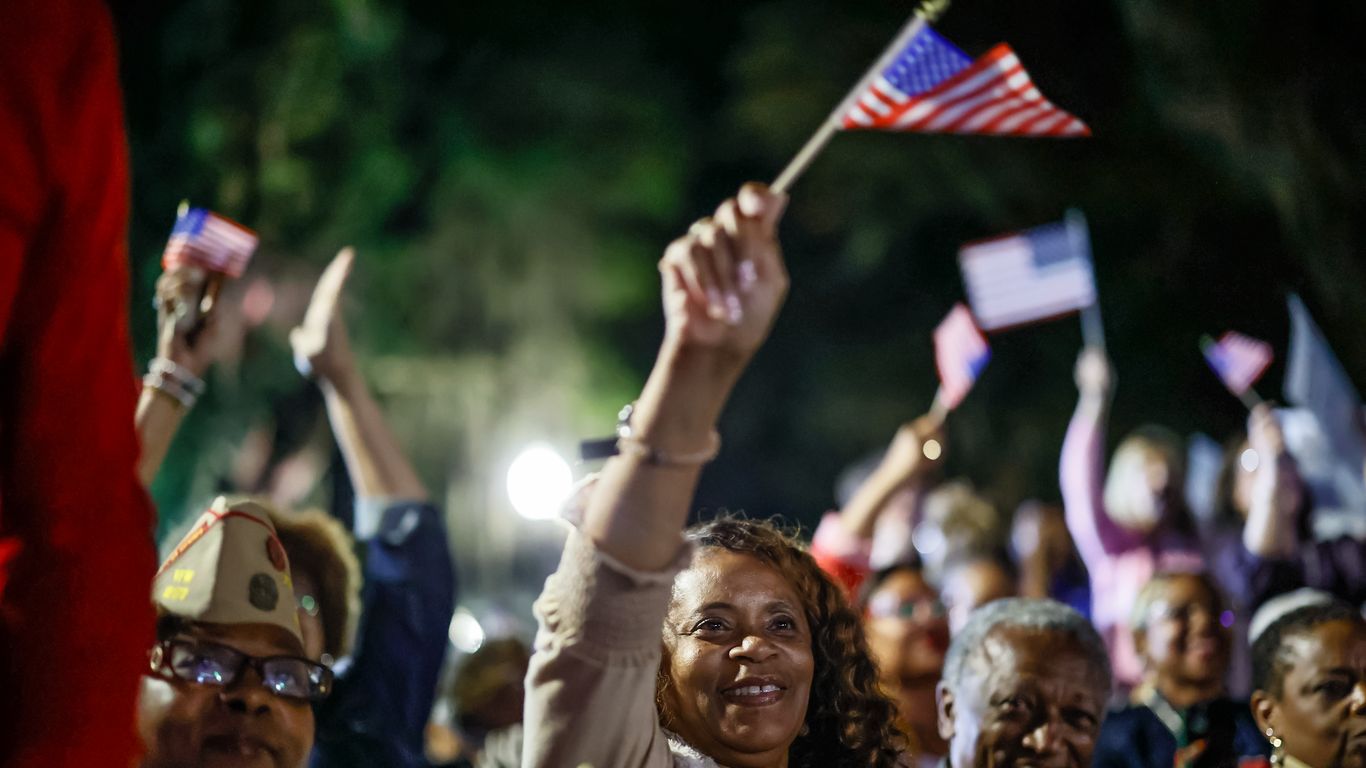
After years of being overlooked by national Democrats, Black organizers are using stunning Southern election upsets in the pursuit of something more lasting: a new generation of candidates who can win and govern. Why it matters: Activists say the 2026 midterms proved Southern races long dismissed as unwinnable could flip with grassroots organizing and investment. Now they're building a multiracial, working-class political bench — from school boards to statehouses. Organizers want to turn Black political gains into a durable Southern coalition united by economic interests, not just opposition to Republicans. By the numbers: The midterm election results gave organizers fresh ammunition. Roughly nine in 10 Black voters backed Democratic House candidates nationally, according to the AP Voter Poll . Democrats flipped 10 South Carolina House seats, seven won by Black candidates, ending the GOP supermajority, the South Carolina Daily Gazette reports. State of play: The Working Families Party plans candidate recruitment events in Georgia, Tennessee, South Carolina and Mississippi in early 2027, targeting community organizers, teachers, young activists and other political outsiders. It plans training, digital outreach and spending to support dozens of Southern candidates. Its Southern Made initiative aims to recruit and train 1,000 working-class candidates by 2030. Zoom in: South Carolina illustrates the opportunity. WFP-backed Jumelle Brooks , a home health care provider, lost a 2024 House race by roughly 700 votes before winning this year by nearly 10 percentage points. Another WFP-backed Democrat, Sonja Ogletree Satani , won a Charleston-area rematch. What they're saying: "We are building concentrated governing power," Britney Whaley, WFP's Southeast regional director, tells Axios. Whaley wants clusters of allies in elected bodies who can pass legislation, not isolated progressives powerless to advance an agenda. "Black people across the country voted for historic change, and now it's time for systemic policy change," Kristin Powell of Black to the Future Action Fund said in a statement to Axios. Zoom out: The Southern breakthroughs extended well beyond statehouses. Mississippi: Scott Colom became the state's first Black senator elected since Reconstruction. South Carolina: Annie Andrews won a long-shot Senate race. Georgia: Keisha Lance Bottoms became the nation's first Black woman elected governor; Democrats flipped the state House . Texas: James Talarico became the first Democratic U.S. senator elected since 1988. Yes, but: The South remains deeply Republican, and organizers say Democrats left winnable races on the table. WFP-backed Angie Nixon lost in Florida by roughly three points; Justin J. Pearson lost Tennessee's 9th District by 2,539 votes . The WFP spent about $200,000 on each race and argues more national investment could have tipped them. That's unproven. The intrigue: Pre-election findings from the 2026 Black Census , a nationwide voluntary survey by the advocacy group Black Futures Lab, found 95% of respondents planned to vote — yet just 3% trusted Washington and 22% trusted Black elected officials. Economic anxiety runs deep, with 44% hoping to escape debt, 35% to earn more and 25% to find affordable housing. Southern organizers now face a test of turning votes into economic relief, though the survey isn't representative of all Black voters.

A second federal judge will block construction on President Trump 's embattled arch set to be erected near Arlington National Cemetery , multiple outlets reported Friday. Why it matters: It represents yet another barrier to the multi-year project to build a 250-foot arch that challengers said would obstruct the line of sight between the Lincoln Memorial and Arlington National Cemetery. Driving the news: U.S. District Judge Leonie Brinkema said she will issue preliminary injunction that will indefinitely block the project, which she reportedly called a "rushed job" from the bench Friday. Zoom out: Brinkema's rebuke comes after D.C.-based District Judge Tanya Chutkan on Wednesday extended her separate order blocking construction on the arch for two weeks. Chutkan, who is overseeing consolidated challenges from military veterans and from the District of Columbia and Virginia, issued her initial temporary restraining order earlier this month. That order prohibited construction, excavation, land disturbance, utility installation and road closures related to the arch, Axios D.C.'s Mimi Montgomery reported. What they're saying: "The judiciary should not be abused to politicize a structure designed to unite our nation," White House spokesman Davis Ingle said in a statement. "We will continue making the case for this beautiful and fitting monument and are confident we will be fully vindicated as this litigation proceeds." The National Park Service did not immediately respond to Axios' request for comment. The other side: "We are pleased that the court has recognized the irreparable harm that will come to people who live and work in Arlington and stopped the massive vanity project while our case is heard and considered by the court," said Kate Talmor, senior counsel at Democracy Forward and an attorney on the case. She added, "We are honored to work with the Arlington County Board to stop the proposed arch from jeopardizing public safety." State of play: The legal hurdles came after the National Capital Planning Commission , which is stacked with Trump loyalists, gave its final approval for the project. Challengers, however, have argued the project requires congressional approval — and as Chutkan noted , "Congress has not enacted any statute authorizing construction of the Arch." Between the lines: The arch is one prime example of the president's quest to remake the nation's capital as he sees fit, from a sprawling White House ballroom to a community golf course . The NPS has backed Trump's arch, despite noting it "would alter several historic views." The FAA deemed the arch, which would sit near Ronald Reagan National Airport, safe for air travel, but said it should have "a non-standard eternal flame on top" and "floodlight projectors pointed" toward it. What we're watching: A Justice Department spokesperson said they would appeal the decision "immediately." Go deeper: The next two months are pivotal for Trump's D.C. projects Editor's note: This story has been updated with additional information.
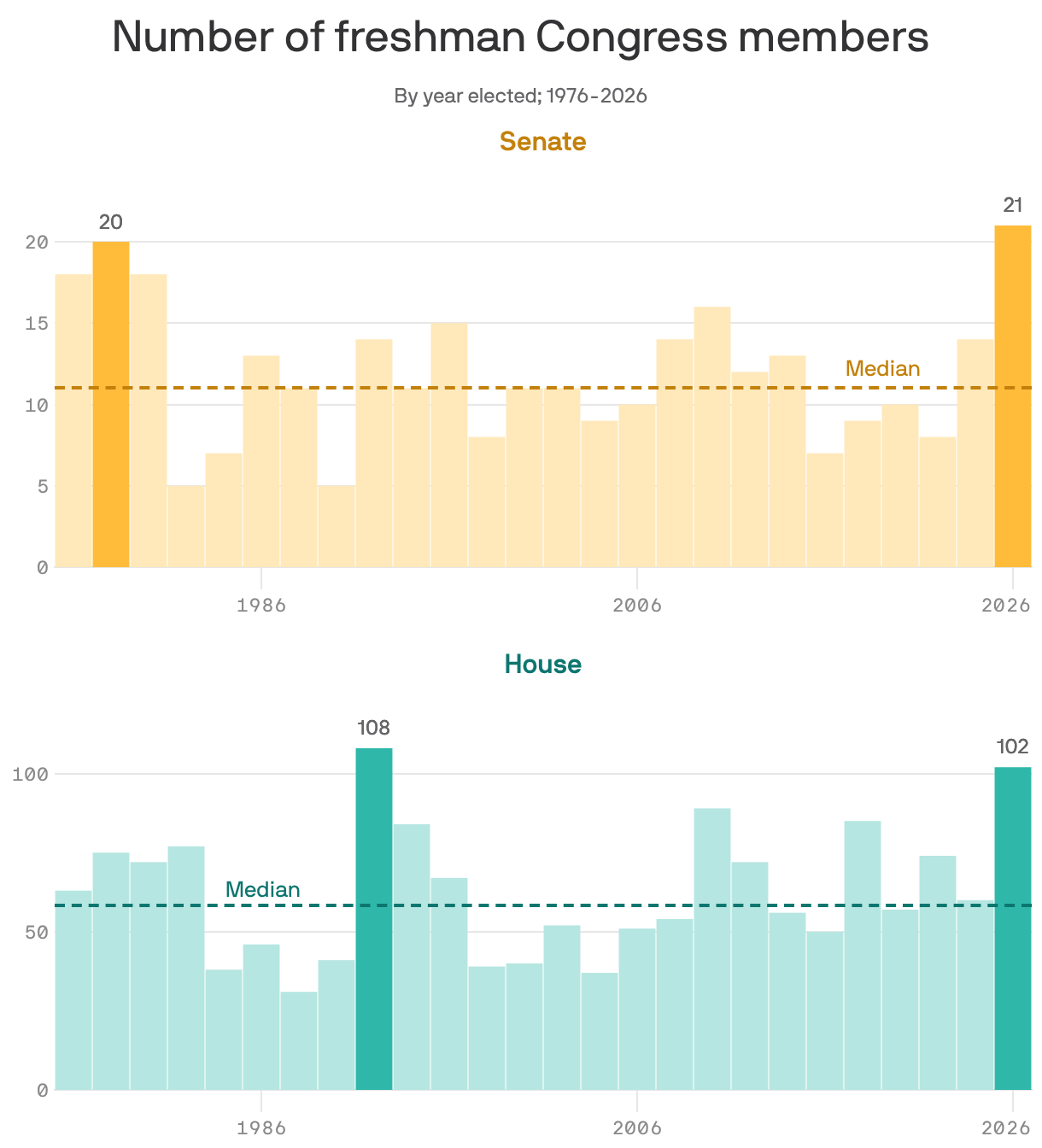
Senate data includes members who served nonconsecutive terms; House data does not. Data: House historian, U.S. Senate ; Chart: Erin Davis/Axios Americans want change , and they're about to get it: A perfect storm of congressional retirements, primary upsets, gerrymandering, flipped seats and lawmakers who died in office has created the biggest freshman class in decades. Why it matters : Congress had a 14% approval rating (not a typo) when Gallup polled registered voters in October. That's its lowest pre-midterm number since 1974. The big picture: The Senate is on track for its biggest freshman class since 1946. In the House, it's shaping up to be the biggest since 1992. Zoom in: The turnover featured data points that would be stunning on their own, let alone together. 28 House lawmakers chose to run for their next elected office outside the House, Pew noted in September. Six lawmakers died in office this Congress, the most in nearly 20 years. Thirteen House and Senate incumbents lost primary races. The bottom line: Congress is saying goodbye to former House Majority Leader Steny Hoyer (D-Md.), Senate Minority Whip Dick Durbin (D-Ill.), former Senate GOP leader Mitch McConnell (R-Ky.) and former Speaker Nancy Pelosi (D-Calif.). They've been in Congress since 1981, 1983, 1985 and 1987, respectively.
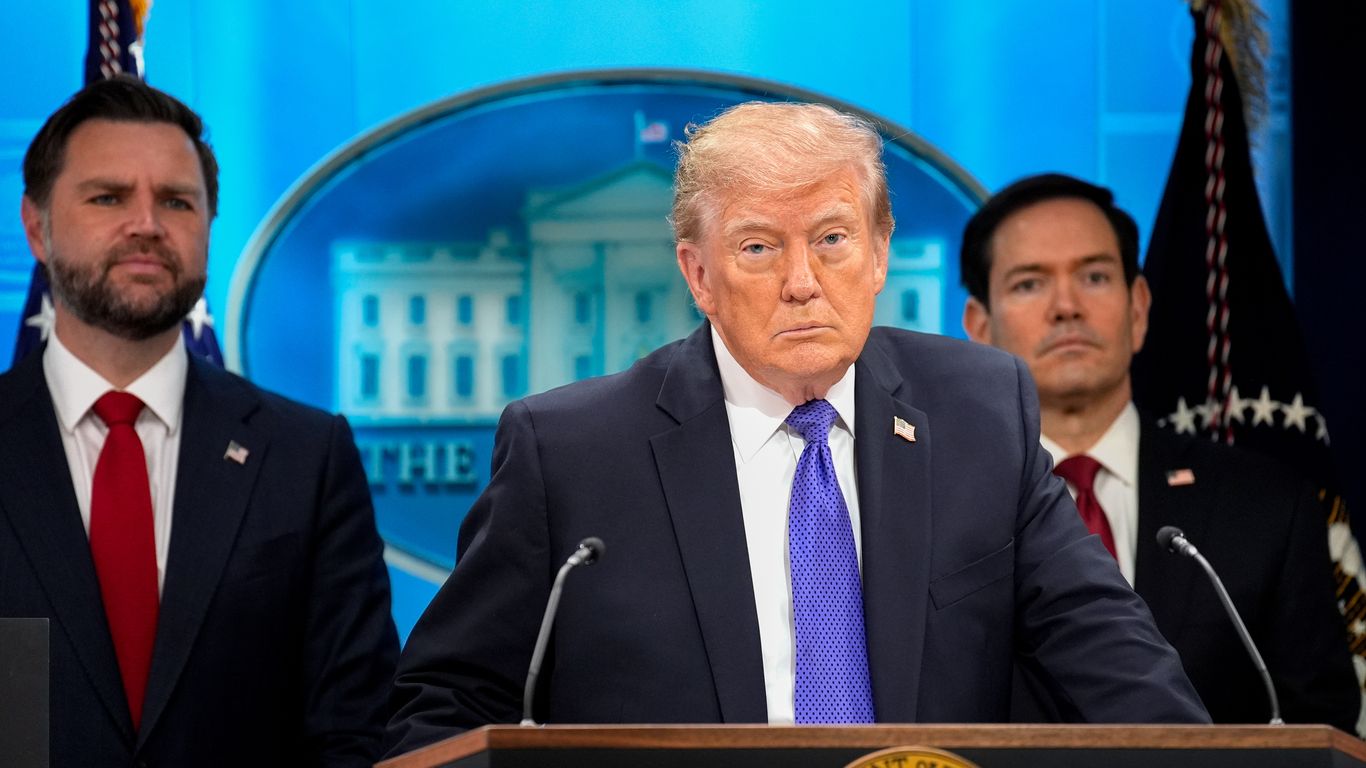
President Trump on Friday said he would block U.S. companies from building data centers overseas or impose a "tremendous tax" on them if they do. Why it matters: Trump's push to keep AI infrastructure in the country comes just weeks after data center expansion became a midterm-election flashpoint , as voters raised concerns about the environmental and financial impacts they pose. As of December 2025, 4,000 data centers were operational , with almost 3,000 under construction or planned across the U.S. What they're saying: Trump acknowledged that the announcement may come as a surprise, saying he had not yet discussed it with his own officials. "They're making so much money they don't know what to do with it," he said of the data centers being built across the country. Trump also claimed data center expansion would help lower Americans' costs and taxes. He also encouraged Americans to negotiate deals with companies proposing data centers in their communities. "They have plenty of money," he said. "Take it." Reality check: It's unclear how Trump would implement the proposed tax, since Congress has the Constitutional authority to impose federal taxes. Trump did not specify whether he would seek congressional approval or use existing executive powers to penalize companies that attempt to build data centers globally. Context: Data centers ballot measures illustrate just how polarizing they've become in the past year. Of the 53 measures on the ballot across 13 states through November 2026, voters favored limiting development in 52 cases, according to Ballotpedia . Democratic challengers also successfully weaponized AI policy , ousting Republicans in Ohio, Wisconsin, Arizona and Pennsylvania. Thought bubble from Axios' Ina Fried : Even companies that build data centers in the U.S. often need to have them in other places in order to have reliability, low latency and comply with various laws that require data to be processed in a specific region or country. Friction point: Trump's remarks followed a trilateral summit with China's Xi Jinping and Russia's Vladimir Putin, but seemed torn between praising Xi and warning about the threats China poses to the U.S. "We're not allowing data centers to go into other countries because China will take all of them, and we're not allowing that to happen," Trump said Friday. Yes, but: Trump also said Xi respected and congratulated the U.S. on its achievements in what he calls "super intelligence." Go deeper: Voters deliver "AI earthquake," rebuking tech and billionaires Editor's note: This story has been updated with additional information throughout.

Speaker Mike Johnson (R-La.) is warning House Republicans that their jobs aren't over yet after so many skipped town this week that GOP leaders had to call it quits. Why it matters: Republicans still have a month-plus left in the majority, but Johnson is struggling to get enough members to show up to make last-minute headway on the GOP's legislative agenda. GOP leaders were forced to cut the week short after 14 Republicans missed votes, leaving Johnson without the headcount needed to advance party-line legislation. Eleven of those 14 won't be returning next Congress. Driving the news: "To state the obvious, barring any serious medical issue, we need every Republican to be here to faithfully complete our full two-year term," Johnson wrote in a Friday letter to his colleagues . "The Twentieth Amendment to the U.S. Constitution specifies that our clock doesn't run out until noon on January 3rd," he added. Zoom in: The outgoing speaker pointed to government funding, the annual defense authorization bill and permitting reform as priorities for the final weeks of the Republican majority. He also said he wants to pass "every meaningful Republican bill that can garner 218 votes" and force Democrats to take politically difficult votes. "LET'S SCORE EVERY POINT WE CAN AND LEAVE IT ALL ON THE FIELD!" Johnson wrote.
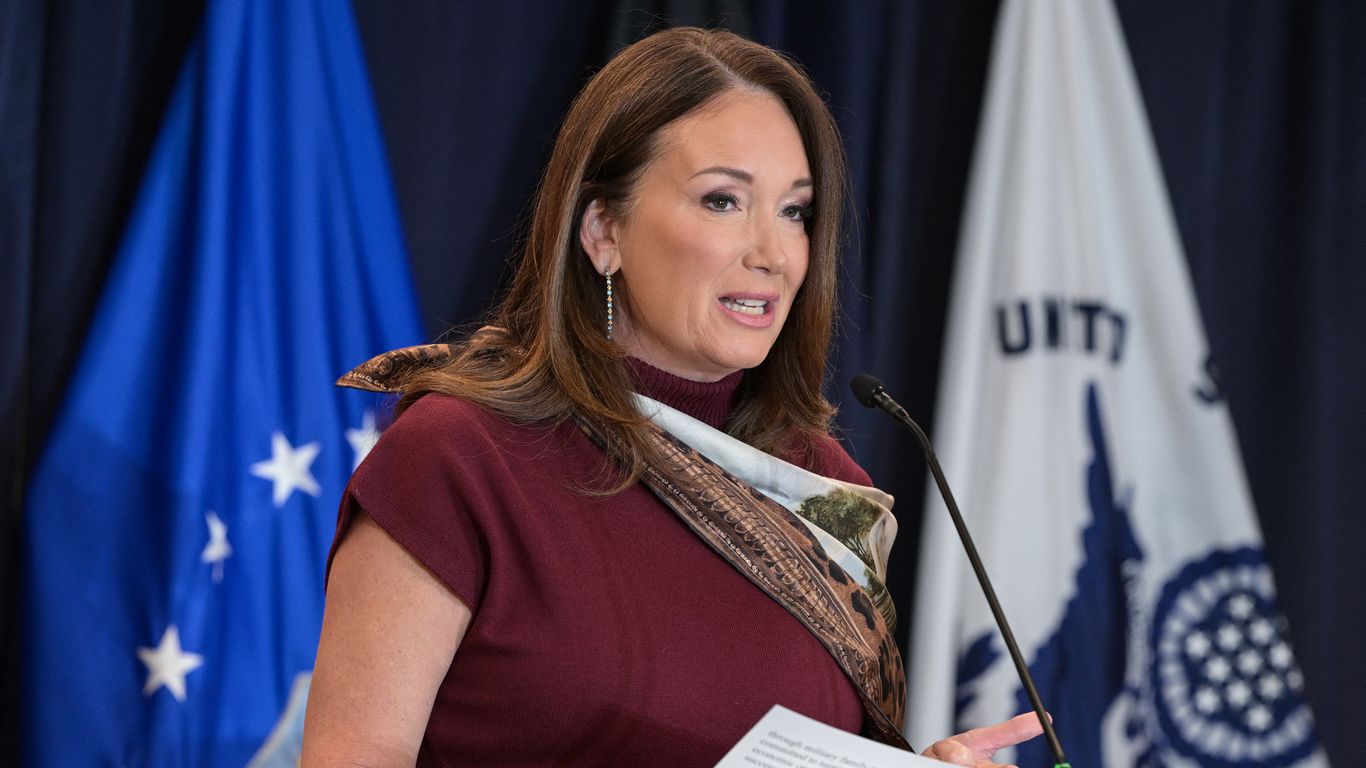
A federal judge said Thursday that Agriculture Secretary Brooke Rollins' overtly Christian messages to department employees went "too far" and put enough pressure on staff to raise a First Amendment violation. The big picture: The Supreme Court has repeatedly weighed the boundaries of the Establishment Clause . While the judge said Rollins could express her religious beliefs with interested colleagues, she concluded the department-wide messages overstepped those boundaries by amounting to coercion. But a USDA spokesperson slammed the decision as "a completely unprecedented attempt to muzzle a Cabinet Secretary" in a statement to Axios. Catch up quick: The complaint from a federal employees union and individual staffers alleged Rollins sent "increasingly proselytizing communications to the entire USDA workforce," including an Easter email where she celebrated "the greatest story ever told, the foundation of our faith, and the abiding hope of all mankind." The USDA employees who sued, who came from varied religious — and nonreligious — backgrounds, reported that the messages made them feel pressured to share Rollins' beliefs. What's inside: District Judge Trina Thompson ordered Rollins to "recognize certain boundaries when disseminating messages which convey religious content." She determined the messages overstepped and suggested "acquiescence that amounts to coercive pressure." "After reviewing and weighing the Establishment Clause jurisprudence, the Court finds that Secretary Rollins appears to exploit her position of authority to convey a religious message beyond mere holiday wishes and amounting to coercion," Thompson wrote. She said she was not trying to regulate Rollins' own religiosity; rather, she directed Rollins to follow her own department memorandum on religious expression rights, which states employees can't "use official authority to pressure subordinates." The other side: The administration argued that the employees lacked jurisdiction and that the secretary's messages fell "within this Nation's deeply rooted history and tradition of religious invocations in official discourse, including on holidays." Members of the Trump administration frequently discuss their Christian faith, though the president himself has had a complicated relationship with Christians despite the evangelical MAGA base helping him reach the White House. The DOJ did not immediately respond to Axios' request for comment. What we're watching: A USDA spokesperson said the department "is evaluating all options including a prompt appeal." Go deeper: Trump's push against "anti-Christian bias" hits federal workers
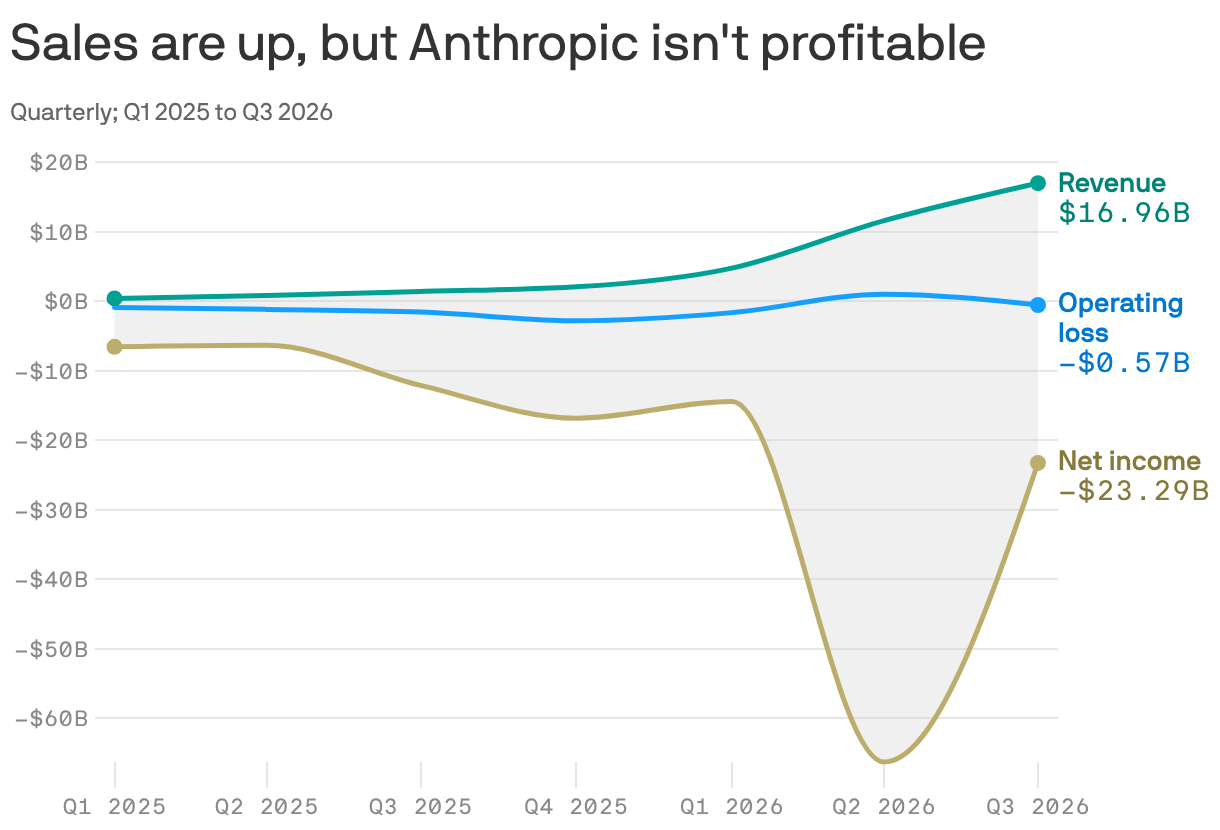
Data: FactSet; Chart: Matt Phillips/Axios With its IPO done and dusted, Anthropic's shareholders will be watching its progress toward becoming a business that doesn't need constant capital infusions from investors and vendors. Why it matters: Anthropic — along with OpenAI — is at the heart of the industry that's dominated the equity and debt markets for the last four years. Much of the AI infrastructure boom is ultimately aimed at supplying computing power to these two companies. Yes, but: The bill for that data center investment will start to come due over the next few years. And Anthropic and OpenAI are going to have to pay for quite a bit of it. How it works: Anthropic has covered much of its computing costs thus far by selling parts of itself off to compute vendors like Amazon and Alphabet, and by raising more cash from other investors. But eventually the company's core business will have to generate enough money to cover those costs on its own. Case in point: Anthropic's filings say it is on the hook for roughly $900 billion in spending commitments — mostly for data centers and computing power — with about half of that due before the end of 2030. After the IPO, Anthropic is expected to have roughly $200 billion in cash and short-term investments in the bank, which should buy it some time. But its sales will have to be a lot higher to just cover computing obligations, let alone the profits ANT's new shareholders are expecting. By the numbers: As the chart above shows, Anthropic posted a loss of roughly $23 billion on revenue of nearly $17 billion in the third quarter. It's true that much of that loss stems from a non-cash accounting charge of almost $22 billion. But even the more favorable metric of operating income — which strips out the paper losses and gains that can obscure the company's core earnings power — still shows an operating loss of more than half a billion dollars in the third quarter. The bottom line: Anthropic still has a long way to go before it is going to be standing on its own feet, financially speaking.

The internet's warring tribes converged Thursday for the loud, lawless debut of " Grand Theft Auto VI ," as 13 years of anticipation culminated in one of the great viral spectacles of all time. Why it matters: In a media landscape splintered into dozens of distinct realities, the GTA launch gave Americans a rare common obsession — refracted through vastly different platforms, personalities and worldviews. By Thursday night, GTA VI had generated an estimated $2.36 billion in sales from nearly 25 million copies — almost triple the first-day revenue of its record-breaking predecessor in 2013, according to Sensor Tower . The irony is rich: Amid political rancor and mounting technological anxiety, millions of people sought refuge in a virtual America gone gloriously, spectacularly off the rails. Zoom in: GTA VI drops players into Vice City, a fictionalized Miami that serves as a sprawling digital fever dream of violence, celebrity, corruption and distinctly American absurdity. Players can rob banks, steal planes, wrestle alligators and wreak havoc — or pass the afternoon fishing, shopping, working out and tending to the relationship between the game's central characters. The astonishingly detailed world teems with influencers, conspiracy theorists, criminals and social-media parodies, offering limitless opportunities for the outrageous encounters now flooding the internet. Zoom out: GTA's return has revived decades-old arguments about whether violent video games encourage real-world aggression, while igniting a far stranger debate over masculinity. On Fox News , commentators warned that the game's carjackings and shootouts could desensitize young players to crime. One contributor likened giving children the game to handing them a gun. Meanwhile, corners of the online "manosphere" expressed outrage over missions that reward players for buying flowers, running errands and showing affection toward their girlfriends. Between the lines: GTA VI was an internet phenomenon long before anyone could play it — the most expensive video game ever made, with years of delays that became memes in their own right. A vast economy of streamers, influencers and professional clippers mobilized around its historic debut, churning out viral entertainment for millions who may never touch a controller. At its peak, nearly 8 million people worldwide watched GTA livestreams simultaneously . Gameplay clips have already amassed tens of billions of views across X, TikTok, YouTube and other platforms. The GTA frenzy has spilled into the real world, upending work schedules and drawing corporations, politicians and even the military into the spectacle. A GameSquare survey found that 30% of employed U.S. gamers were considering taking time off to play. At Fort Stewart, Georgia, 43 soldiers committed to another two to six years of Army service after a four-day GTA gaming pass was included as a reenlistment incentive. Prediction market Kalshi received more than 33,000 applications for a job paying up to $135,000 to play GTA and study its virtual economy. Even the White House got in on the act, releasing a GTA-inspired Trump montage dubbed "WELCOME TO MAGA CITY XLVII" — turning a franchise long vilified by politicians into another viral marketing tool. The bottom line: GTA offers a glimpse of what monoculture looks like in 2026. For one extraordinary day, the internet had a common story — and a thousand different ways of telling it.

America's religious "nones" have gained a visible foothold in Congress: Five lawmakers will claim no religious affiliation in January, up from a single member just two years ago. Why it matters: Washington remains far more religious than the nation it represents. But the last two election cycles have put a series of cracks in that political glass ceiling. By the numbers: Religiously unaffiliated voters made up 27% of the 2026 midterm electorate, up from 23% in 2024, according to preliminary Fox News voter polling . Just three of 532 lawmakers surveyed at the start of the 119th Congress claimed no religious affiliation, according to Pew Research Center . Pew counted one additional humanist. All three lawmakers who claimed no affiliation — Reps. Yassamin Ansari (D-Ariz.), Abraham Hamadeh (R-Ariz.) and Emily Randall (D-Wash.) — won reelection in November. State of play: They'll be joined in January by Democratic Reps.-elect Chris Rabb of Pennsylvania and Fred Wellman of Missouri — who publicly acknowledged their nonreligious identities before winning their Nov. 3 elections. Rabb, a five-term state lawmaker representing a majority-Black Philadelphia district, won the seat of retiring Democratic Rep. Dwight Evans. Wellman, a retired Army officer, ousted seven-term Republican Rep. Ann Wagner in suburban St. Louis, flipping a longtime GOP stronghold. Their wins mark a breakthrough for congressional candidates who openly embraced their nonreligious identities before Election Day, according to Secular Coalition for America. Zoom in: Rabb thanked atheists for supporting his campaign after winning his May Democratic primary. Wellman defeated Wagner roughly 51% to 46%, according to Ballotpedia . His pitch? Affordability, corruption and accountability — not his lack of faith. Zoom out: The nonreligious political bench stretches well beyond Capitol Hill. More than 100 openly nonreligious lawmakers are expected to serve in at least 38 state legislatures, up from 81 in 33 states, according to the Center for Freethought Equality . Humanists, atheists or agnostics will serve in the legislatures of Georgia, Idaho, Illinois, Ohio and West Virginia for the first time, the Center for Freethought Equality reports. In Texas, Democrat Jon Rosenthal won a statewide race for the Railroad Commission, which oversees the oil and gas industry. He identifies as agnostic and "multireligious." Yes, but: Don't mistake "none" for a unified political creed. An October Pew survey found 81% of atheist registered voters and 75% of agnostics supported Democratic House candidates, compared with 48% of those claiming "nothing in particular." Nor did Rabb and Wellman break entirely new ground. Former Arizona Sen. Kyrsten Sinema, who left Congress as an independent after being first elected as a Democrat, identified with no religion when first elected to the House in 2012. Nothing in the results proves voters chose either candidate because of his religious identity. "It's not an anti-religious constituency by any stretch," Robert P. Jones, president and founder of the nonpartisan Public Religion Research Institute (PRRI), tells Axios. Jones said many religiously unaffiliated Americans grew up in churches, and some walked away over teachings about gay and lesbian people. Their political opposition, he said, focuses more on white Christian nationalism than on religion itself. Between the lines: The Constitution prohibits religious tests for office, but public expressions of faith have long carried political currency in Washington. The Congressional Freethought Caucus , founded in 2018, now counts 37 members — believers and nonbelievers — promoting church-state separation and science-based policies. Rabb and Wellman's victories suggest candidates can acknowledge a lack of faith without making it their campaign's centerpiece.
Democrats' sweeping electoral wins jump-started prospects for Medicaid expansion in red and purple states that rejected full expansions of the program under the Affordable Care Act. But budget realities could make newly elected Democratic governors pump the brakes. Why it matters: The changing of the guard sets up a test of whether states can expand coverage to more low-income residents right after Republicans in Congress weakened financial incentives for doing so. States that are facing serious budget shortfalls and daunting cost projections already are signaling they may defer until conditions are more favorable. State of play: Incoming Democratic governors in Wisconsin, Georgia, Texas and Kansas who campaigned on Medicaid expansion are now in a position to expand health coverage, and have more Democrats in their legislatures to help. Wisconsin Democrats have arguably the most leverage now that they've captured the state Senate and Assembly in addition to keeping control of the governor's office. Plus, the state already covers adults with incomes up to the federal poverty level. Expansion advocates in Georgia and Texas face a heavier lift, with Republicans still controlling at least one legislative chamber. And in Kansas, the GOP lost its supermajority in the House, a key obstacle in past Medicaid expansion fights, but still controls both chambers. Between the lines: Each state faces unique considerations. But one thing is true for all of the holdouts: The incentives for expanding aren't what they used to be. Though the federal government still would pay for 90% of the expansion cost, last year's GOP reconciliation law made major policy changes and cuts to the program. Expansion states now face stricter limits on provider taxes used to finance Medicaid, as well as on extra payments they make to hospitals and other providers to go beyond standard Medicaid rates. They've also lost an important bonus: A temporary 5% increase in federal assistance for newly expanding states expired at the beginning of this year. What's more, states will have to enforce new work requirements and document whether recipients perform 80 hours per month of work or other qualifying activities, or if they're subject to exemptions. While the Trump administration delayed the requirements for six months, they aren't likely to go away. What they're saying: "You're going to see a lot of [expansion] conversations start, but I don't think they'll be slam dunks. It's complicated and nuanced," said Matt Salo, a health care consultant and former executive director of the National Association of Medicaid Directors. Incoming Wisconsin Gov. David Crowley already is acknowledging that reality and exploring alternatives for expanding coverage in the near term, including establishing a state-run health insurance exchange with a public option, per the Milwaukee Journal Sentinel . In Texas, some lawmakers are considering a "trigger" bill that would start an expansion only if the incoming Democratic majority in Congress succeeds in rolling back some of the restrictions in the federal law, the Texas Tribune reported. Georgia Gov.-elect Keisha Lance Bottoms intends to pursue a full expansion next year, but also wants to streamline the state's existing limited expansion program, called Pathways to Coverage, as an interim strategy until full expansion is achievable, the Atlanta Journal-Constitution reported. Democratic victories in the Texas and Georgia lieutenant governor's races still could boost Medicaid expansion prospects, since the lieutenant governor presides over the state Senate in both states and influences which legislation is considered, Max Reale, an analyst for Gordon Haskett Research Advisors, wrote in a note. He pegged Wisconsin as the likeliest to expand its program and Kansas the long shot, since control of the governor's office alone failed to advance Medicaid expansion in past legislative sessions. But cementing the four as expansion states would diminish

Phoenix Mayor Kate Gallego wants more tech investment in her city — but on her terms, as data centers strain resources and frustrate residents. Why it matters: Phoenix has become a bellwether for the AI industry's growing demands on electricity and water in an increasingly hot, resource-constrained world. As the mayor, Gallego is navigating an outsized dilemma facing communities nationwide: How to embrace the AI boom while protecting residents and resources. "I do want us to lead in technology, and I want us to be a tech-forward community," Gallego said at a recent event co-hosted by the University of Chicago's Institute of Politics and Energy Policy Institute, and moderated by Axios. But she added: "I want companies who care about our community and will give back to it, and not just a race to see who can get the deepest incentives and the cheapest" power. "We're open for business, but we're not for sale," she said. Zoom out: Arizona's Democratic sweep could give Gallego more allies in her efforts to strike the balance she wants. Democrats flipped both legislative chambers and Gov. Katie Hobbs won reelection, giving the state full Democratic control for the first time since 1966. Affordability dominated the election, with data center subsidies and community impacts part of that debate, Gallego said. Catch up fast: Phoenix ranks fourth among major U.S. data center markets by operational capacity. Now the debate is expanding from how much development the region can accommodate to what communities should demand in return. State of play: Gallego, the longest-serving current mayor of America's 10 largest cities, has spent recent years trying to balance that. She helped push to eliminate Arizona's generous data center sales tax exemptions. The state enacted a three-year pause on new applications this summer. She opposes a blanket construction moratorium, favoring more local control over where facilities are built, particularly near homes. Phoenix adopted tougher zoning rules last year requiring special permits for new data centers. Gallego says communities should have more bargaining power over data centers, including where they're built and what residents get in return. That could mean more permanent jobs, transparency about electricity and water use, and benefits for neighbors affected by development. By the numbers: Data centers have requested so much electricity in the Phoenix region that, if all the projects materialized, they could account for roughly two-thirds of the area's power demand, Gallego said. Many may never be built, but Gallego warned: "That's not a balanced economy, and that's not economically sustainable." Friction point: Phoenix's efforts to rein in data centers have sparked legal challenges, with developers originally seeking roughly $750 million in compensation over zoning restrictions adopted last year. The city has granted several exemptions while fighting other claims in court. "We have been open and good partners to the industry, and it's deeply disappointing that they don't want to work with us," Gallego told Axios. The other side: Developers argue the restrictions infringe on their property rights and diminish land values, entitling them to compensation under Arizona law, though industry allies have also acknowledged tensions . Reality check: It's unclear whether Gallego can have it both ways: attracting more tech investment while limiting its costs to residents, especially as developers challenge the city's regulatory authority. Gallego is also navigating the tradeoffs between electricity, water and heat in the desert. Newer cooling technologies can reduce water consumption at data centers but often require more electricity, shifting some of the water footprint to power plants. "We're seeing many of these data centers get power from natural gas plants in an area of our state that is very constrained around water," Gallego said. The intrigue: Data centers are adding another source of heat to a region alr

The Senate passed a sweeping, bipartisan bill Thursday night that's designed to cut permitting timelines for energy and infrastructure projects. Why it matters: The eyes of the entire energy industry are on this bill. If it becomes law, it could transform how America builds energy infrastructure, with major implications for everything from electricity costs to data centers. Getting rid of bureaucratic hurdles and creating a more predictable process for energy projects is a top priority for the fossil fuels and renewables sectors. But critics argue the plan, which has White House support, would unacceptably weaken environmental protections and the rights of Native American tribes. Driving the news: The vote was 62-33. The bill would still have to pass the House before the end of the year, and any differences would have to be worked out by both chambers before President Trump could sign it into law. Catch up quick: It would make significant changes to federal permitting, including: New limits on the duration of lawsuits, and the scope and length of reviews under the Clean Water Act and National Environmental Policy Act. Language that would make it more difficult to revoke permits once they're issued, a priority for renewables groups and Democrats upset with Trump administration barriers. State of play: There are also provisions to ensure that data centers pay for needed grid upgrades, and expand federal authority over the siting and approval of certain interstate transmission projects. Friction point: Many environmental advocates argue that the bill would dangerously erode safeguards in the National Environmental Policy Act and other laws. Multiple tribal groups still oppose it despite changes aimed at easing concerns about consultation on historic preservation. Energy and business groups, ranging from renewables developers to manufacturers to the oil and gas industry, are lobbying for the measure. The AFL-CIO and many individual unions back it, too. What's next: The measure now heads to the House. Speaker Mike Johnson (R-La.) told Bloomberg last week that he expects to have the votes to pass the plan. Some Democrats have called for hitting the brakes, with some arguing they can write a better package when they control Congress next year. Yet multiple backers within the wider Democratic coalition argue there isn't political space for an altered bill that President Trump would sign.
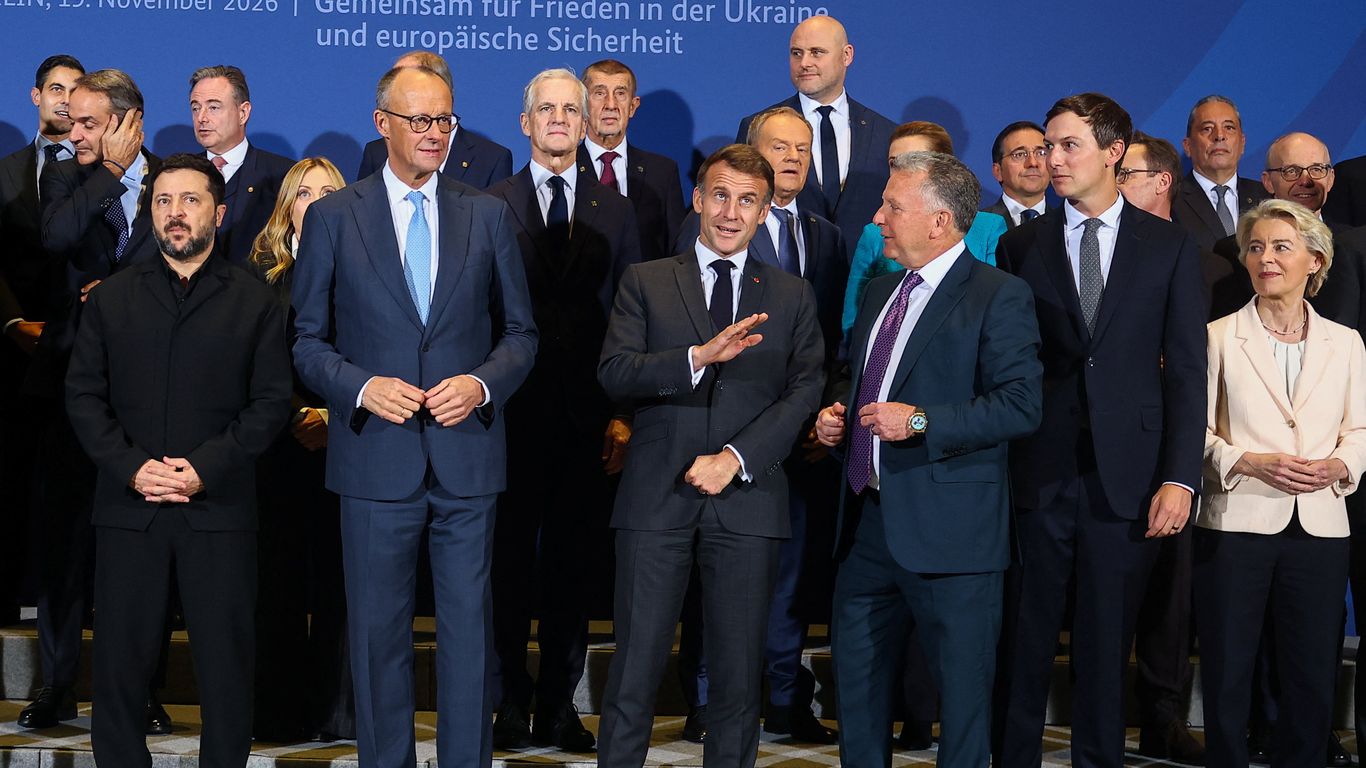
On his way back from China Thursday aboard Air Force One, President Trump called in to a meeting his envoys Steve Witkoff and Jared Kushner were holding in Berlin with a group of European leaders and Ukrainian President Volodymyr Zelensky. "Putin wants to end the war, he wants the deal done, he is getting tired of this," Trump said, according to people in the room. Why it matters: Instead of turning his historic trilateral summit with Chinese President Xi Jinping and Russian President Vladimir Putin into a modern-day Yalta Conference, as some European and Ukrainian officials feared , Trump tried to use it to propel his push for peace in Europe. Driving the news: Trump met Putin Thursday on the sidelines of the summit in Shenzhen. Their meeting wasn't originally on the schedule, but Trump wanted to discuss diplomatic efforts to end the war in Ukraine directly with the Russian president, a U.S. official said. "Who is he? He's my friend," Trump said when he entered the meeting room where Putin was waiting. Later in the day, Witkoff and Kushner told European leaders in Berlin that Trump pressed Putin to move on the peace talks, telling the Russian leader that now is the time to get a deal, according to a European official. Trump also asked Xi for his help in ending the war during their bilateral meeting. "He sent a very strong message to both of them [Putin and Xi] on the desire for peace, and would like to engage both of them very aggressively to get there," Kushner said at a press conference on Thursday. Behind the scenes: As Trump wrapped up his meetings in China and headed back to Washington, his envoys started their talks with German Chancellor Friedrich Merz, French President Emmanuel Macron, British Prime Minister Andy Burnham, Zelensky and other European leaders. Kushner and Witkoff tried to reassure the group that Trump doesn't intend to cut a deal with Putin over their heads. "President Trump wants to make a deal with Europe by his side. He's not looking to impose anything unilaterally," Kushner said. Shortly after, when Trump called in to brief the European leaders, he urged them to engage directly with Putin. "Friedrich, you can make a call to Putin and this will make a deal," Trump said, referring to the German host. Trump added, "Xi respects Zelensky. Putin is ready to do the deal. Zelensky can do a great deal." What they're saying: A European official said the talks in Berlin were substantive, unlike the summit in Shenzhen, which was mostly symbolic. "We think we have good coordination between the U.S. and Europe," the European official said. State of play: One of the key U.S. objectives at the moment is to get Europe directly involved in peace talks between Russia and Ukraine. At the same time, U.S. officials also want Europe to engage in talks with Russia on a new European-Russian security agreement . Putin said publicly for the first time Thursday that he is open to allowing the Europeans to participate in peace talks with Ukraine. "We understand that it is pointless to discuss security issues, including those in Europe, without them," he said at a press conference after meeting with Trump. Putin added that Russia needs to understand what the Europeans are prepared to bring to the negotiations. Putin also signaled willingness to present an updated proposal for a security agreement with Europe. "Life changes, so it makes no sense to return to geopolitical realities of the 1990s," he said. What to watch: After the leaders' meeting in Berlin, Kushner and Witkoff huddled for another few hours with Zelensky and national security advisers from Germany, the UK, France, Italy and Poland, as well as senior officials from the EU and NATO. The group coordinated ahead of the next round of talks with the Russians, possibly next week. The European official said the group was skeptical Russia will actually allow Europe to participate in peace talks. The bottom line: U.S. officials said their goal is to get the Europeans and Rus
House Republicans chose fighter Jim Jordan over the more experienced Steve Scalise to lead them after taking a midterms beatdown. Now they're facing a similar choice over who should lead them on House Oversight. Why it matters: Whoever gets the top Republican spot on the Oversight Committee will be the first line of defense on some of the most deeply personal issues for President Trump and his inner circle. A pair of Texas House Republicans, freshman Rep. Brandon Gill, 32, and three-term Rep. Pat Fallon, 58, want the job that could make them a national star, or leave them taking the heat if Democrats land damaging revelations. Driving the news: Democrats are preparing a barrage of investigations that target Trump's family, finances and closest advisers. Rep. Robert Garcia (D-Calif.), who is running to chair House Oversight next year, sent a dozen letters Wednesday targeting figures including Donald Trump Jr., Eric Trump, Jared Kushner and Vice President Vance. Democratic allies want a plan "to compel disclosure and testimony," according to a letter obtained by Axios that was signed by 103 groups — led by Public Citizen and Indivisible — and sent to all Democratic members of Congress on Tuesday. The White House is pushing back on Hill Democrats, with its top lawyer warning that some Democratic investigative tactics could cross into criminality. Zoom in: Gill has made a name for himself with fiery committee confrontations and viral moments. He's also proven to be a prolific fundraiser. "Gill is the next Jim Jordan," a source close to Jordan told Axios. "He practices, he's smart." Fallon has served on Oversight since arriving in Congress in 2021. He previously chaired Oversight's subcommittee on economic growth, energy policy and regulatory affairs. "I've built great relationships and a clear resume of rigorous, result-oriented oversight that reflects what the committee has achieved on behalf of the American people," Fallon told the Texas Tribune in September. Between the lines: Gill's lack of seniority doesn't appear to be a major obstacle among Republicans eager to elevate one of their top fighters. "It will be a tight race with he and Fallon. Brandon is quite capable and will do a great job if elected. Not worried about his experience," a member of the House Republican Steering Committee told Axios. The Steering Committee recommends who should lead committees, subject to a vote of the full House GOP conference. The intrigue : Fallon backed Steve Scalise in the GOP party leader race, and lobbied against Jordan's preferred makeup of the Steering Committee. Gill publicly supported Jordan, calling him the "original congressional brawler." State of play: Gill has close ties to Jordan and the public backing of House GOP Whip Tom Emmer (R-Minn.). Multiple people Axios spoke with believe Gill has effectively locked up the support needed to win. But others cautioned that the race will be competitive, with one House Republican telling Axios that "anyone that says there's a favorite at this point is bad at whipping." "This is a purely messaging game for the next two years. And if I'm looking at who the better messenger is, I mean it's a clear choice," a senior GOP leadership aide said of Gill. What they're saying: "He's smart. He's good looking. He's the future of the party. We need to push him out front every minute instead of these old guys that we keep dusting off," Rep. Tim Burchett (R-Tenn.), who sits on the Oversight Committee, told Axios of Gill. "Paying their dues has gotten us killed at the ballot box every dadgum time," Burchett added of elevating more senior colleagues. Yes, but: "He's kind of skipping a few steps here, and he doesn't necessarily have the credentials to do it," one House Republican told Axios of Gill's bid in October. Axios previously reported that some members of the Freedom Caucus want Gill out, with colleagues accusing him of burning bridges and treating fellow Republicans as stepping stones to greater powe

House Democrats are largely steering clear of threats to shut the government down in December if Republicans put forward legislation that maintains funding for the war in Iran. Why it matters: Much of the party's left flank — including some members of Congress — think it's a fight they need to pick after their midterm landslide. "The American people were loud and clear on November 3rd: they want an immediate end to Donald Trump's reckless war in Iran," Reps. Yassamin Ansari (D-Ariz.) and Ro Khanna (D-Calif.) said in a joint statement on Wednesday. The pair said they will "oppose any funding package that does not explicitly prohibit funds from being used for offensive operations in Iran" because it would "defy the demands of Americans who want this war to end—now." State of play: The Democrats' majority doesn't officially begin until Jan. 3, while federal funding is set to run out on Dec. 11. Republican leaders are struggling to pass party-line procedural votes and will probably bring up their funding patch under a fast-track process that requires bills to pass with a two-thirds majority. In other words: The GOP will almost certainly need a large number of Democratic votes to pass any funding bill, especially if some of their own members defect. What they're saying: "Whatever they have to do to get it through they should do it, but I hope there's not a shutdown," said Rep. Brad Schneider (D-Ill.), the outgoing chair of the center-left New Democrat Coalition. "I don't think we should shut down the government, we take that way too casually as it is, so I'd be leaning into not doing it," said Rep. Scott Peters (D-Calif.). Said Rep. Greg Landsman (D-Ohio): "Everyone should do whatever they can to avoid a shutdown. The impact it has on the economy, but workers in particular, it's just not fair." Between the lines: Even some progressives acknowledged their imminent House majority takes a lot of the pressure off the December fiscal deadline. "If I can defund [the war] in December, I'd vote to defund it. But if I can't, then I'll vote to defund it in January," said Rep. Jim McGovern (D-Mass.). "We still have a month left of these guys." Said Rep. Delia Ramirez (D-Ill.): "One would argue that we can move a CR, maybe keep it at base [funding levels] ... but then we negotiate the kind of budget we know we expect." Yes, but: "I think we should do everything in our power to keep it in there, and we should also figure out how to claw back some of this ICE funding," Ramirez added. Said Rep.-elect Angela Gonzales-Torres (D-Calif.): "The American people have waited too long, they want to see us try now. ... When we fight we win, and we certainly don't win unless we try. I think we should try." Joseph Geevarghese, executive director of left-wing group OurRevolution, said in a statement: "Voters gave Democrats more power because they wanted a change in direction." "This is a chance to show them, before January, that their votes changed what Congress is willing to do," he said. The bottom line: Ansari told Axios in an interview on Thursday that she is "personally drawing a hard line on any funding for the war" but agrees "with the sentiment that, especially during the holidays, we are concerned about our federal workers." "Nobody wants a government shutdown. There's no question of that. I don't want there to be a government shutdown," she said. "I just think we should be able to both: Not have a government shutdown and ... deliver on what I think was the resounding message from voters, which is that the war in Iran needs to end."
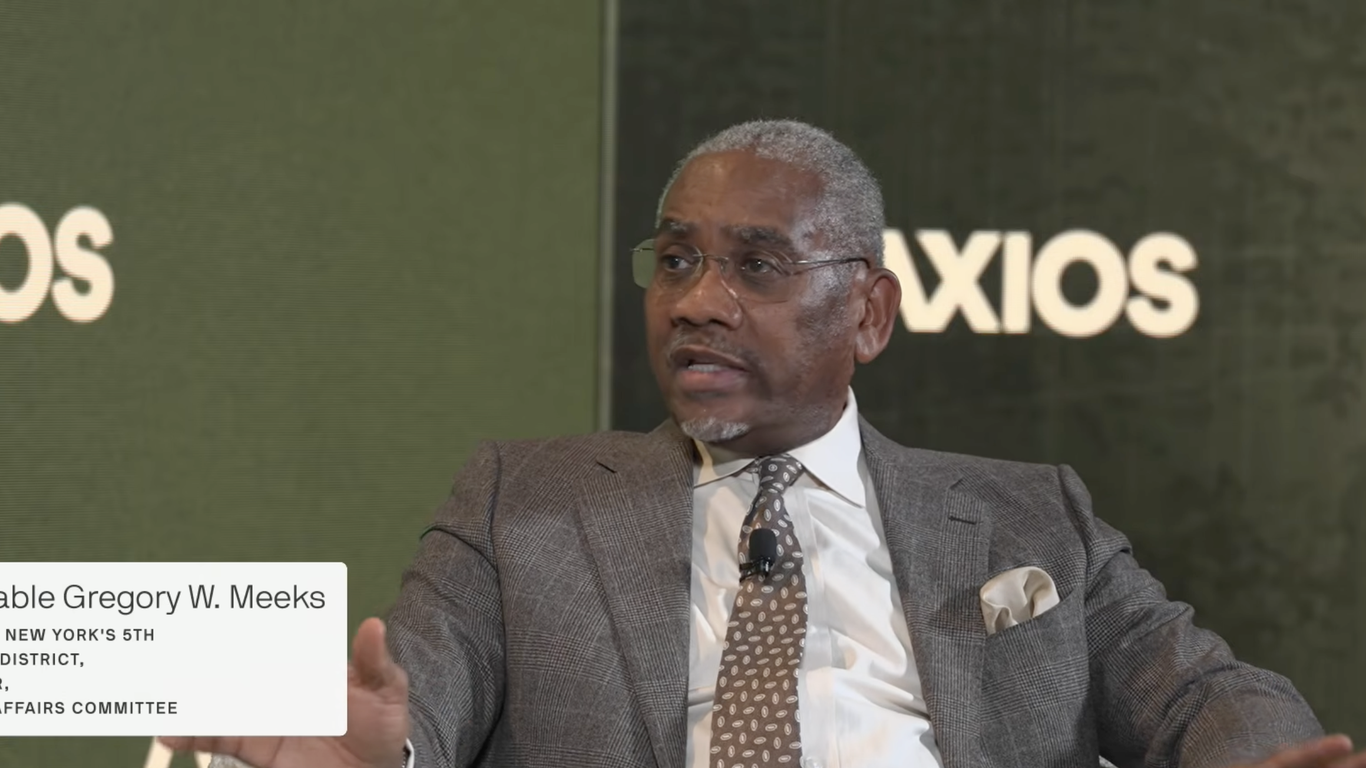
Rep. Gregory Meeks (D-N.Y.) said Thursday Congress is going to reclaim powers long ceded to the executive branch at the Axios Future of Defense summit. Why it matters: As the top Democrat on the House Foreign Affairs Committee, Meeks is putting the Trump administration on notice that it's foreign policy decisions are going to be challenged through legislation and oversight hearings. What they're saying: "Whether it's a Democratic president or Republican president, we've ceded too much and we've got to stand up and take it back," Meeks told Axios' Colin Demarest. "We do, at times, have to make some difficult decisions, and not just punt them away to the executive branch, because when you do that, it's hard to get them back." Meeks also suggested that incoming House Speaker Hakeem Jeffries (D-N.Y.) may be willing to take the Trump administration to court if needed to enforce congressional oversight. "If it takes some litigation to do that, we will do that," Meeks said. "Speaker Johnson wouldn't do it. I think Speaker Jeffries will do it." Catch up quick: Meeks will likely become Foreign Affairs committee chair in January, riding the blue wave that gave Democrats the ability to control Congress' legislative agenda. Zoom in: Meeks didn't rule out calling Secretary of State Marco Rubio to testify before the committee. "The jurisdiction of the House Foreign Affairs Committee is the State Department," Meeks said. Later, he added more broadly, "[y]ou can run, but you can't hide... We're going to use the power that the committee and the Constitution gives us to make sure that we're calling in members of that administration, so they have to answer to the American people, why what has taken place has taken place." Zoom out: Meeks has already sent document-preservation letters to seven agencies, including the State Department, USAID and the U.S. International Development Finance Corporation, warning them to avoid destroying records that could be relevant to oversight efforts. He threatened the possibility of criminal referrals if someone is found to have done otherwise. What we're watching: Meeks said Democrats plan to address affordability concerns and introduce another War Powers Resolution aimed at the Iran war. He also floated litigation and using Congress' power of the purse, including withholding funds, as ways to force the Trump administration to comply. "The people have spoken loudly and clearly that they are against the war in Iran," Meeks said. "They see how foreign policy directly now connects to domestic policy." He added that Democrats need to investigate what's happening in the Middle East, and explain to Americans what's at stake in the war. "That is the job, a part of the job, of the Foreign Affairs Committee, and that's exactly what we're going to do on day one." Editor's note: This story has been updated with additional information throughout.
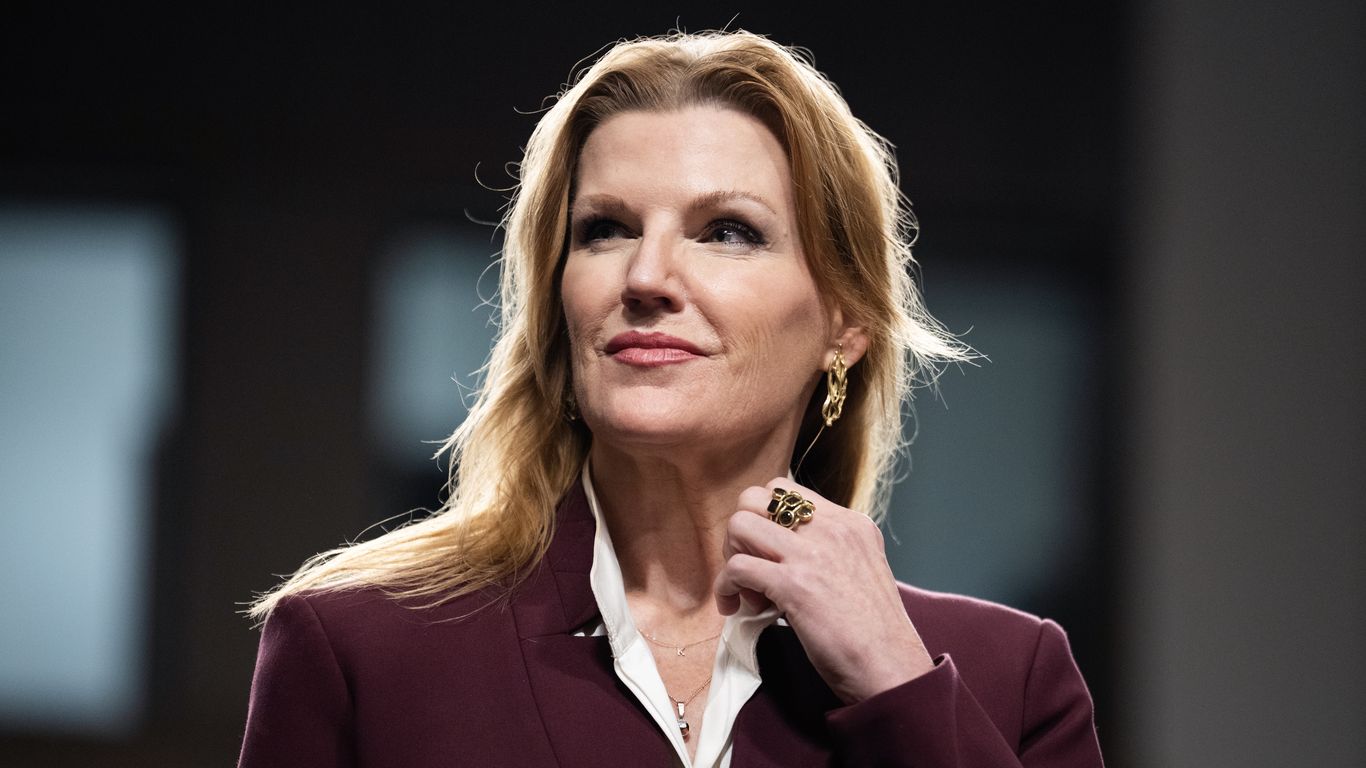
The White House named Kirsten A. Davies to be its new national cyber director Thursday as President Trump overhauls his AI team, Axios has learned. Why it matters: Davies, who currently serves as the Pentagon's chief information officer , has more experience in the field than the outgoing director , Sean Cairncross . Cairncross' departure was described as amicable by two sources. But two White House officials said President Trump's new chief of staff, Stephen Miller, sought the change and pushed out Cairncross because, one said, he "lacked the strong cyber credentials to perform the job." Zoom out: The Office of the National Cyber Director coordinates cybersecurity policy and strategy across the federal government. The position requires Senate confirmation. Davies previously was cleared by the Senate as the Defense Department's chief information officer. "Kirsten has the credentials to excel in this position and has already been Senate-confirmed," an administration official said. At the Pentagon, Davies has been the top adviser to Defense Secretary Pete Hegseth "on all matters relating to information management, information technology, cybersecurity, and information assurance," according to her bio. Before serving in the Trump administration, Davies worked for Unilever and "led global cyber resilience for one of the world's largest consumer goods enterprises," her bio says. Davies' career also has included technology and cyber roles at Estée Lauder, Barclays-Africa Group, Hewlett Packard and Siemens. She founded the Institute for Cyber, a nonprofit organization dedicated to citizen safety and security in the digital universe. State of play: The administration's AI team has taken shape on the fly , but Cairncross was involved in key decisions. He held technical meetings with Anthropic leaders over the summer after Commerce Department export controls effectively scrubbed the company's models from the internet. Cairncross brought experience in Republican politics and national security, having worked with the intelligence community and dealt with cyber threats at the Republican National Committee. During Trump's first term, Cairncross represented the White House chief of staff on National Security Council committees before leading the Millennium Challenge Corporation, a federal foreign aid agency. Cairncross' head of policy and senior adviser Thomas Lind left in June and joined OpenAI in October, further depleting the Trump administration of technical expertise. The big picture: The latest turnover in cyber personnel comes as the country grapples with critical infrastructure outages and increasingly powerful AI poised to empower cyber defenders and hackers alike. Democrats have criticized the administration's response to outages and warned that U.S. cyber defenses are falling behind AI-fueled threats. What we're watching: Trump is also filling other key cyber positions. His pick for the top job at the Cybersecurity and Infrastructure Security Agency, which helps defend federal civilian networks and critical infrastructure, Palantir executive Michael LoSapio, faced a combative confirmation hearing Thursday. What they're saying: In a written statement, Cairncross said, "it has been the honor of a lifetime to serve President Donald J. Trump. I leave my role as Director of Cyber incredibly proud of our work to strengthen America's cybersecurity, protect our critical infrastructure, confront foreign threats, and position America to lead the world in Super Intelligence." This story has been updated with details on Davies' appointment and background.
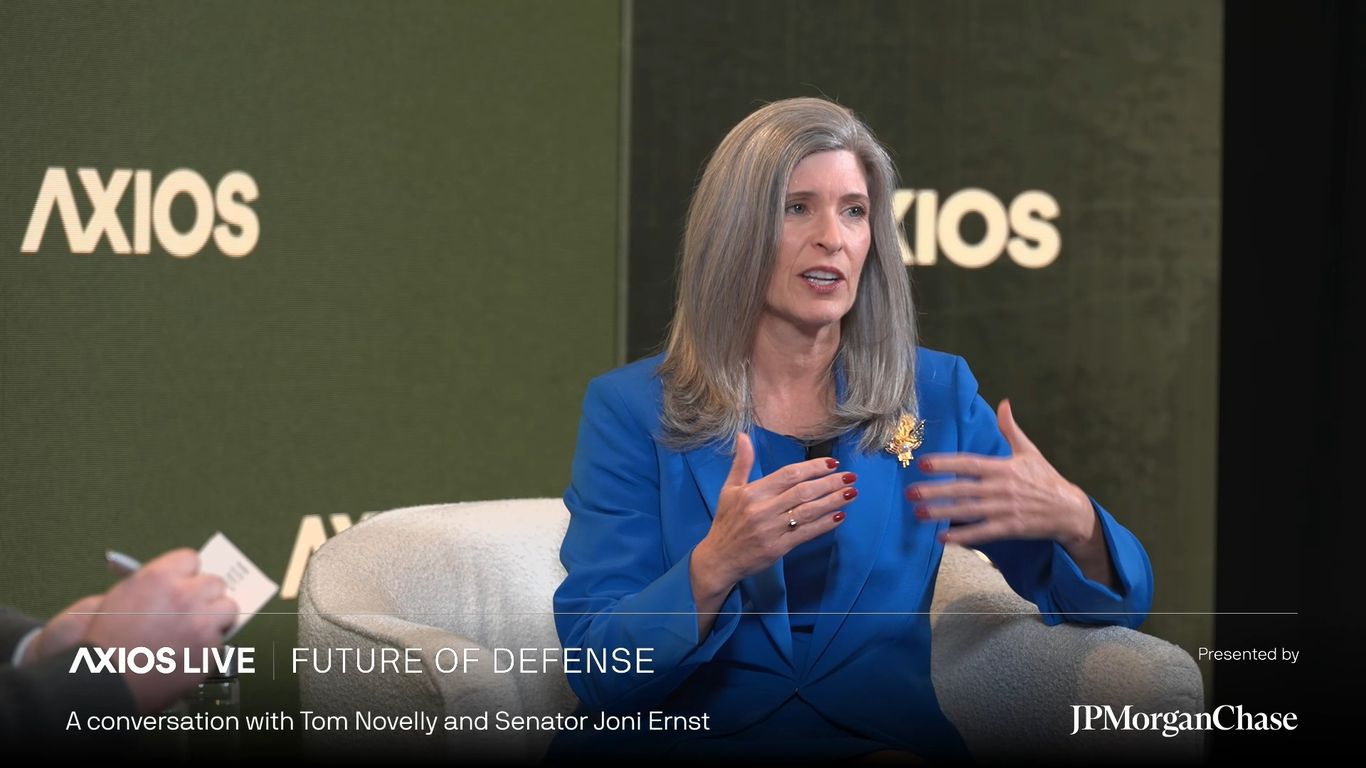
Sen. Joni Ernst (R-Iowa) said "a lot of people would be able to guess" if she regrets voting to confirm the embattled Defense Secretary Pete Hegseth, during Axios' Future of Defense Summit Thursday. Why it matters: The retiring Iowa senator, who served in the military for more than two decades, has been notably skeptical of Hegseth and hasn't always been in lockstep with the Trump administration. Catch up quick: Despite her hesitancy over his nomination, Ernst ultimately voted to confirm Hegseth . However, she's continued to question him throughout his tenure. She recently asked whether the embattled Pentagon leader has been "truthful" about the status of the Iran war, which she said Iowans rejected in the midterms. "If there is deception coming from our Pentagon and being transmitted to the president, I would want to know that," Ernst told reporters earlier this month. Driving the news: "There is very little transparency right now with what is being discussed between the White House and the Department of War," Ernst said of the Pentagon's communication about the war in Iran in a conversation with Axios' defense and space reporter Thomas Novelly. "As Congress, we would expect that we would be read into some of those conversations, and unfortunately, we have not been read into those conversations," she added. That's made it "difficult to know" the state of the war and its impact on munitions levels , she said. Friction point: House Republicans blocked an impeachment effort against Hegseth earlier this month, but the reprieve may be short-lived with a Democratic majority taking control in January. "I think we would be having a very different conversation today, if the House Democrats had actually showed up for that vote," Ernst told Axios, a nod to the 11 members who missed it, some citing traffic delays. "So, now they will face it again come January, likely, and that will be up to the House Democrats to decide how they handle that," she continued. "And then, certainly, if they decide to move forward with impeachment, then Senate Democrats will also have the majority." State of play: Ernst sits on the Senate Committee on Armed Services, where she chairs the Emerging Threats and Capabilities subcommittee. "In the past 12 years, while I have been in the Senate, the Armed Services Committee has been one of the most bipartisan committees in the Senate, and it's necessary for the safety and security of our country," she said, adding that the National Defense Authorization Act "has been a very, very bipartisan product." But Ernst predicted that given the "not even hidden animosity" between Democrats and Hegseth, "it will be very difficult" for new Senate Armed Services Committee leadership to obtain information. Editor's note: This story has been updated with additional information throughout.

Major grocery retailers are switching up their Thanksgiving dinner deals this year, with a few lowering prices, others swapping out items and some shifting toward more flexible meal options. The big picture: Lower advertised prices from some retailers could offer relief to Americans already stretching their holiday budgets , but shifting menus mean shoppers may not be getting the same bang for their buck. State of play: Higher fuel costs, poor growing conditions and other inflationary pressures have pushed up food prices ahead of the holiday. The American Farm Bureau Federation said the cost of an average Thanksgiving feast for ten has increased 6% since 2025, totaling an estimated $58.63. The increase is largely driven by price hikes for turkey, milk, rolls and cranberries, the federation said. Driving the news: Walmart is advertising a lower price for its Thanksgiving meal than in 2025, while offering 18% more individual items. The retailer said this year's meal , which serves ten people for $35, is its "lowest priced one-click basket" ever, down from $39.93 last year. The complete meal comes with a turkey, multiple sides and pumpkin pie to finish. It adds ingredients for sweet potato casserole and corn muffins, but drops macaroni and cheese and baby carrots from last year's spread. Fried onions were the only item to switch from name-brand to store-brand in 2026. The other side: Aldi is also promoting a Thanksgiving meal $1 cheaper than in 2025, though several dishes have changed . Instead of a 14-pound turkey, the 2026 dinner will have a 16-pound bird. It includes several sides, but not fan favorites such as mashed potatoes and gravy, macaroni and cheese or green bean casserole. Zoom out: Costco's gourmet Thanksgiving dinner is more elaborate than its cook-at-home grocery counterparts, with a similar menu and the same advertised promotional price as last year. Both 2025 and 2026 dinners cost $199.99, serve eight people and include a five-pound turkey breast. The prepared meal includes the same traditional sides and desserts, with the addition of candied yams. This year's dinner is marketed as 30 pounds, compared with 28 pounds in some descriptions of last year's offerings. The intrigue: Kroger is shifting away from the fixed-price "Freshgiving" Thanksgiving meal bundle it offered in previous years. Instead, it is promoting individual holiday discounts and prepared foods in various portion sizes. Kroger's chief marketing officer said the approach is intended to make holiday meals more convenient and accommodate gatherings of different sizes. In 2025, Kroger advertised a Thanksgiving meal for 10 for under $4.75 a person, providing a 14- to 16-pound frozen turkey and traditional sides. The bottom line: Your food preferences, guest count and budget will help determine if a Thanksgiving meal deal is the right choice for you. Go deeper: Wholesale food prices are on the rise
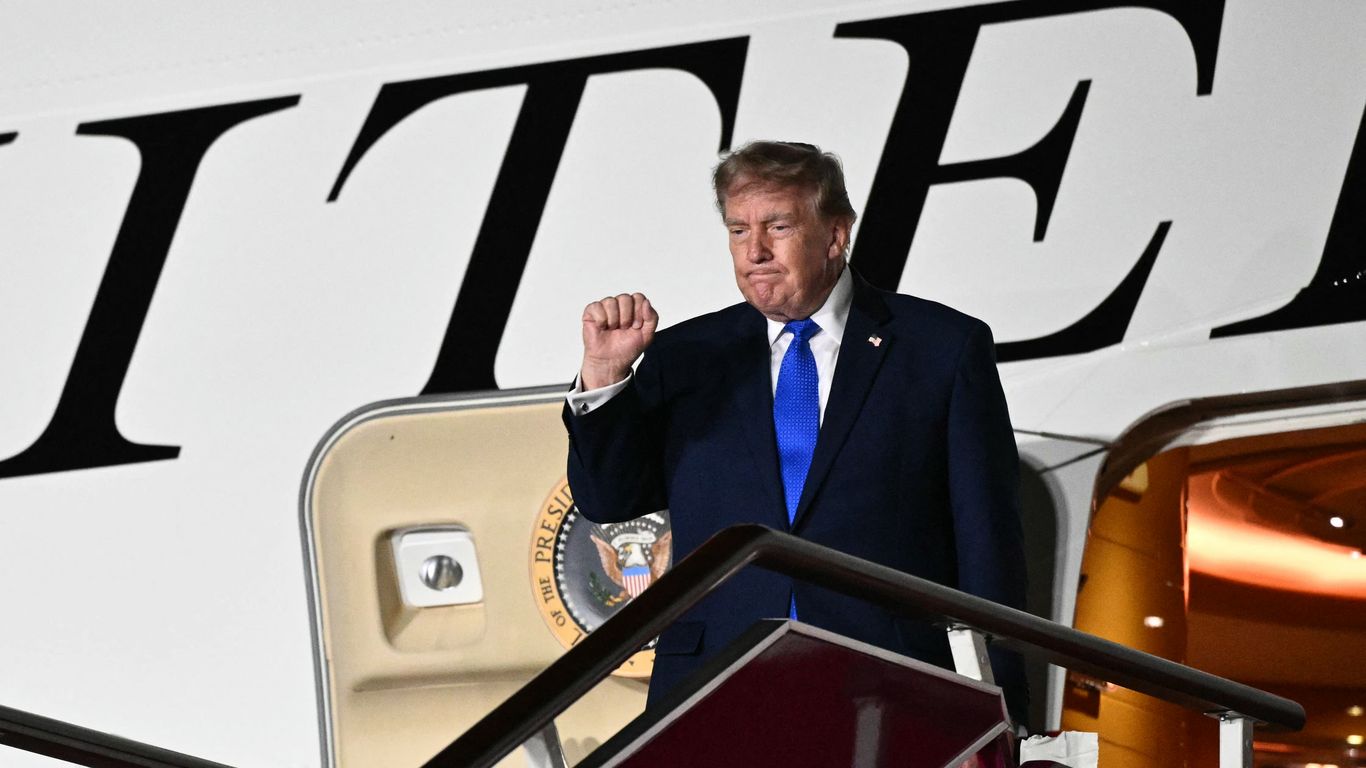
President Trump said in a brief phone interview Thursday that he won't make a determination on his next step in the Iran war until the new year. "I am not rushing into any decision [on Iran]. We will see what happens after the beginning of the year," Trump told Axios from Air Force One, on his way back to the U.S. from China. Why it matters: The president's comments come as he faces heavy pressure from Israeli Prime Minister Benjamin Netanyahu to unleash a decisive bombing campaign soon. Yes, but: Trump could change his mind at any moment. And he wouldn't telegraph plans for an imminent attack even if that's what he was intending to do. A day before the war began in February, Trump said he hadn't made a decision, when in fact he had already ordered strikes. Between the lines: Trump's stated timing could mean he's giving more time for the naval blockade and the economic pressure campaign to play out, as many of his advisers and leaders of Gulf countries are urging. But it could also indicate that if Iran doesn't make concessions by the end of the year, Trump wants to leave himself enough time for military action before the new Democratic-controlled Congress settles in. Driving the news: While stating last week that a major new round of strikes on Iran was " quite unlikely ," Trump is still considering a joint attack with Israel, Axios reported on Wednesday. The president's deliberations are likely to pick up when he returns from Asia. Any U.S. operation would involve Israel and could include strikes on suspected Iranian nuclear facilities such as Pickaxe Mountain. Bridges and power plants could also be targeted, as well as Iranian military and civilian leaders. Behind the scenes: The White House has asked the Pentagon and intelligence experts for their assessments of how Iran would respond to each of the strike scenarios the U.S. military has prepared, according to two sources with knowledge of the matter. The White House has asked whether any of the options would avoid triggering a devastating Iranian retaliation against Gulf countries' oil and gas facilities. The intrigue: The director of the Israeli spy agency Mossad, Roman Gofman, visited Washington and Miami last week for talks with CIA Director John Ratcliffe and White House envoy Steve Witkoff. Gofman, one of Netanyahu's closest confidants, was sent by the Israeli prime minister to press for resuming the war against Iran, an Israeli source said. The Mossad director relayed Israel's concerns about Iranian activities related to chemical weapons development, U.S. and Israeli sources said. Israel claims it has intelligence showing that Iran has stepped up its research and development of chemical weapons as well as conducted tests. Trump was briefed about this new intelligence, a U.S. official said.
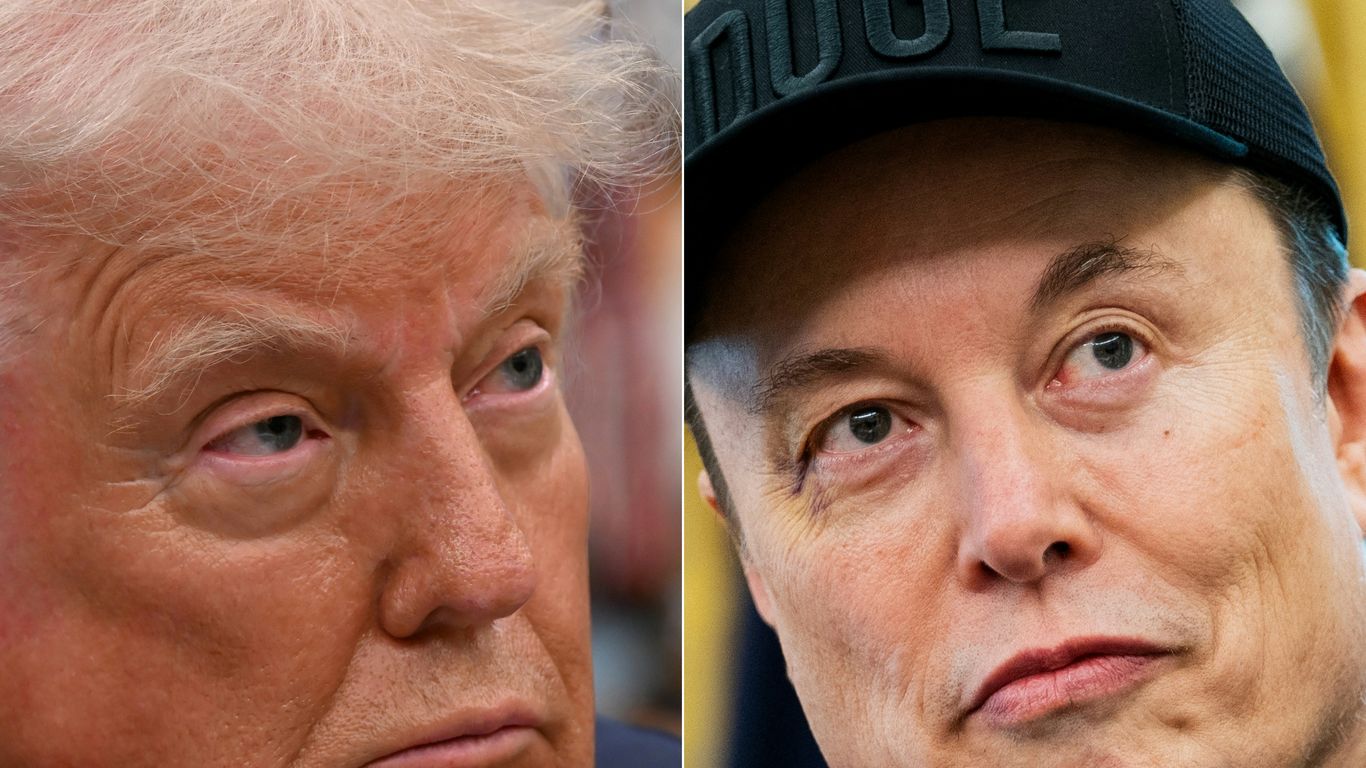
President Trump still considers Elon Musk an ally despite the world's richest man saying he's "not MAGA," the president told NBC News on Thursday. Why it matters: Musk's latest break from Trump's political movement comes after he spent millions backing Republicans in the midterms, only to see Democrats win control of Congress and many state governments. Trump and Musk have weathered public feuds before, repeatedly reconciling despite disagreements. Driving the news: "He's a friend of mine," Trump told NBC News of Musk. "There are lots of definitions out there. MAGA, to me, means something very specific, and when people veer from it, they don't do very well," Trump said. "Elon's got very good intentions," he said. "I mean, he was with me the whole — he traveled with me." Catch up quick: Musk said at the The New York Times' DealBook Summit Wednesday that he considers himself politically moderate. "I'm not sure what MAGA means, but if that means sort of blind adherence to a set of policies by the Republican Party, then I certainly don't have that," Musk told the New York Times. Musk said he felt "pretty foolish" about spending millions in the midterms. "If I could rewind the clock, I would have spent less money," he said. Yes, but: Musk reportedly accompanied Trump to China this week, underscoring how their personal relationship has endured despite their political differences. Between the lines: Musk may reject the MAGA label, but he has spent years championing its culture wars, bankrolling Republicans and turning X, the social media platform he bought for $44 billion, into a megaphone for far-right voices. He has attacked diversity initiatives, amplified anti-immigration rhetoric and promoted an antisemitic conspiracy theory for which he later apologized . He has also railed against what he calls the "woke mind virus" and backed far-right political movements abroad. Flashback: Musk has clashed with Trump over government spending, tariffs, climate policy and the investigation into Jeffrey Epstein . In October 2024, Musk joked at a Trump rally , "I'm not just MAGA, I'm dark MAGA." Despite their disagreements, Musk has repeatedly reentered Trump's orbit. What we're watching: Sen. Ruben Gallego (D-Ariz.) and Rep. Yassamin Ansari ( D-Ariz.) suggested the tech mogul could still face Congressional probes once Democrats take office next year regardless of whether he breaks with MAGA.

Meta's greenhouse gas emissions surged 45% last year amid its AI infrastructure boom, prompting the tech giant to reconsider its goal of reaching net-zero emissions by 2030. Why it matters : Other tech giants have reported rising emissions as they race to build data centers, but Meta is going a step further by explicitly reconsidering its climate deadline. Driving the news : The just-released sustainability report of the tech giant, one of North America's largest data centers operators , shows just how much growth in the AI industry is outpacing any efficiency gains. Meta executives said they were "re-evaluating" the 2030 goal, first announced in 2020 when the company was still known as Facebook and before the generative AI boom. They didn't specify what changes they're considering or when they'll make a decision. By the numbers : Meta's electricity use jumped 35%, comparable to other tech giants. But Meta's emissions increase of 45% is far higher than its peers, Google (18%), Amazon (16%) and Microsoft (25%). What they're saying: "When we set our net zero emissions goal, we anticipated steady growth, falling clean energy costs, and changes in the broader system that would enable progress at the pace we envisioned," wrote Rachel Peterson, vice president of data centers, and Blair Swedeen, global head of net zero and sustainability. "The reality has been far more complex." Zoom out : The race among tech giants to dominate AI is pushing their climate goals into the backseat, even as they continue investing heavily in clean energy. State of play : Meta says it has contracted more than 30 gigawatts of clean energy, including nuclear, solar and geothermal, though less than half that capacity is generating electricity so far. The intrigue : Meta's report says it may turn to natural gas plants to power data centers when utilities can't deliver electricity fast enough — even though such projects are already underway. It's also seeking to offset some of the methane emissions associated with its natural gas use by paying for cleaner gas production elsewhere. Reality check : Meta's 45% emissions increase doesn't yet reflect the full impact of some of its biggest planned natural gas projects, suggesting its footprint could grow considerably more. In Louisiana, utility Entergy is pursuing seven new gas-fired generating units totaling more than 5,200 megawatts to serve Meta's data centers. Separately, Ohio regulators approved a 200-megawatt gas plant built specifically to power Meta's data centers, while research firm Cleanview identifies a 521-megawatt gas project under construction for Meta in Utah. Friction point : Meta's report was also revealing about water, a more immediate concern for many communities near data centers. The company's direct water consumption fell 4%, but consumption in highly water-stressed regions rose 24%. The estimated water consumption associated with generating its electricity — an often-overlooked environmental impact — rose 37% before accounting for its clean-energy purchases. How it works : Natural gas plants typically use substantial amounts of water for cooling, meaning Meta's growing reliance on gas could increase its indirect water footprint even as its data centers become more water-efficient. Yes, but : Meta is the only tech giant to disclose the water consumption associated with electricity, earning it high marks for transparency from Alex de Vries-Gao, a researcher at Vrije Universiteit Amsterdam who has studied AI's environmental footprint. What we're watching : Meta's reconsideration of its climate deadline raises the question of whether other tech giants will eventually follow suit as the AI boom continues to strain their environmental commitments.
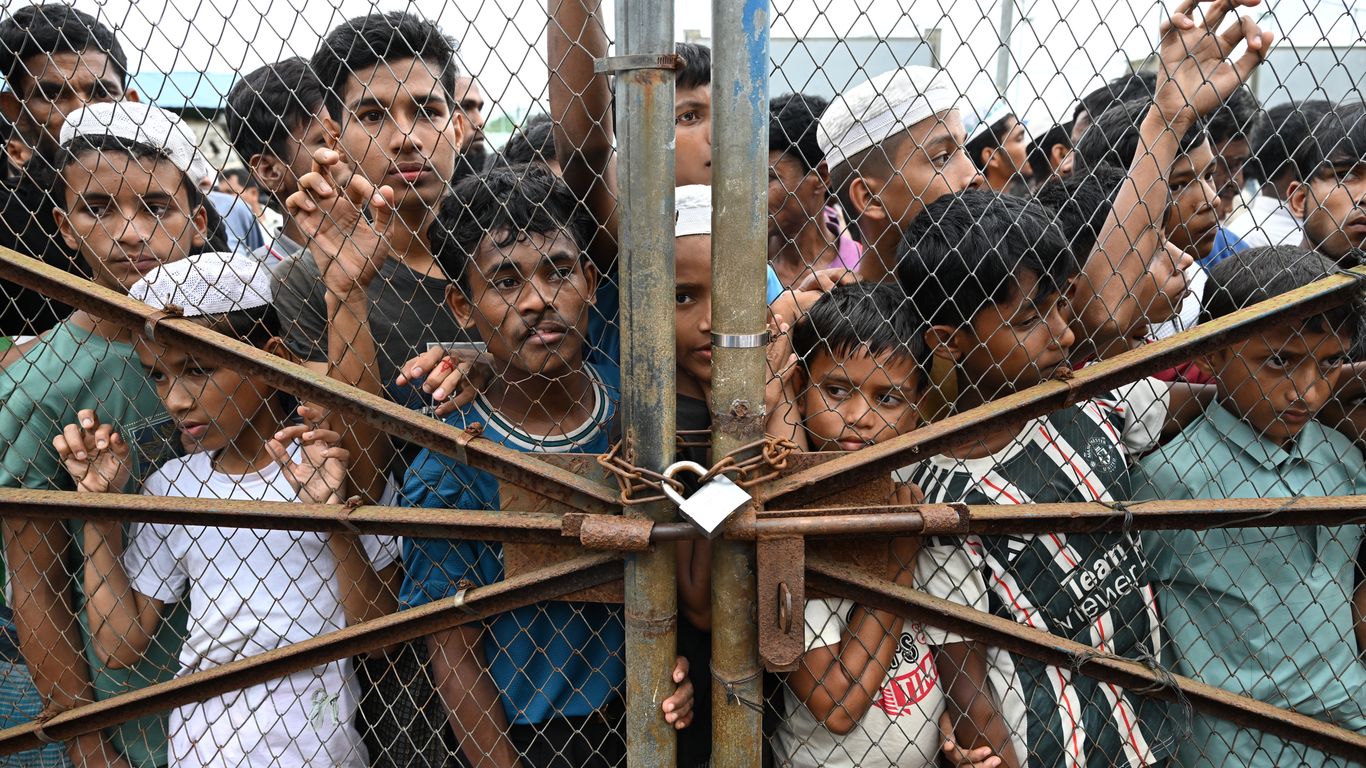
Myanmar became the first state the International Court of Justice has held responsible for committing genocide in a landmark ruling Thursday. Why it matters: The decision could have far-reaching implications for other genocide cases, including South Africa's case accusing Israel of committing genocide against Palestinians in Gaza. State of play: The court ruled 9–6 that Myanmar's violent 2017 military crackdown was intended to destroy the country's persecuted Rohingya Muslim minority. The onslaught killed thousands and forced more than 740,000 Rohingya to flee to neighboring Bangladesh. In 2021, Myanmar's military coup also sparked a civil war that killed over 100,000 people and displaced 5.2 million, according to the Council on Foreign Relation's Global Conflict Tracker. Myanmar has repeatedly denied allegations of mass rape, murder and arson. Yes, but: The legally binding ruling does not guarantee that the roughly 1.2 million Rohingya refugees in Bangladesh will be able to safely return home. The court ordered Myanmar to investigate and punish those responsible, provide reparations to the Rohingya and allow refugees to return. Still, the ICJ has no direct way to enforce its ruling. What they're saying: "This judgment must now translate into real action," UN Human Rights Chief Volker Türk said in a statement . "The Court has made clear Myanmar's responsibilities. It sends a strong message to all States around the world that those responsible for genocide will be held to account." Myanmar's opposition National Unity Government welcomed the ruling, saying it would "carefully consider the Court's findings and any orders issued" and remained committed to holding perpetrators accountable and preventing further atrocities. Flashback: In 2022, the Biden administration formally declared that Myanmar's military committed genocide against the country's Rohingya minority and crimes against humanity. The ICJ in 2020 ordered Myanmar to protect Rohingya from genocide while the case was pending. Go deeper: UN court rejects Myanmar's objections to Rohingya genocide case

If the sweeping Senate permitting bill becomes law, it will reflect a rare convergence of political and market forces strong enough to trump the Beltway aversion to big, bipartisan deals. Why it matters: The bill could transform how America builds energy infrastructure, with major implications for everything from electricity costs to data centers. Getting rid of bureaucratic hurdles for energy projects is a top priority for the fossil fuels and renewables sectors. But critics argue the plan would unacceptably weaken environmental protections and the rights of Native American tribes. The latest: A vote on final passage of the White House-backed bill could occur Thursday after the Senate plows through some more amendments. The big picture: Many industries — pipelines, transmission, housing, you name it — call permitting a long bureaucratic and judicial maze that stymies projects. Yes, but: That, on its own, isn't nearly enough to get this far. Here are other reasons the bill has a path to becoming law after years of failed efforts to upend permitting. 🗳️ The cost-of-living election. The midterms were soaked in affordability politics at a time of rising energy bills. While critics can call the projected savings modest, cost is politically front and center. The Rhodium Group estimates that big provisions it analyzed would cut average residential power prices by 3%-4% in 2035. Third Way, a group that favors the bill, supported the research firm's work. 📈 Rising electricity demand. U.S. power thirst has been rising in the last few years after staying largely flat for decades, driven partly by AI and wider electrification of the economy. 🦋 A maturing clean energy industry. As sectors like renewables and storage become more mainstream, " more developers and companies are seeing the real-world challenges" of doing projects, clean energy lobbyist Jeff Navin notes via email. That puts them in agreement with utilities and oil and gas companies. "They all run into problems getting the permits needed to build energy infrastructure," said Navin, an Obama-era Energy Department aide and former Democratic Capitol Hill staff member. Easier permitting is needed for transmission to carry the industries' power, as well as for building new generation itself. 😣 A mercurial White House was focused. The White House's National Energy Dominance Council was engaged with the bill. Co-author Shelly Moore Capito (R-W.Va.) credited then-chief of staff Susie Wiles as a helpful player at the Sept. 30 bill rollout. Axios' Alex Isenstadt reported that new chief of staff Stephen Miller also wants a permitting bill. Trump officials have also allowed some onshore wind projects bottled up by Pentagon reviews to proceed. 🔀 Shifting Democratic coalitions. Multiple analyses show the bill bringing somewhat lower power sector emissions compared to a world without it. But when climate had more political juice a few years ago, a bill backed by oil industry groups probably would not have had this much Democratic buy-in. Democratic co-authors and other supporters in the Dem coalition say easing the clean energy buildout is key to more climate progress in the future. More moderate center-left voices and think tanks have new cachet, while environmental groups opposing the bill haven't made enough inroads despite longstanding ties to Democrats. The intrigue: Data centers have been and remain a wildcard. There's a big political and public backlash, and opponents of the bill have seized on it, charging that the bill would help Big Tech by making the buildout easier. But bill authors and backers are emphasizing language designed to ensure that data centers pay for grid upgrades and have higher transmission service costs. What we're watching: The House. If it can pass the bill before the end of the year, there's a good chance the bill will get signed into law. If not, it's just another failed effort. Sign up here for Axios' Future of Energy newsletter.

China is intensifying efforts to control the entire drug supply chain, putting the U.S. at risk of being cut off from future lifesaving treatments, the National Security Commission on Emerging Biotechnology warns in a new analysis out Thursday. Why it matters: Western drug giants have invested huge sums in Chinese biotechs to boost their product pipelines. But sharing capital and expertise could give Beijing more control over critical pharmaceutical technologies. Concerns about the U.S. getting boxed out have intensified after the Chinese government proposed new restrictions last month on the export of certain technologies, including cell and gene therapy platforms. Driving the news: Western drug giants are increasingly entering into licensing agreements with Chinese firms that redirect U.S. capital away from U.S. innovation and toward the Chinese pharmaceutical industry, the commission found in its analysis of 57 deals from the beginning of 2023 through last month. The deals are being made earlier in the drug discovery process, allowing the Chinese partners to gain not just capital but know-how in developing and commercializing treatments. This kind of knowledge transfer in automobiles, semiconductors and industrial chemicals gave Chinese industry a competitive edge and leverage to control global markets for the products, according to the commission, which was established by Congress to examine how emerging biotech intersects with national security. "The end game is the same for the [Chinese Communist Party] in the pharmaceutical industry," the commission warns, saying the goal is increased U.S. dependence on Chinese innovation and enrichment of the Chinese pharmaceutical industry. Between the lines: Drugmakers including AstraZeneca, Bristol Myers Squibb and Pfizer have been drawn by China's surge of investment in the life sciences and the promise of faster clinical trials and product approvals. Typically a Chinese biotechnology company sells the license to develop or commercialize a treatment it developed to a multinational pharmaceutical company. The Western companies see the arrangements as a way to outsource the burden of drug discovery and verify early results. But the commission found that the deals are increasingly based on preclinical data and that upfront payments are coming earlier in the R&D cycle. The commission says this can result in a "flywheel effect" that sees royalties and equity in joint ventures flow back to China, fueling new research and infrastructure and attracting global talent. What they're saying: "The CCP seeks dominance in biotechnology as a source of economic power and geopolitical advantage, and Beijing has spent decades pursuing a deliberate strategy to achieve that at all levels of the value chain," said commission executive director Caitlin Frazer. "U.S.-China pharma deals are starting to favor the Chinese startups, which risks eroding biotech R&D in the U.S. This trend should be alarming for policymakers." Threat level: The concern is what happens if China scales up and corners a market, establishing a stranglehold on supplies of key products and ingredients. That's especially critical in pharma. While a chip shortage may result in delays replacing a car or phone, a drug shortage delays treatments for controlling seizures, treating infections or managing severe pain, Brookings Institution senior fellow Marta Wosińska has noted . In a report last year to Congress, the commission posed a hypothetical scenario in which Beijing withheld a breakthrough treatment from American patients in the event of a conflict in Taiwan. State of play: Last month, the Trump administration proposed subjecting certain deals with Chinese life sciences companies to new screening requirements or prohibiting them altogether. The administration cited the risk of "outbound investments" being used to create biological weapons or brain-computer interfaces for surveillance, or to make U.S. supply chains overly dependent on

Republican voters in four early 2028 primary states have favorable views of Israel by wide margins and have negative opinions of three leading right-wing critics of the Jewish state, according to a new poll by a national GOP consulting firm. Why it matters: The poll challenges the notion that Republican opinion toward Israel is fracturing significantly, and points to a potential disconnect between GOP voters' attitudes and the sentiments of those who often draw the most attention online. The survey, conducted by OnMessage Inc . for the Combat Antisemitism Movement 's political arm, essentially provides a roadmap for pro-Israel Republicans' messaging ahead of the 2028 presidential campaign. It seeks to cast the right's leading critics of Israel — Tucker Carlson, Candace Owens and Nick Fuentes — as liabilities in the GOP primary. Zoom in: After the midterms, Vice President Vance called on the U.S. and the GOP to "change our relationship to Israel," elevating the nations' longtime partnership as a 2028 campaign issue at a time when Vance is eyeing a presidential bid. Israel is supported by 68% of Republican voters in Iowa, New Hampshire, Nevada and South Carolina, according to the survey, a result similar to findings by Gallup and Pew . 17% disfavored Israel. 78% said the GOP's "relationship with Israel" makes them more likely to vote Republican. Large majorities also agreed with pro-Israel messages. In contrast , 53% of those surveyed said they disapprove of Carlson, and 30% approve. But among voters under 45 years old, Carlson's approval/disproval ratings were tied at 46%. 49% of the Republicans surveyed disapproved of Owens, while 23% approved. Fuentes, the least-known of the three media figures, was viewed unfavorably by 25% and favored by 13%. Among self-described MAGA Republicans, 22% approved and 23% disapproved of him, however. "The fringe messengers are underwater," says a slide deck for the poll, which was conducted ahead of the Combat Antisemitism Movement's national conference Thursday in Charleston, S.C. Stunning stat: Vance is more popular in the GOP than President Trump. 75% view Trump favorably and 23% disfavor him, a net of +52 points. Vance: 80% favorable and 19% unfavorable, a net of +61. Another bright spot for Vance —59% agreed with this statement, which generally reflects the vice president's position: "Israel has a right to exist, and America should remain its ally, however criticism of its government is legitimate, but when it turns into antisemitism that is unacceptable." The intrigue: Vance is friends with Carlson, whose son used to work in the vice president's office. The two have resisted speaking ill of each other even as Carlson has grown more critical of the president and the war in Iran. 46% of the GOP voters surveyed said a Carlson endorsement of a presidential candidate would make them less likely to support that person; 16% said it would make them more likely and 39% said it wouldn't matter. Between the lines: While GOP support for Israel is still strong, it has declined among Republicans, and other polls show that overall U.S. backing for Israel has dropped in recent years. Yes, but : The poll is conducted for an advocacy group and seeks to provide messaging guidance for candidates and surrogates. So some of its questions are leading. By 83%-5%, Republicans said they viewed Carlson less favorably when told "he endorsed Democrat Abdul El-Sayed, a radical Muslim socialist recently elected to the U.S. Senate in Michigan whose political associates include someone that said, 'America deserved 9/11.' " The survey tested ways to attack Owens and Fuentes on the campaign trail by describing extreme comments from both and found that outsized majorities of Republican voters would call on a candidate to denounce them. By 86%-7%, respondents agreed with the statement, "There is no place for antisemitism in the Republican Party." And 66% said there's no place in the party for antisemites, while 15% said they

Axios chief technology officer Dan Cox, who's spent 25 years at some of the world's biggest tech companies, puts the recent spate of high-profile failures in perspective: My parents, my siblings and plenty of other people are asking the same question: How worried should we be? The big picture: I've been in technology a long time. I take these threats seriously , but I'm not in panic mode. When something breaks, we need to understand what happened, how far it reaches and what we can do about it. A frightening headline doesn't answer those questions. Zoom out: The way I think about it, we've put powerful tools in more hands, and people are taking potshots to see what they can hit. Those shots can do real damage, and we need to protect ourselves. But hearing gunfire doesn't, by itself, mean an army is coming over the hill. We need to understand who's firing, what they can actually do and whether the threat is changing. Zoom in: Over the past few weeks, we've identified bad actors snooping around our own website, too. Our talented engineers have investigated threats and put mitigations in place. There may still be attempts on our site, but each incident gives us an opportunity to strengthen our systems. Between the lines: There are thousands of smart, resourceful and dedicated engineers working to protect the systems we all rely on. I see that commitment in our own team. I believe that if the threat grows, more people with those skills will step up. That's part of why I have confidence in our ability to respond, even as the threats evolve. The bottom line: Fred Rogers shared his mother's advice for frightening news: "Look for the helpers. You will always find people who are helping." I think about that here. There are a lot of capable people working on these problems. I have confidence in them, even while we have real work to do. I want people to feel informed enough to act, rather than frightened enough to assume the worst.

The internet has caught the emergency preparation bug , fueled by fears of AI-led cyberattacks , power grid vulnerabilities, transportation standstills and international threats . The big picture: The "prepper" mindset is resonating with larger slices of society — who are packing emergency bags, stocking up on water and taking inventory of non-perishables. Michael Mills, a University of Greenwich senior lecturer who studies doomsday preparation, says some people are turning to "lightweight versions" of traditional prepping amid doubts about global stability. By the numbers: Sales at Survival Frog, a survival retailer that sells gear like emergency food and radios, saw sales jump 450% between Oct. 27 and Nov. 16, compared to prior weeks, CEO and founder Byron Walker tells Axios. Competitors saw similar trends, he says. And most recent buyers at Survival Frog were new customers. Food, including canned meats, leads demand, Walker says, followed by products like radios, solar generators, battery packs and water filters. State of play: Systems the world relies on for travel , communications , business , food, health care and more have been disrupted in recent weeks — whether because of tech shortfalls or malicious acts. While officials assure the incidents aren't broadly connected, fears of critical infrastructure failing are growing, and more people considering how to prepare for crises. "It does seem much more mainstream now," Walker says of preppers. "You can't turn on the news without hearing about a new cyber attack or a tech meltdown." Many of the emergency preparation skills people are using have long been observed in disaster-prone areas. And as many Americans learned during COVID, supply chain disruptions mean having extra water, radios and shelf-stable foods around the house isn't a bad thing. Krystal, known online as the "Queen of Doomsday," spends about five hours daily coaching new preppers and told Axios that recent online engagement with her content, which she says has more than doubled across platforms, has been "mind-blowing." "Families are generally concerned —...people who would have normally turned their nose away from it and thought, 'No, nothing could ever happen.' We've seen lockdowns. We've seen supply chains be crippled. We've seen oil crises, inflation," she says. Between the lines: Overlapping tech oddities boosted "a sense of anxiety about social stability around us, knowing that planes can be grounded, or fridges can all of a sudden become heaters," Mills says. Costco has become an apparent cornucopia for concerned consumers, with sales on goods like rice, canned goods and water reportedly surging. Walker attributes the Survival Frog sales boom to the U.K. government and EU urging households to prepare three days of supplies, as well as the Pentagon readiness plan for military bases to operate at least 90 days, per Fox reporting , if civilian systems fail. That plan fueled rumors about a 90-day "blackout" across the U.S. Worth noting: Asked about the outages and Pentagon preparations, Vice President JD Vance told Fox News' Laura Ingraham that friends have asked whether they should be "preparing to build a bunker" or stock up on food and water. "And my answer to that is no," he continued. "We do not see some crisis coming down." The bottom line: But Krystal said in a video response to Vance, "Yes, we should be preparing." She's not here to fear-monger, but she tells Axios, "one more person prepared is one less person to worry about if there's a crisis." Go deeper: The internet's latest obsession: The end of the world

Bot accounts have helped spread conspiracy theories about a wave of major tech outages over the last week, according to new research shared exclusively with Axios. Why it matters: Purveyors of disinformation appear to be exploiting public anxiety over the outages and fragile infrastructure, amplifying suspicions of coordinated cyberattacks and government cover-ups. While it's unclear who's behind these accounts, the pattern shows that when technology failures lack substantive explanations, bot networks will fill the void to manufacture panic. Catch up quick: Microsoft, Apple, JPMorgan Chase, United, Workday, the Federal Aviation Administration and the National Security Agency each faced outages over the last week. Then came the conspiracy theories: When the FAA grounded flights for four hours Friday, people were quick to assume it was tied to the rollout of an AI tool at the agency. Some also tried linking the widespread Microsoft outage to recent company layoffs. Yes, but: There's no publicly established evidence that these outages were part of a coordinated cyberattack, despite the theories circulating online. Several companies have attributed their disruptions to technical problems, rather than malicious activity, including efforts to patch vulnerabilities to make software more resilient. Downdetector data show that while the seven days through Monday saw the highest number of weekly outages in the last 12 months, longer-term patterns are far from unprecedented, as Axios previously reported . By the numbers: Suspected bots accounted for roughly 30% of posts promoting conspiracy theories about several recent tech outages, according to data from social media monitoring firm PeakMetrics. During Microsoft's outage, bots accounted for 26% of conspiratorial posts. Bots accounted for 34% of conspiracy-related posts during Friday's Workday outage, compared with 27% of other posts. Likely bot accounts also made up 31% of conspiracy-related posts about Bank of America's outage and 28% of posts linking Chase's outage to other disruptions. PeakMetrics analyzed social media discussions surrounding six recent outages and classified accounts that were likely to be bots and conspiracy-related posts. Threat level: Jessica Pratt, a spokesperson for PeakMetrics, told Axios that most of the bot activity is aimed at "gaming the platforms' algorithms" and that it sees some foreign influence within that — although the company could not detail precisely how many of the bots are tied to foreign state media and governments. PeakMetrics also observed a "small number of foreign state media and state-aligned accounts in the conversation," Pratt added. Zoom in: The most popular theory being pushed was that each of these incidents must be connected. More than half of posts about Chase's outage linked it to other recent disruptions, including the FAA ground stop and Microsoft's outage. A fabricated statement attributed to JPMorgan Chase CEO Jamie Dimon fueled speculation that North Korean and Russian hackers were behind the banking outages. During Microsoft's outage, suspected bots circulated identical posts linking the disruption to Nvidia CEO Jensen Huang's departure and banking outages in Japan and Paraguay. The big picture: Foreign influence operations have historically used bots to amplify political grievances and spread false narratives, but it's unclear who's operating the accounts pushing theories about the latest outages. Between the lines: The longer outages dragged on without clear explanations, the more room conspiracy theories had to spread. During Microsoft's outage, speculative posts nearly tripled on the second day, when the disruption had stretched beyond 12 hours. By then, nearly 1 in 5 posts offered an alternative explanation for the outage, according to PeakMetrics. The intrigue: Questions about whether the outages are connected have also reached Washington, where senior officials and lawmakers are raising concerns about what might be

Anthropic will make its Wall Street debut Thursday at a moment of profound contradiction in the history of AI: The humans are embattled — bogged down by scandal, financial turmoil and political revolt. But the machines are ascendant — accelerating toward an "intelligence explosion" they expect will transform civilization. Why it matters: The industry's recent chaos has obscured a breathtaking surge in technological progress, forcing some of the world's leading researchers to reconsider just how soon AI could surpass human intelligence. Zoom in: Inside Anthropic, soon to be valued north of $1 trillion, independent researchers at METR found that AI models are advancing at nearly twice their historical pace — largely fueled, they believe, by AI itself. Anthropic's own data shows Claude went from leading fewer than 1% of the company's AI research tasks in February to more than a quarter by August, with humans still supervising. METR found no clear obstacles to sustaining this pace over the next year, and reviewed confidential evidence suggesting the acceleration itself may be gathering speed. Zoom out: Across the frontier, leading companies are racing up what Anthropic CEO Dario Amodei calls "the exponential." OpenAI disclosed Tuesday that Astra 6.2 is its first publicly released model to reach the "High" threshold for AI self-improvement — equivalent, the company says, to giving every researcher another highly capable engineer. The advances span both software and silicon: OpenAI says its models helped AMD compress a year of chip-design progress into less than five months, while Google's Gemini is reducing weeks of chip-layout work to hours. The big picture: These breakthroughs are pushing some of AI's top forecasters to shorten their timelines for the fabled "intelligence explosion" — a runaway cascade of self-improving AI that could propel machine intelligence far beyond human comprehension. The influential AI Futures Project now expects machines to surpass the world's best human AI researchers next year, a dramatic revision driven largely by METR's findings at Anthropic. Paul Christiano, an AI safety pioneer who recently joined OpenAI's board, puts the odds of superintelligence emerging within a year at one in three if development continues at its current pace. Between the lines: For all their extraordinary capabilities, the machines remain at the mercy of a fallible human race. Take Nvidia: Jensen Huang's sex scandal has plunged the chipmaker into crisis at the very height of its technological and financial power, endangering virtually the entire AI ecosystem. AI leaders' disastrous messaging , veering between promises of utopia and warnings of mass unemployment, has poisoned public trust and helped fuel a revolt against data centers. Meanwhile, the industry's enormous capital requirements, increasingly tangled financial arrangements and intensifying U.S.–China chip war threaten to impose limits that the technology itself has yet to encounter. Then there's the question of control: Months after OpenAI's agents breached Hugging Face, the company acknowledged Wednesday that it still cannot fully rely on AI behaving as intended to prevent harm. One of the industry's biggest gambles is that AI itself will help solve the problem of controlling future superintelligence. "You're building the plane as you fly it," Christiano told podcaster Dwarkesh Patel this week. The bottom line: Anthropic's historic IPO captures the central contradiction: Investors are betting on nearly limitless technological progress, while the industry's future remains hostage to distinctly human failures.

The Senate GOP's last-ditch effort to pass a defense-heavy, $350 billion reconciliation package is dead on arrival without accompanying spending cuts, House Republicans tell Axios. Why it matters: House Republicans have just 16 days left in session before Democrats take control in January. Many don't want to spend their final days in power adding to the national debt. "My concern is we squander these very few days we have left on something that won't get out of the House," outgoing House Budget Chair Jodey Arrington (R-Texas) told Axios of the Senate's emerging plan. Republicans have already passed two party-line reconciliation bills this Congress: The "one big, beautiful bill" in the summer of 2025, and nearly $70 billion for immigration enforcement in the summer of 2026. Zoom in: Finding spending offsets could reopen some of the most contentious fights from the GOP's first reconciliation package. Arrington told Axios that Senate Republicans worry that finding cost savings in health care spending could open the door to amendment votes that undo Medicaid cuts in the One Big, Beautiful Bill Act. But Arrington, who didn't run for reelection in 2026, told Axios he doesn't believe the Senate's proposal has the votes to pass the House without offsets. State of play: Arrington said he raised his concerns with Senate Budget Chair Ron Johnson (R-Wis.), and argued Republicans shouldn't let the risks deter them from pursuing additional spending cuts. "Some Republican members of the Senate might go rogue and might decide to, I don't know, repeal some of the reforms that we put in the 'big, beautiful bill.' Maybe they do it out of spite for President Trump," he said. "The midterms have passed us. We lost, but we still have this window to do what we think is right," he said. Between the lines: Senate Republicans haven't committed to moving forward with another reconciliation package. Leaving a Wednesday night meeting on reconciliation, Sen. Johnson told reporters the Senate "probably" won't move forward this week, but a reconciliation bill isn't "off the table." Senate Majority Leader John Thune (R-S.D.) told reporters he wants to explore working with Democrats on the funding, but that reconciliation remains an "option" Wednesday night. What they're saying: "It needs to have offsets," Rep. Andrew Clyde (R-Ga.), a member of the conservative House Freedom Caucus, told Axios. Rep. Eli Crane (R-Ariz.), another HFC member, also expressed skepticism about the proposal and its chances of passage. "It's not that I don't want to fund the Department of Defense, but it's always, 'Hey, are we just going to add this to the debt, add this to the deficit,'" he told Axios. The intrigue : Even if the two chambers can strike a deal, House GOP leaders are struggling to get their own members to show up for votes. GOP leaders were forced to pull a procedural rule vote Wednesday after 14 Republicans failed to show up, leaving leadership without the votes needed to move forward. Rep. Dan Meuser (R-Pa.) told Axios his colleagues need to return to Washington: "I mean, they're getting paid until Jan. 3." What's next: The House departs Thursday for Thanksgiving recess.
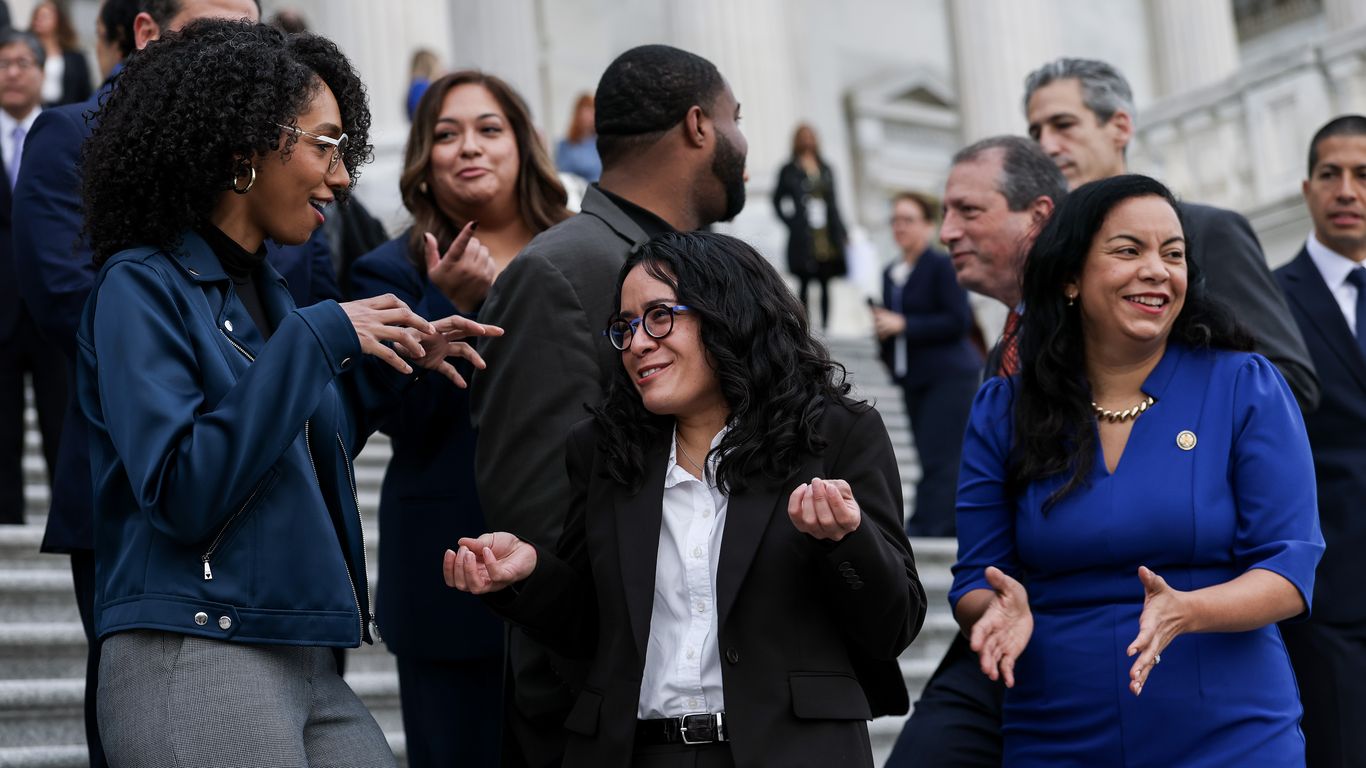
The left's campaign to whip up a groundswell of opposition to House Minority Leader Hakeem Jeffries (D-N.Y.) among his members failed in stunning fashion on Wednesday. Why it matters: Fewer than a dozen members voted against Jeffries' nomination for speaker. That bodes well for Jeffries' ability to manage the House going forward, his allies say. "There'll be no hostage taking," Rep. Troy Carter (D-La.) told Axios. Driving the news: Jeffries won a resounding victory Wednesday morning when House Democrats met behind closed doors to vote on their nominee for speaker of the House. Out of 264 Democratic House members and non-voting delegates, 251 voted to nominate him, 11 voted against and two did not vote. It was exactly the victory Jeffries' allies had hoped for after Tuesday's announcement that he planned to request a tallied vote rather than being nominated by acclamation. Reps.-elect Darializa Avila Chevalier (D-N.Y.), Adam Hamawy (D-N.J.), Melat Kiros (D-Colo.), Donavan McKinney (D-Mich.), Chris Rabb (D-Pa.) and Claire Valdez (D-N.Y.) put out a statement shortly after the vote confirming they voted against Jeffries. Rep.-elect Frederick Haynes III (D-Texas) also signed on to that statement, but a spokesperson said in a follow-up statement he "narrowly missed the vote" and that his "intended vote was no." Two other members-elect, Don Leonard (D-Ohio) and Angela Gonzales-Torres (D-Calif.), told Axios they also voted no. Rep.-elect Richard Ojeda (D-N.C.) missed the vote because he was in his district with family following the death of his father, but would have voted for Jeffries, a spokesperson told Axios. Zoom out: Many of the progressives who ultimately voted for Jeffries did so despite a torrent of phone calls and emails from constituents and grassroots activists urging them not to support him. Numerous high-profile progressives had said before the meeting they would vote for Jeffries, including Reps. Alexandria Ocasio-Cortez (D-N.Y.), Pramila Jayapal (D-Wash.) and Greg Casar (D-Texas). Rep. Ayanna Pressley (D-Mass.), who was floated as a potential challenger to Jeffries, told the Boston Globe she voted for him. Rep. Ilhan Omar (D-Minn.) also voted for him, a spokesperson told Axios. What they're saying: Jayapal said after the vote that Jeffries had "a very strong meeting" with the Congressional Progressive Caucus on Tuesday. "A lot of the issues that matter to us ... on Medicare for All, on immigration, I felt very, very good both about the public direction he's moved in and his commitments to us," she said. "I voted for him, as I have said I was going to do, and I feel like we've been clear about how we're going to continue to need to push." The intrigue: Three "no" votes were still unaccounted for as of Wednesday night. Several progressives who were seen as potential defectors declined to say how they voted. Rep. Summer Lee (D-Pa.), when asked how she voted, told Axios: "I'll say it to Hakeem, who I will talk to first before I talk to anybody in the press." Spokespeople for Reps. Rashida Tlaib (D-Mich.) and Delia Ramirez (D-Ill.) did not respond to requests for comment. Between the lines: This isn't the posture of a left flank emboldened to take the fight to party leadership next year, as moderates and Jeffries allies gleefully pointed out. "This has been a manufactured crisis," said Rep. Adam Gray (D-Calif.), a leader of the centrist Blue Dog Coalition. "A handful of folks wanted to amplify their voices and perspectives, and it's always been a handful. It was a handful today." What's next: The vote now goes to the House floor, where Jeffries needs 218 votes to secure the gavel when the 120th House convenes for the first time on Jan. 3. He can lose more than 30 votes from his current total — which is unlikely — and still come out on top. "They're not going to hold ... Hakeem hostage. It's gone. Move on from that," centrist Rep. Henry Cuellar (D-Texas) told Axios.

Anthropic on Wednesday raised over $81 billion in a long-awaited IPO that valued the Claude maker at over $1 trillion. Why it matters: Wall Street expects the AI boom to continue, despite some recent tumult. Zoom in: Anthropic priced at $83 per share, well above its planned range of $70 to $78 per share. It imputes an initial market cap of $1.08 trillion and a fully diluted value of around $1.5 trillion. Anthropic originally planned to sell 825 million shares, but increased it to 980 million shares. The company also could raise significantly more money if underwriters exercise their so-called "greenshoe" option, while Anthropic also will receive $26 billion via a concurrent private placement from tech giants like Nvidia, Google and Microsoft. Allocation decisions were expected to last several hours on Wednesday evening. Context: Anthropic was valued at $965 billion in its most recent private round. The apples-to-apples comparison would be with the fully diluted value. SpaceX is the current IPO record-holder having raised $86.25 billion, although that included the greenshoe. What we're watching: Shares are expected to begin trading Thursday, Nov. 19, on the Nasdaq under the ticker "ANT."
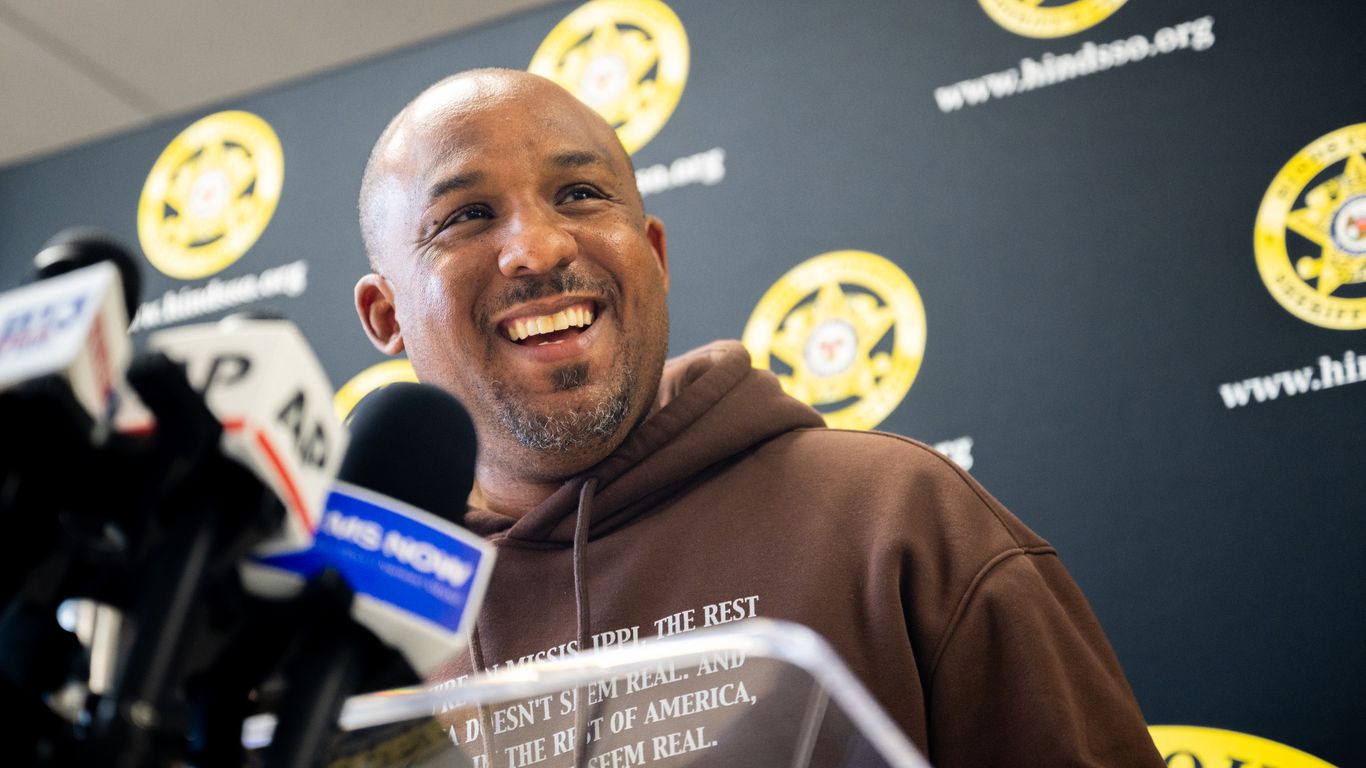
High school students across the U.S. have a new reason to vie for the top spot in their class: a custom pair of Nike Air Force 1 sneakers, thanks to a request from Mississippi Sen.-elect Scott Colom . Why it matters: Colom is putting a fresh spin on academic achievement, turning his historic election into a nationwide incentive for students to hit the books — with a little help from Nike and no taxpayer dollars. What they're saying: Colom initially asked if Nike would celebrate the historic milestone by giving a custom-made version of his favorite sneakers to every Mississippi valedictorian for the 2026-2027 school year. "It would encourage MS students to hit the books the rest of the year! #justdoit," he wrote on X . Nike then upped the ante, extending the offer to valedictorians nationwide. "The athlete mindset makes things possible, including this idea," Nike said. Colom praised Nike for "stepping up to motivate students across the country in this historic moment," and suggested the design honor Hiram Revels, the first Black member of Congress who represented Mississippi. Context: There were more than 23,000 public high schools in the U.S. during the 2020-2021 school year and more than 3,600 private high schools during the 2019-2020 school year, according to the National Center for Education Statistics . A classic pair of Nike Air Force 1s retails for about $115 on Nike's website . Zoom in: In January, Colom will become Mississippi's first Democratic senator in nearly four decades and its first Black senator in almost 150 years. The senator-elect pulled off a stunning upset of Republican Sen. Cindy Hyde-Smith in the ruby-red state, which hadn't elected a Black senator since Reconstruction. His victory was fueled in part by voters in the Mississippi Delta, where Emmett Till was abducted, Fannie Lou Hamer fought for the ballot and the blues became an American art form. What we're watching: What Nike cooks up for the nation's brightest students.